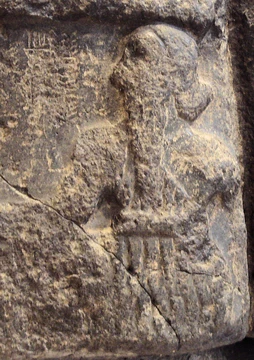
Nabonidus
Last native ruler of ancient Mesopotamia and unorthodox religious reformer.

Nabonidus, whose name means "May Nabu be exalted," was the final king of the Neo-Babylonian Empire. His reign lasted from 556 BC until Babylon fell to Cyrus the Great and the Achaemenian Empire in 539 BC. As the last native ruler of ancient Mesopotamia, his defeat ended a long sequence of Sumero-Akkadian states, kingdoms, and empires. He was also the last independent king of Babylon. Some scholars view him as a vibrant and individualistic leader, an unorthodox religious reformer, and even the first archaeologist.
Nabonidus's origins and claim to the throne are unclear. He never claimed kinship with previous kings, suggesting he was not related to the Chaldean dynasty. He likely had a prominent career before becoming king, possibly marrying a daughter of Nebuchadnezzar II. His mother, Adad-guppi, was of Assyrian ancestry, while his father, Nabu-balatsu-iqbi, about whom little is known, may have been Assyrian or Babylonian. Some historians speculate that one of his parents might have belonged to the Sargonid dynasty, which ruled the Neo-Assyrian Empire until its fall in 609 BC.
Nabonidus became king after the deposition and murder of Labashi-Marduk in 556 BC, a plot likely led by his own son Belshazzar. Throughout his reign, inscriptions and later sources indicate he worked to elevate the moon god Sîn while diminishing the status of Babylon's traditional national deity, Marduk. Some suggest he aimed to replace Marduk entirely with Sîn as the head of the pantheon, but the extent of these religious reforms is debated. From 552 to 543/542 BC, Nabonidus lived in self-imposed exile in Tayma, Arabia. The reason is unknown, but it may have been due to conflicts with the Babylonian clergy and oligarchy. During this time, Belshazzar acted as regent, though Nabonidus remained recognized as king.
Upon returning to Babylonia in 543/542 BC, Nabonidus intensified his religious efforts, rebuilding the Eḫulḫul temple dedicated to Sîn in the northern city of Harran. His reign ended abruptly in 539 BC when Cyrus the Great swiftly conquered his empire. After the battle of Opis, the Persians entered Babylon without resistance. Several sources say Nabonidus was captured but spared, possibly allowed to go to the region of Carmania. He may have still been alive in exile as late as the reign of Darius the Great.
Quick Facts
- Birth Date
- 620–615 BC
- Dynasty
- Chaldean dynasty · (through marriage) (?)
- Issue
- Belshazzar / Ennigaldi-Nanna / Ina-Esagila-remat / Akkabuʾunma
- Issue Link
- #Family, children and descendants
- Issue Pipe
- Among / others
- Succession
- King of the Neo-Babylonian Empire
- Death Place
- Carmania (?)
- Birth Place
- Harran
- Title
- King of Babylon · King of Sumer and Akkad · King of the Four Corners · King of the Universe
- Father
- Nabu-balatsu-iqbi
- Mother
- Adad-guppi
Facts from the source article.
Lore & Background
Nabonidus's origins remain unclear; he made no genealogical claims to previous kings, suggesting he was not related to the Chaldean dynasty. He may have married a daughter of Nebuchadnezzar II. His mother, Adad-guppi, was of Assyrian ancestry and served as a priestess of the moon god Sîn in Harran. His father, Nabu-balatsu-iqbi, is little known but is called a 'learned counsellor' and 'prince' in inscriptions. Nabonidus was, to his own surprise, proclaimed king after the deposition and murder of Labashi-Marduk in a plot likely led by Nabonidus himself or other nobles, though some later traditions implicated his son Belshazzar without historical evidence.
Reader's Guide
Nabonidus's reign is significant for its religious unorthodoxy: he worked to elevate the moon god Sîn above Babylon's traditional national deity Marduk, possibly aiming to replace Marduk as head of the pantheon. From 552 to 543/542 BC he undertook a self-imposed exile in Tayma, Arabia, leaving Belshazzar as regent. Upon return, he escalated religious efforts, rebuilding the Eḫulḫul temple in Harran. His reign ended abruptly with Cyrus the Great's conquest in 539 BC; after the battle of Opis, Babylon fell without a fight. Nabonidus was captured but spared, possibly exiled to Carmania. His legacy includes being considered the first archaeologist and the last independent king of Babylon, ending millennia of Mesopotamian native rule.
Did You Know?
- He spent a decade in self-imposed exile in Tayma, Arabia, from 552 to 543/542 BC.
- His mother, Adad-guppi, claimed to have influence with kings Nabopolassar, Nebuchadnezzar II, and Neriglissar.
- Some scholars characterize him as the first archaeologist.
More in Kings of the Universe 1-24
Spotted an error? Know more?
Reader corrections go straight into our review queue. Suggest an edit · How this site is sourced