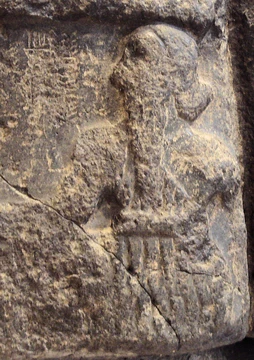
Marduk-nadin-ahhe
Sixth king of the Second Dynasty of Isin, restorer of Ur's Eganunmaḫ.

Marduk-nādin-aḫḫē (c. 1095–1078 BC) was the sixth king of the Second Dynasty of Isin, also counted as the 4th Dynasty of Babylon. His reign is remembered for restoring the Eganunmaḫ in Ur and for severe famines and droughts.
He was the son of Ninurta-nādin-šumi, the third king of the dynasty; his brother was Nabu-kudurri-uṣur, the fourth king; and his nephew was Enlil-nādin-apli, the fifth king. According to a reconstructed passage in the Walker Chronicle, while Enlil-nādin-apli was away on a campaign in Assyria—reportedly marching to conquer the city of Assur—Marduk-nādin-aḫḫē and the nobles rebelled. When the king returned to his land and city, they killed him with a sword.
Early in his reign, Marduk-nādin-aḫḫē raided Assyria and captured the cultic idols of the gods Adad and Šala from Ekallāte, a town only about thirty miles from Assur. His Assyrian counterpart, Tukultī-apil-Ešarra, retaliated with several raids deep into Babylonia. The Assyrian king claimed to have conquered Dūr-Kurigalzu, Sippar of Šamaš, Sippar of Anunitu, Babylon, and Upi, massacring many and plundering vast amounts of booty. He also said he burned the palaces of Babylon belonging to Marduk-nādin-aḫḫē and defeated him twice in chariot battles. The Synchronistic History records that the first battle was by the Lower Zab, opposite Ahizûhina, and the second year he defeated Marduk-nādin-aḫḫē at Gurmarritu, upstream from Akkad. Although Assyrian forces plundered Ugarsallu as far as Lubda and ruled parts of Suhu as far as Rapiqu, these areas were on the periphery of Babylonia. The idols of Adad and Šala were not recovered until 418 years later, when a later Assyrian king returned them to their sanctuaries.
Seven kudurrus, two building inscriptions, and one unpublished garment inventory attest to this king. The kudurrus show normal real estate activity in northern Babylonia. One, dated to his first year, grants independence from forced labor for residents near the mouth of the Ṣalmani Canal. Another, from his tenth year, gives land to Adad-zer-iqiša in thanks for fighting the Assyrians; one of its witnesses is Abullu-tetaparâu, the son of the king of Babylon.
Quick Facts
- Title
- King of Babylon
- Predecessor
- Enlil-nādin-apli
- Successor
- Marduk-šāpik-zēri
- Royal House
- 2nd Dynasty of Isin
Facts from the source article.
Lore & Background
Seven kudurrus (boundary stones), two building inscriptions, and one garment inventory attest to his reign. The kudurrus record normal real estate activity in northern Babylonia, including a tax exemption granted in his first year and a land grant to Adad-zer-iqiša for fighting the Assyrians in his tenth year. One kudurru lists seven officers of royal service, including the governor of Isin and the chamberlain, who likely accompanied the king in his travels. Another records a land purchase for a chariot, saddles, asses, an ox, grain, oil, and garments.
Reader's Guide
Marduk-nādin-aḫḫē's reign is significant for its intersection of architectural restoration, military conflict, and environmental hardship. His restoration of the Eganunmaḫ at Ur, a major religious structure, demonstrates continuity with earlier Kassite traditions and his role as a builder-king. However, his reign was overshadowed by repeated Assyrian incursions under Tukultī-apil-Ešarra, which resulted in the destruction of Babylonian palaces and the loss of cultic idols that were not returned for centuries. The famines and droughts that accompanied his rule were severe enough that the Babylonians reportedly resorted to cannibalism, and an Assyrian Chronicle records that he lost his throne and 'disappeared' following disruptions caused by Aramean migrations. His legacy is preserved primarily through kudurrus and building inscriptions, which provide insight into land tenure, court officials, and royal patronage. The astrological report from Ea-mušallim, linking scanty rains to a good omen for the king, reflects the period's reliance on divination to interpret natural disasters. Overall, his reign illustrates the fragility of Babylonian power in the face of Assyrian aggression and internal crisis.
Did You Know?
- He deposed and killed his nephew, Enlil-nādin-apli, to take the throne.
- He captured the cultic idols of Adad and Šala from Ekallāte, which were not returned for 418 years.
- An astrological report from Ea-mušallim linked scanty rains to a good omen for the king's military campaigns.
- The famines during his reign were so severe that Babylonians reportedly ate one another's flesh.
More in Kings of the Universe 1-24
Spotted an error? Know more?
Reader corrections go straight into our review queue. Suggest an edit · How this site is sourced