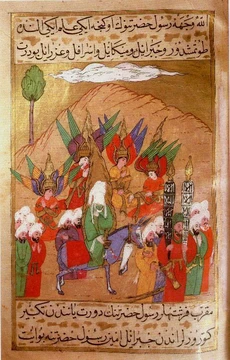
Zulfiqar
Sword of Ali, symbol of bravery and spiritual authority.

Zulfiqar is the sword of Ali, who was both the cousin and son-in-law of the prophet Muhammad, the first Shia Imam, and the fourth Sunni Rashidun caliph. Tied to Ali’s courage, skill in battle, and spiritual standing, the weapon grew into a major Islamic symbol, especially within Shia Islam. Its blade is famous for being double-edged or split at the tip into two points.
The name comes from Arabic, where “Dhu” means “possessor” and “faqar” can mean “vertebrae,” “notches,” or “grooves.” This likely refers to marks on the blade that resemble a spine, though other interpretations link it to the stars of Orion’s belt, a double-edged sword, or a metaphorical blade that separates right from wrong.
A well-known saying attributed to Muhammad praises Ali: “There is no sword but Zulfiqar, and there is no hero but Ali.” After Ali’s death, the sword’s location is unknown. Some accounts say it passed between the Alids and Abbasids, while Twelver Shia belief holds that the Mahdi now possesses it. Stories also credit Ali with miraculous deeds performed using Zulfiqar.
The sword appeared on banners of the Ottoman Empire and Iran, notably on Ottoman military flags in the 16th and 17th centuries, and on Safavid and Qajar standards. Its name is used as a given name and epithet in the Muslim world. In modern times, it has been adopted for military purposes: Reza Shah Pahlavi renamed a military order to Order of Zolfaghar in 1925; an Iranian main battle tank and a short-range ballistic missile are both named Zulfiqar; the 58th Ranger Division of Shahroud also bears the name; and at least three Pakistan Navy ships have been called PNS Zulfiqar.
Invocation of Zulfiqar appears in talismans, often with the two-part phrase “there is no hero but Ali, and there is no sword but Zulfiqar” or the reverse. This formula may have ancient roots, possibly originating as an Arab Christian invocation.
In legend, Muhammad received the exclamation “No sword but Zulfiqar, no hero but Ali” from Allah, and gave the sword to Ali to replace a broken one. Al-Tirmidhi records a tradition from Ibn Abbas that Muhammad acquired the sword at the Battle of Badr after dreaming of it before Uhud. During Qajar Iran, actual swords were made with the legendary double-pointed tip.
- Type
- Sword
- Associated figure
- Ali ibn Abi Talib
- Meaning
- Possessor of vertebrae
- Known for
- Symbol of bravery and spiritual authority in Islam
- Depicted on
- Ottoman and Iranian banners and flags
Lore & Background
The name Zulfiqar means 'possessor of vertebrae,' referring to notches or grooves on the sword's blade resembling the vertebrae of a spine. The hadith 'There is no sword but Zulfiqar, and there is no hero but Ali' is attributed to Muhammad in praise of Ali's bravery and his sword. The fate of Zulfiqar after Ali's death is unknown; according to some accounts, the sword changed hands several times between the Alids and the Abbasids, while Twelver Shia Islam holds that it is now in the possession of the Mahdi.
Reader's Guide
Zulfiqar is a central symbol in Islamic history, especially within Shia Islam, representing Ali's martial and spiritual authority. Its name and bifurcated design have been reproduced on Middle Eastern weapons, flags, and talismans. The sword appears on banners of the Ottoman Empire and Iran, and its name has been used in modern military contexts, including an Iranian main battle tank, a short-range ballistic missile, and a Pakistani Navy ship. The meaning of the name remains uncertain, with interpretations ranging from celestial references to a spine-splitting weapon. The sword's legendary status is reinforced by talismanic invocations and poetic references across centuries.
Did You Know?
- The name Zulfiqar means 'possessor of vertebrae,' referring to notches on the blade resembling a spine.
- Twelver Shia Islam holds that Zulfiqar is now in the possession of the Mahdi.
More in Islamic mythology 1-24
Spotted an error? Know more?
Reader corrections go straight into our review queue. Suggest an edit · How this site is sourced