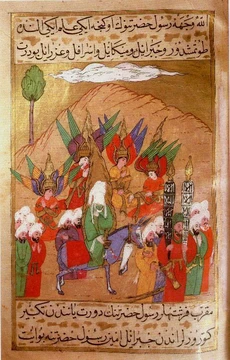
Barṣīṣā
Ascetic who fell to temptation and denied God.

Barṣīṣā, also known as Barsisa, is a figure in Islamic theology whose story dates from at least the 9th century. He is described as an ascetic from the tribe of Israel who succumbed to the Devil's temptations, denied God, and committed a series of grave sins. His story serves as a cautionary tale about the dangers of pride and yielding to evil.
- Field
- Islamic theology
- Known for
- Fable of an ascetic who denied God after succumbing to temptation
- Nationality
- Israelite (tribe of Israel)
Lore & Background
Barṣīṣā was one of the most pious worshippers from the tribe of Israel during his time. Three brothers, knowing his piety, asked him to care for their sister while they went to war. He initially refused and sought refuge in Allah, but eventually agreed on condition that she live next door. He would place food at her door and call out to her. Over time, Shaytan (the Devil) tempted him to deliver food directly, then enter the house, then speak with her, leading to adultery. The woman became pregnant, and Shaytan convinced Barṣīṣā to kill the baby and then the mother to hide his sins. When the brothers returned, he lied that she had died of illness and showed them a false grave. However, the brothers had dreams revealing the truth, found the actual grave with the corpses, and seized Barṣīṣā. Before his execution, Shaytan appeared as a man and offered to save him if he prostrated to him. Barṣīṣā did so, and Shaytan abandoned him. He died without repentance, having committed adultery, murder, lying, betrayal of trust, and shirk (associating partners with God).
Reader's Guide
The story of Barṣīṣā is significant in Islamic theology as a warning against the gradual nature of temptation and the ultimate sin of shirk, which God will not forgive if unrepented. The fable passed into European literary culture after its publication under the title 'History of Santon Barsisa' in the British periodical The Guardian in 1713. The anonymous contributor, who found the story in a volume of 'Turkish Tales', noted its Islamic origin but explained that 'the moral to be drawn from it is entirely Christian'. In this form, the fable inspired Matthew Gregory Lewis's 1796 Gothic novel The Monk. The tale thus bridges Islamic and European literary traditions, illustrating how a moral narrative can transcend cultural boundaries while retaining its core cautionary message about the dangers of yielding to evil.
Did You Know?
- The name Barsisa derives from Aramaic bar, 'son', and ṣīṣa, 'gold plate', referring to the high priest's breastplate.
- The fable was published in The Spectator in 1713 under the title 'History of Santon Barsisa'.
- In Islamic theology, God will not forgive a person who dies in a state of shirk without repentance.
Name, Etymology, and Theological Provenance
Barṣīṣā is an Aramaic compound: bar meaning "son" and ṣīṣa meaning "gold plate," a reference specifically to the high priest's breastplate. The full epithet thus translates as "the man of priestly regalia," evoking a figure of sacred authority and ritual purity. Within Islamic theological literature, the character appears as an ascetic whose story is framed as a cautionary parable about the Devil's power to corrupt even the most devout. The tale is dated to the early tenth century, placing it firmly within the medieval Islamic intellectual tradition. It was preserved and transmitted through works such as Ibn al-Jawzi's Talbees Iblees, a collection of diabolical deceptions. The name's priestly connotations create an immediate tension with the narrative's trajectory: a man whose very title signals holiness becomes, step by step, the embodiment of every grave sin the Islamic tradition recognizes. This contrast between the sacred weight of the name and the profane acts it comes to describe is central to the fable's theological force.
The Narrative Arc of Temptation and Ruin
The fable follows a man renowned for his piety among the tribe of Israel. Three brothers, departing for war, entrust their sister to his care, and after initial refusal he agrees, provided she lives in the adjacent house. He leaves food at her door and calls her to collect it. Shaytan then begins a slow campaign of persuasion, first arguing that it is unkind to make a woman go outside in public to fetch her meal, then suggesting he deliver it himself. Barsisa resists each suggestion but gradually yields: he brings the food in, enters the house, begins speaking with her out of concern for her loneliness, and ultimately commits adultery. She becomes pregnant. Fearing the brothers' return, Shaytan convinces him to kill the infant, then to silence the mother. He shows the brothers a false grave and claims she died of illness. The next day, however, both brothers dream of her murder and the true burial site, and they uncover the bodies. Barsisa is seized and brought before the ruler. Facing execution, he prostrates to Shaytan, who appears as a man, and is then abandoned to die.
European Literary Transmission and Adaptation
The story crossed into European literary consciousness in 1713, when an anonymous contributor to the British periodical The Guardian published it under the title "History of Santon Barsisa." The contributor explained that he had encountered the tale in a volume of "Turkish Tales" and, anticipating that readers might take offense at its Islamic provenance, prefaced the publication with a note insisting that the moral lesson was "entirely Christian." This act of cultural re-framing—stripping the parable of its specifically Islamic theological context and recasting it as a universal moral—allowed the narrative to circulate freely in English-language print. The fable's influence proved durable: nearly eighty years later, it served as a direct inspiration for Matthew Gregory Lewis's 1796 Gothic novel The Monk. Through this chain of transmission, a tenth-century Islamic cautionary tale about diabolical temptation and unforgivable sin was transformed into a cornerstone of European Gothic fiction, its original theological architecture largely obscured by the layers of adaptation it accumulated along the way.
Theological Framework and the Architecture of Sin
Within Islamic theology, the Barṣīṣā narrative functions as a stark illustration of the cumulative and unforgivable nature of certain sins. The protagonist's descent encompasses zina (adultery), murder of both the infant and the mother, deliberate deception of the brothers, betrayal of a sacred trust, and ultimately shirk—the act of prostrating to Shaytan in place of God. The fable's theological weight rests on a specific doctrinal point: a person who dies in a state of shirk without having repented cannot receive God's forgiveness. This final act, performed under the pressure of imminent execution, seals Barsisa's eternal fate. Shaytan operates throughout as a patient, incremental tempter, never demanding the ultimate transgression all at once but guiding Barsisa through a series of small concessions that each make the next step seem reasonable. The story thus encodes a broader Islamic warning about the insidious architecture of moral compromise, where the distance between the first small concession and the final, irrevocable act is traversed one quiet surrender at a time.
Frequently Asked Questions
Who is Barṣīṣā in Islamic tradition?
Barṣīṣā (also rendered Barsisa) is an Israelite ascetic whose tale appears in Islamic theological literature. He is remembered as a once-pious holy man who ultimately rejected God after falling prey to the Devil's seductions.
What happens in the story of Barṣīṣā?
The narrative follows a devout ascetic who is gradually corrupted by satanic temptation, leading him to deny God and commit a string of serious transgressions. His downfall unfolds as a chain of escalating moral failures rather than a single dramatic act.
What is the purpose of the Barṣīṣā narrative?
It serves as a cautionary warning against pride and the slow erosion of faith when one yields to evil influences. The story illustrates how even a deeply devoted person can be led astray if arrogance makes them vulnerable to temptation.
How old is the Barṣīṣā story in Islamic sources?
The tale is attested in Islamic theological texts dating back to at least the ninth century CE. It has been preserved and retold across various branches of Islamic literature since that period.
What is Barṣīṣā's tribal or ethnic background in the story?
He is identified as a member of the tribe of Israel, placing him within the broader Abrahamic tradition of prophetic figures. This Israelite origin links his narrative to the wider Judeo-Islamic storytelling tradition.
More in Islamic mythology 1-24
Spotted an error? Know more?
Reader corrections go straight into our review queue. Suggest an edit · How this site is sourced