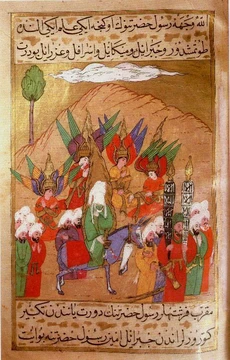
Book of Idols
Composite work on pre-Islamic Arabian idolatry, attributed to Ibn al-Kalbi.

Unknown author · Public domain
The Book of Idols (Kitāb al-ʾAṣnām) is a composite work attributed to the Arab scholar Hisham ibn al-Kalbi (737–819) that describes the polytheistic and idolatrous religion of pre-Islamic Arabia. It portrays this state as a degradation from the pure monotheism introduced by Abraham and Ishmael, restored only by Islam. The work is an itemized list of idols and sanctuaries, with descriptions of their geography, associated tribes, and occasional details about their destruction in the Islamic era. It relies on Arab oral tradition and is not considered a reliable source by many modern historians.
- Key deities
- Al-Uzza, Al-Lat, Manat (the Daughters of Allah); Wadd, Suwa, Yaghuth, Ya'uq, Nasr
- Manuscript length
- 56 folios (line counts vary)
Lore & Background
The Book of Idols is a centuries-long accumulation of individual reports, not solely the work of Ibn al-Kalbi. It emerged through accretion, reworkings, and interpolations, resulting in repetitions and contradictions. The core goes back to Ibn al-Kalbi, transmitted through Abu Bakr Ahmad ibn Muhammad al-Jawhari (d. 944–45), who added reports he thought also went back to Ibn al-Kalbi. Later, an appendix with more idols was added. Other recensions likely existed but have not survived. Yaqut al-Hamawi (d. 1229) quoted the text extensively, including material not found in the sole extant manuscript.
Reader's Guide
The Book of Idols is significant as the most popular Islamic work about pre-Islamic Arabian religion, but its reliability is disputed. It portrays eight pagan gods named in the Quran as dominating Arabian religion, and offers two origin myths for the transition from Abrahamic monotheism to polytheism: one involving 'Amr bin Luhay bringing idols from Syria to Mecca, and another tracing idolatry back to Cain's descendants. The work also describes multiple Kaabas in pre-Islamic Arabia and distinguishes between idols made of wood, gold, or silver (aṣnām) and those of stone (awthān). Its legacy is complicated by its composite nature and the fact that it was largely unknown among Islamic scholars until the 20th century, except through citations by Al-Masudi and Yaqut. Modern scholars like Gerald Hawting argue that accusations of idolatry in Islamic tradition were rhetorical weapons against monotheistic competitors, not accurate historical records.
Did You Know?
- The sole extant manuscript was discovered at auction in Damascus by Egyptian philologist Ahmad Zaki Pasha in the first half of the 20th century.
- The longest entry in the Book of Idols is about the goddess al-Uzza, one of the 'Daughters of Allah' mentioned in Surah 53.
- Ibn al-Kalbi claims that remnants of Abraham's monotheism survived among a small group of hanifs, who performed rituals like circumambulation and pilgrimage.
- The text contains two contradictory origin myths for the rise of polytheism in Arabia.
The Definitive Account of Pre-Islamic Faith
The eighth-century Book of Idols, composed by Hisham ibn al-Kalbi, stands as the single most comprehensive surviving treatment of the religious practices that characterized pre-Islamic Arabia. Scholar F.E. Peters has argued that no other text matches its depth when it comes to documenting how Arabian communities venerated their deities, spirits, and sacred objects. While the work belongs to the broader Muslim literary tradition—alongside the Qur'an and other Islamic writings—it functions as a crucial window into a world that had already been largely transformed by the seventh century. The text sits alongside the writings of the Yemeni historian al-Hasan al-Hamdani, whose works on South Arabian beliefs, including the Crowns from the Accounts of the Yemen and the Genealogies of Himyar, provide complementary regional detail. Together, these sources form the backbone of what modern scholars can reconstruct about a faith system that, by the time al-Kalbi wrote, had already been displaced by Islam.
From Sacred Stones to Carved Idols
One of the most striking narratives preserved in the Book of Idols traces the origin of Arabian idol worship back to the descendants of Ishmael, the son of Abraham. According to al-Kalbi's account, these Meccan settlers migrated to distant lands and carried with them holy stones taken from the Kaaba. They erected these stones in their new territories and performed circumambulation around them in imitation of the rites performed at the Kaaba itself. This, al-Kalbi argued, set in motion the gradual rise of full idol worship among the Arabs. The implication is that stone veneration preceded the adoption of carved or sculpted deities, which may have arrived through foreign cultural contact. This progression from aniconic stone reverence to representational idolatry finds a parallel in the third-century Syriac Homily of Pseudo-Meliton, which describes how Syriac-speaking communities in northern Mesopotamia, predominantly Arab, related a god to a stone as his physical representation. The Kaaba itself is said to have contained as many as 360 such idols at its height.
A Mosaic of Local Cults and Regional Pantheons
Far from being a single unified religion, Arabian polytheism as documented through sources like the Book of Idols was a patchwork of local and regional cults, each with its own deities, ritual specialists, sacred sites, and practices. The kingdoms of South Arabia developed elaborate pantheons in which the god ʿAthtar often held the supreme position, while smaller peoples maintained their own patron deities—Almaqah for the Sabaeans, Wadd for the Minaeans, ʿAmm for the Qatabanians, and Sayin for the Hadramites. In less complex societies, worship centered more tightly on a single local figure, such as Dhu Ghaba at Dedan or Dushara among the Nabataeans. The great names most associated with the Kaaba—Hubal, al-ʿUzzā, Allāt, and Manāt—appear in particular regional, political, or mercantile contexts. Nomadic communities, known primarily through Safaitic inscriptions, invoked their deities for practical concerns: rain, security, health, and the reunification of scattered families. Rituals included pilgrimage, divination, and animal sacrifice, all directed toward forces beyond human control.
Reading Between the Inscriptions and the Gaps
The Book of Idols does not exist in isolation; it is one thread in a web of evidence that scholars must weave together to understand pre-Islamic Arabian religion. Pre-Islamic inscriptions in scripts such as Safaitic, Sabaic, and Paleo-Arabic preserve countless divine names, often invoked in petitions or thanksgivings, yet the texts are too brief to yield a full theology or mythology. External Greek and Jewish accounts add further data: Esarhaddon's Annals name deities like Atarsamain and Nukhay; Herodotus reports Arab worship of Orotalt and Alilat; Strabo and Origen each list different divine figures. The Muslim tradition itself, including the Qur'an, offers additional references. A significant scholarly debate surrounds whether polytheism truly remained dominant or whether henotheism and monotheism had already gained ascendancy by the fourth century. The coexistence of Christian communities—especially Miaphysite and Nestorian—Jewish diaspora settlements, and limited Zoroastrian influence further complicates any simple narrative, and the Book of Idols must be read against this layered backdrop.
Gallery

Frequently Asked Questions
What is the Book of Idols?
It is an Arabic text that catalogs the gods, statues, and sacred sites worshipped across pre-Islamic Arabia. The work frames these polytheistic practices as a moral and spiritual decline from the original monotheism established by Abraham and Ishmael, a faith it claims was only fully restored through Islam.
Who is credited with writing the Book of Idols?
The text is traditionally attributed to Hisham ibn al-Kalbi, an Arab scholar who lived from 737 to 819 CE. In practice, it is a composite compilation drawing heavily on oral Arab traditions rather than a single author's original composition.
Which major deities appear in the Book of Idols?
The most prominent figures include the so-called 'Daughters of Allah' — Al-Uzza, Al-Lat, and Manat — alongside a group of male deities such as Wadd, Suwa, Yaghuth, Ya'uq, and Nasr. Each entry typically notes which tribe venerated the idol and where its sanctuary was located geographically.
How long is the Book of Idols manuscript?
The surviving manuscript runs to roughly 56 folios, though exact line counts vary by edition. It is structured as a running itemized list of idols and their associated sanctuaries rather than a continuous narrative.
Do modern historians trust the Book of Idols as a source?
Most contemporary scholars treat it with significant caution, viewing it as a later Islamic-era reconstruction rather than a neutral record of pre-Islamic religion. Its theological framing — presenting idolatry as a degradation from Abrahamic monotheism — shapes how the material is organized and presented.
More in Islamic mythology 1-24
Spotted an error? Know more?
Reader corrections go straight into our review queue. Suggest an edit · How this site is sourced