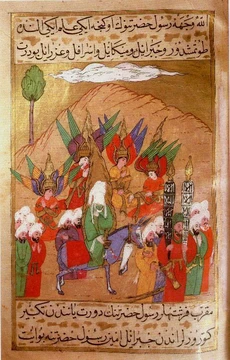
Heavenly Quran
Primordial heavenly version of the revealed Quran.

The Heavenly Quran (Arabic: أمّ الکتاب, romanized: *umm al-kitāb*, meaning "mother of the Book") is, in a widespread Islamic view, the original, eternal version of the Quran that exists in heaven. The idea of a sacred text based on a heavenly original is not exclusive to Islam; according to Alfred Guillaume, it stretches back "thousands of years" to "the early Sumerians."
Within the Quran itself, verses 43:4 and 13:39 mention the "mother of the book" (*umm al-kitab*). Verse 85:22 refers to a "well-guarded tablet" (*lawh mahfuz*), and verse 56:78 speaks of a "concealed book" (*kitab maknun*). The Quran's revelation is described as being "sent down" in verse 17:105: "With the truth we (God) have sent it down and with the truth it has come down." The Quran is also called *kalam allah*—the word of God—and for most Muslims, it is an eternal and uncreated attribute of God, not something God wrote or created.
The heavenly Quran is distinct from the earthly one. There is disagreement over whether the revealed Quran is an exact copy of the heavenly original or a shortened version. In mainstream Islamic theology, the Injil (Gospel) and the Islamic concept of the Torah are separate revelations derived from the same heavenly tablet, not subsections of the Quran itself.
- Field
- Islamic theology
- Known for
- Primordial heavenly version of the Quran
- Also called
- Mother of the Book (umm al-kitāb), well-guarded tablet (lawḥ maḥfūẓ), concealed book (kitāb maknūn)
Reader's Guide
The Heavenly Quran is significant in Islamic theology as the eternal, uncreated archetype of the revealed Quran, often identified with the 'mother of the book' and the 'well-guarded tablet.' It is also called kalam allah — the word of God — and to most Muslims is an eternal and uncreated attribute of God, as opposed to something written or created by God. The Quran that resides in heaven is distinct from the earthly Quran, and it is disputed whether the revealed Quran is a precise copy of the Heavenly Quran or an abridged version. Commonly, the Injil and the Islamic notion of Torah are thought to be part of the Heavenly Quran. This concept has parallels in earlier religious traditions, as noted by Alfred Guillaume, who traces the idea back thousands of years to the early Sumerians.
Did You Know?
- The Heavenly Quran is also called the 'mother of the book' (umm al-kitāb) in Islamic belief.
- The concept of a heavenly archetype for a holy book goes back thousands of years to the early Sumerians, according to Alfred Guillaume.
Definition and Core Identity
The Heavenly Quran, known in Arabic as umm al-kitāb (literally 'mother of the Book'), represents a foundational concept in Islamic theology. It is understood as a primordial, pre-existing version of the Quran that resides in the divine realm. This heavenly text is not merely an early draft but is regarded as the source from which the revealed scripture on Earth derives its authority. The concept positions the Quran as having an eternal dimension that transcends its physical, earthly manifestation. For most Muslims, this celestial text is identified as kalam allah—the very word of God—and is considered an eternal, uncreated attribute of the Divine rather than something that was authored or manufactured. This theological framing elevates the Heavenly Quran beyond a written document into the realm of God's own speech, making it fundamentally distinct from any human composition or even a created artifact.
Quranic References and Terminology
The concept of the Heavenly Quran is woven directly into the text of the Quran itself through several distinct terms. Verses 43:4 and 13:39 employ the phrase 'mother of the book' (umm al-kitab), establishing the foundational relationship between the celestial and terrestrial scriptures. Verse 85:22 introduces the image of a 'well-guarded tablet' (lawh mahfuz), while verse 56:78 speaks of a 'concealed book' (kitab maknun), each term adding a different nuance to the idea of a preserved, hidden divine record. The act of revelation is described in verse 17:105 as a sending down, with God declaring that the truth was sent down and with truth it came down. This language of descent reinforces the notion that the earthly Quran flows from a higher, pre-existing source. The multiplicity of terms—mother, tablet, concealed book—suggests that the Quran itself resists a single fixed image for this heavenly archetype, instead offering layered metaphors for the same underlying reality.
Cross-Cultural and Historical Roots
The notion that a sacred text or religious symbol is grounded in an archetype preserved in a celestial realm is far from exclusive to Islamic tradition. According to the scholar Alfred Guillaume, this idea stretches back thousands of years, reaching as far as the early Sumerian civilizations. This deep historical lineage places the concept of the Heavenly Quran within a much broader human pattern of imagining divine knowledge as stored in a transcendent repository before being communicated to the earthly world. The Sumerian parallel suggests that the impulse to locate the origin of sacred words beyond the physical realm is one of the oldest theological intuitions in human religious thought. By situating the umm al-kitab within this ancient continuum, the Islamic concept gains a dimension of cultural continuity that connects it to the earliest known literate societies. It frames the Heavenly Quran not as a novel invention but as the Islamic expression of a universal human longing to trace revelation back to a pristine, uncorrupted source beyond time and material decay.
Theological Tensions and Relationships
A central question in Islamic theology concerns the precise relationship between the Heavenly Quran and the scripture received on Earth. Scholars have debated whether the revealed Quran constitutes an exact, word-for-word copy of its celestial counterpart or whether it represents an abridged rendering of the full heavenly text. This dispute touches on the nature of revelation itself and the degree to which divine meaning can be fully captured in human language. Additionally, the Heavenly Quran is understood to encompass not only the Islamic scripture but also the Injil (the Gospel) and what Islam identifies as the Torah, suggesting a unified divine source from which multiple revealed traditions flow. The distinction between the heavenly and earthly Quran is further sharpened by the doctrine that the Quran is kalam allah—an eternal, uncreated attribute of God—rather than a created object. This means the celestial text exists in a category entirely different from any physical book, existing as God's own speech rather than as ink on parchment.
Gallery
Frequently Asked Questions
What is the Heavenly Quran?
The Heavenly Quran is the primordial, eternal form of the Quran that, in a widespread Islamic understanding, resides in the heavens prior to its earthly revelation. It is regarded as the unchanging original from which the text recited by Prophet Muhammad was transcribed.
What are the different names for the Heavenly Quran?
It is known by several titles drawn from the Quran itself: "Mother of the Book" (umm al-kitāb), "well-guarded tablet" (lawḥ maḥfūẓ), and "concealed book" (kitāb maknūn). Each name highlights a different aspect—its origin, its protection, or its hidden nature.
Which Quranic verses mention the Heavenly Quran?
Verses 43:4 and 13:39 refer to the "mother of the book," verse 85:22 speaks of a "well-guarded tablet," and verse 56:78 alludes to a "concealed book." These four passages together form the scriptural foundation for the concept of a heavenly original.
Why is the Heavenly Quran significant in Islamic theology?
It anchors the belief that the Quran is not a human composition but a faithful earthly copy of a text that has existed eternally in the celestial realm. This reinforces the doctrine of the Quran's uncreated, divine origin and its status as a revelation rather than an invention.
Is the idea of a heavenly source text unique to Islam?
No; the scholar Alfred Guillaume observed that the notion of a sacred book resting on a heavenly prototype reaches back thousands of years, as far as early Sumerian traditions. Islam's Umm al-Kitab fits within a much older cross-cultural pattern of linking revealed scripture to a celestial archetype.
More in Islamic mythology 1-24
Spotted an error? Know more?
Reader corrections go straight into our review queue. Suggest an edit · How this site is sourced