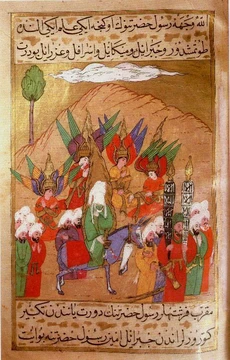
Al-Jinn
Quranic chapter on jinn, their conversion, and monotheism.

Al-Jinn (Arabic: الجن, 'The Jinn') is the 72nd chapter (sūrah) of the Quran, consisting of 28 verses (āyāt). Its name and topic are the jinn, beings created from smokeless fire according to the Quran. The chapter is generally considered a Meccan surah, placed in Juz' Tabāraka -lladhi (surahs 67–77), a grouping based on length and recitation rather than chronological order. Traditional dating places its revelation around 3–4 B.H. (before the Hijrah, i.e., circa 619–620 CE), when Muhammad was evangelizing near present-day Ta'if.
Quick Facts
- Number
- 72
- Name-En
- The Jinn
- Prev Sura
- Quran 71
- Next Sura
- Quran 73
- Classification
- Meccan
- Othernames
- Jinns, The Unseen Beings
- Juz
- 29
- Rukus
- 2
- Verses
- 28
- Words
- 286
- Letters
- 1,109
- Audio
- Chapter 72, Al-Jinn (Murattal) - Recitation of the Holy Qur'an.wav
Facts from the source article.
Lore & Background
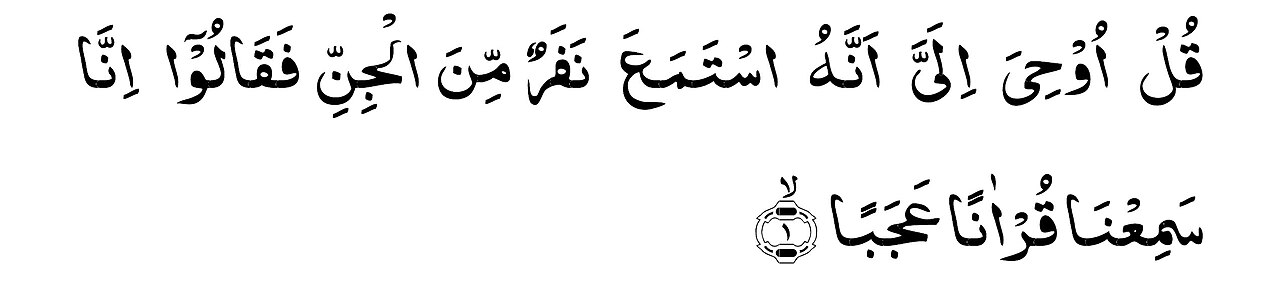
The surah opens with a number of jinn converting to Islam after hearing the Quran. They recant their belief in false gods and venerate Muhammad for his monotheism, apologizing for past blasphemy and criticizing mankind for either neglecting them or encouraging disbelief. The chapter also addresses the folly of men and jinn in ascribing offspring to God, and describes jinn prying into heavenly secrets being driven away with fiery darts.
Reader's Guide
Al-Jinn is significant for its detailed treatment of jinn, invisible beings created from smokeless fire, and their relationship with humanity and God. The surah establishes that jinn, like humans, are divided into believers and unbelievers, with believers rewarded in Paradise and unbelievers punished in hell. It reaffirms monotheism (tawhid) among the jinn and emphasizes the inescapable wrath of God. The chapter also clarifies that the Islamic Judgement Day (Qiyamah) is known only to God, and that God takes into account all deeds when judging. The surah's mention of jinn spying on heaven and being repelled by meteors reflects pre-Islamic beliefs about soothsayers. Its legacy includes influencing Islamic theology on the nature of jinn, their free will, and their accountability before God, as well as providing a scriptural basis for the Mosque of the Jinn in Mecca.
Did You Know?
- The surah states that humans are created from earth and jinn from smokeless fire.
- Abdullah Yusuf Ali says it is 'tolerably certain' that Al-Jinn was revealed around 2–3 B.H.
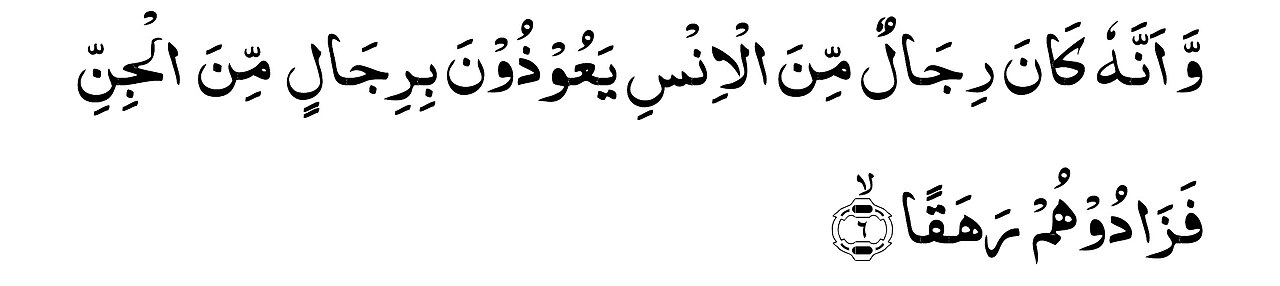
- Verse 6 mentions that travelers among humans sought refuge among the jinn when scared.
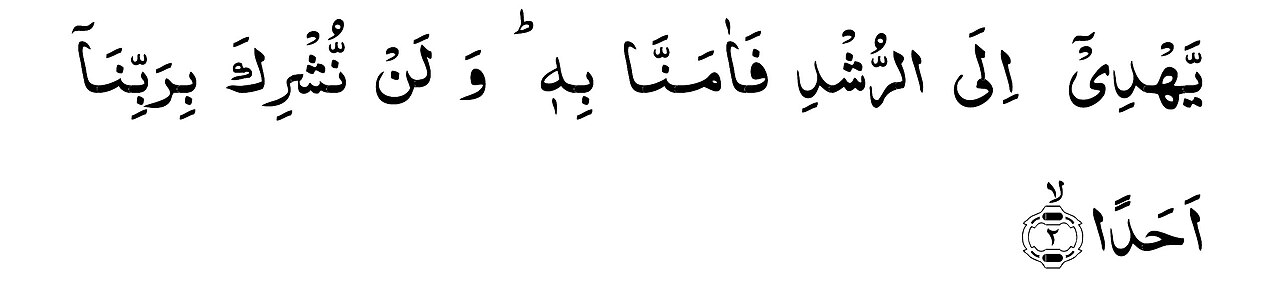
- Verses 20-22 reaffirm monotheism (tawhid) among the jinn.
Moral Agency and Theological Standing
Jinn occupy a unique position in Islamic theology as beings who, like humans, bear full moral responsibility before God. They are not inherently wicked or inherently virtuous; rather, each individual jinni is classified as either a believer (Mu'minun) or an unbeliever (kuffar) based on whether it accepts divine guidance. This moral parity means that Islam places jinn and humans on the same plane in relation to the divine, with both groups subject to judgement and an afterlife. The Quran explicitly condemns the pre-Islamic Arabian custom of worshipping jinn or seeking their protection, framing such practices as a deviation from monotheism. Because jinn are not a strictly Islamic invention, scholars note they likely represent several older pagan beliefs that were absorbed and reinterpreted as Islam expanded across the Arabian Peninsula and beyond. This adaptability allowed the faith to acknowledge spirits from other religious traditions without dismissing them outright, weaving them into a broader theological framework where accountability, rather than origin, defines a being's standing before God.
Form, Society, and Human Encounters
Although naturally invisible to the human eye, jinn are understood to possess thin, subtle physical bodies that grant them the remarkable ability to shapeshift. Their most common assumed form is that of a snake, though they may also appear as scorpions, lizards, or even humans. In their natural state, jinn prefer to live among their own kind in a social structure that mirrors the tribal arrangements of the Arabian peoples, rarely intruding into human affairs unless provoked. When a human disturbs or harms a jinni, the typical response is retaliation in kind, and the most extreme encounters involve the jinn possessing the assailant's body, a condition that then demands exorcism. Interactions between jinn and humans can span the full spectrum: negative, positive, or neutral, ranging from brief and casual to deeply intimate, including sexual relations and the production of hybrid offspring. This wide range of possible contact means that a jinni's relationship with a particular person is neither fixed nor predictable, making the boundary between the human and jinn worlds one of cautious coexistence rather than absolute separation.
The Word's Long Linguistic Journey
The term jinn traces back to the Semitic root jnn, whose core meaning is to hide or to adapt, leading some scholars to read the word as literally describing beings concealed from the senses. The Arabic collective noun is properly plural, with the singular form jinnī giving rise to the English word genie. The word's deeper etymology remains contested: some researchers link it to the Latin genius, a Roman guardian spirit, arguing that both represent lesser deities dwelling in local sanctuaries, trees, or springs. Others point to the Aramaic ginnaya, meaning tutelary deity, or to the Avestic Jaini, a wicked female spirit in possibly pre-Zoroastrian Iranian mythology. The scholar Wensick, however, champions a purely Arabic origin, reasoning that since these spirits are hidden from human sight, they would naturally be called jinn. The anglicized genie entered English through the 1706 French edition of the Thousand and One Nights, where the French génie was chosen for its rough phonetic and semantic similarity to the concept of benevolent intermediary spirits.
Pre-Islamic Roots and Folkloric Afterlife
Long before Islam, jinn were already objects of worship and fear across pre-Islamic Arabia, a fact attested in both the Quran and ancient Arabic poetry. Some scholars trace them to malevolent desert spirits that took animal forms, while others see them as once-majestic pagan nature deities that were gradually marginalized. The scholar Joseph Chelhod situates jinn within a dualistic cosmology: if the high god El, or Allah, embodies celestial order, then jinn represent the chthonic, chaotic powers of the lower world, perpetually striving upward toward divinity. In this framework, angels are imagined as daughters born from a union between the divine and jinn, symbolizing the meeting of heavenly and earthly forces in the intermediate realm of stars. In popular practice, jinn appear on charms and talismans, are invoked for protection or magical aid under a king's leadership, and are feared as tools of sorcerers. Many believers wear amulets bearing God's name, holding that such markings render them immune to jinn assault. These folkloric customs, once widespread across the Muslim world, have faced growing disapproval in modern times due to their perceived association with idolatry.
Gallery



Frequently Asked Questions
What is Al-Jinn in the Quran?
Al-Jinn is the 72nd sūrah of the Quran, a Meccan chapter of 28 verses devoted to the jinn, beings the Quran describes as created from smokeless fire. It sits within Juz' Tabāraka -lladhi, the recitation grouping that spans surahs 67 through 77.
What does the surah Al-Jinn say about the nature of jinn?
The chapter portrays jinn as a distinct creation with free will, the ability to hear and respond to revelation, and their own social order. They are held to the same monotheistic standard as humans, capable of both faith and disbelief.
When and where was Al-Jinn revealed?
Traditional scholarship places its revelation around 619–620 CE, during the Meccan period when Muhammad was preaching in the area near present-day Ta'if and opposition to his message was intensifying.
Why is Al-Jinn significant in Islamic theology?
It is one of the few surahs dedicated entirely to a non-human creation, establishing that jinn share the same covenant of monotheism and moral accountability as humankind. The chapter reinforces the idea that the divine address extends to all sentient beings, not just humans.
How does Al-Jinn fit into the broader Islamic tradition about jinn?
The surah frames jinn as witnesses to revelation who can convert, complementing other Quranic passages and hadith narratives that describe their interaction with the human world. It anchors the theological principle that jinn inhabit a parallel society governed by the same divine law.
More in Islamic mythology 1-24
Spotted an error? Know more?
Reader corrections go straight into our review queue. Suggest an edit · How this site is sourced