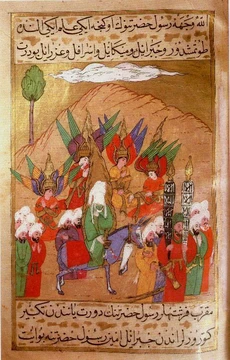
Isra' and Mi'raj
Islamic narrative of Muhammad's night journey and heavenly ascension.

Ahmad252 · CC BY-SA 4.0
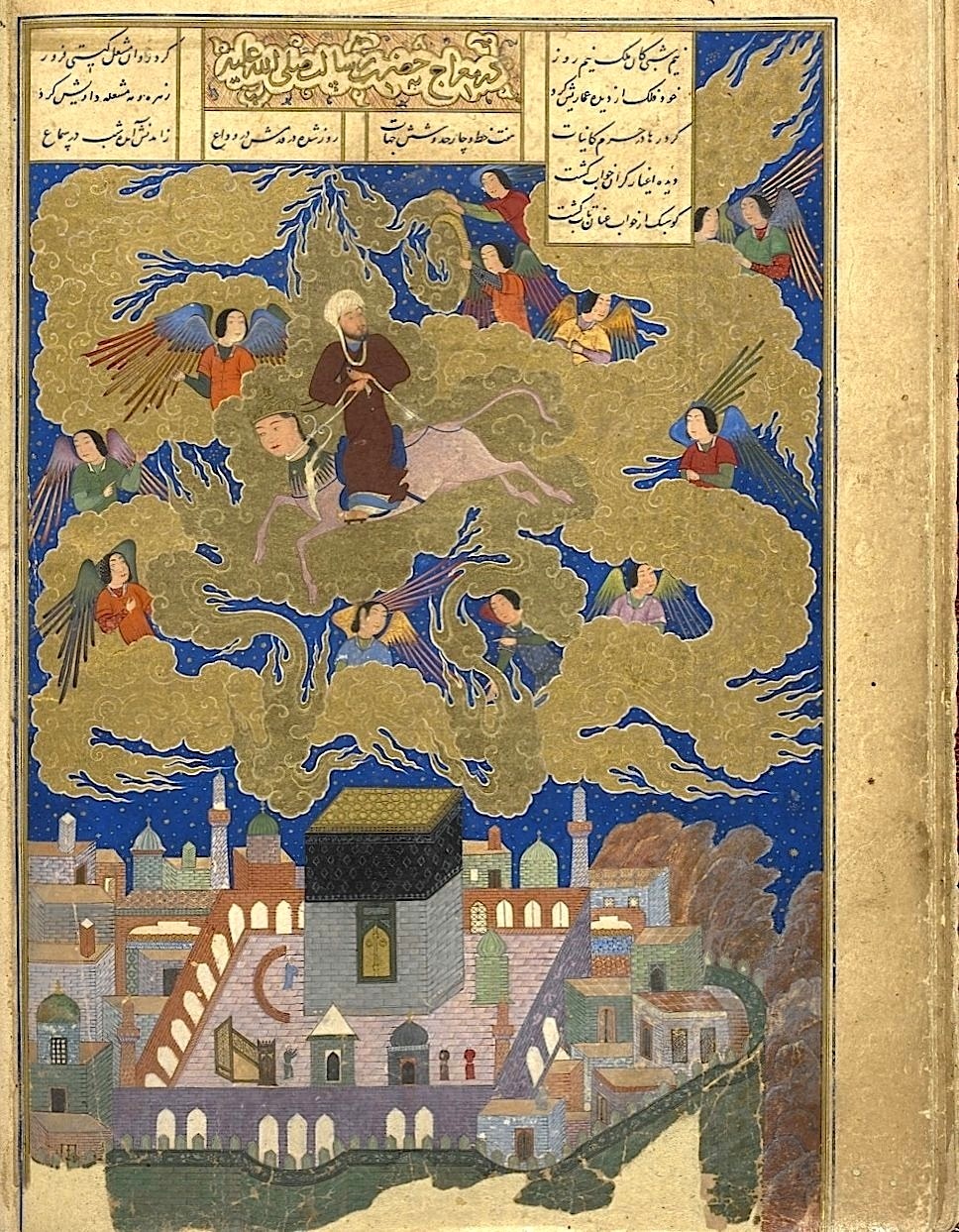
The Israʾ and Miʿraj (Arabic: الإسراء والمعراج, meaning "The Night Travel and Ascension"), also called the Ascension of Muhammad, is a set of Islamic stories that developed over time about the prophet’s night journey. In these accounts, Muhammad ascends through the heavens, sees the afterlife, and returns. The topic remains influential in shaping religious and political positions today. However, the Quran—the central authority in Islam—contains only two passages that refer to this event, and neither specifies who is speaking or being addressed: verses 1–18 of Surah an-Najm and several verses from the 17th chapter, later named Surah al-Isra. The overall story and its details come from various miraculous reports, some based on hadith—collections of Muhammad’s sayings and actions—that were compiled centuries after his death.
About two centuries after Muhammad, Ibn Sa'd gathered some of the earliest written versions of these stories, which had previously been passed down separately, into a single account. This process of editing continued in later centuries, eventually producing the full narrative that different Islamic sects accept in various forms today. According to his version, the angels Gabriel and Michael accompany Muhammad to a spot in the sacred area of the Kaaba, between the Zamzam well and the Maqam Ibrahim. There, a ladder (miʿrāj literally means "ladder") is placed, and they use it to ascend to heaven. At the top, Muhammad meets earlier prophets. In one version of the tradition, Gabriel holds Muhammad’s hand tightly and rises with him into heaven. When they reach the Sidrat al-Muntaha, mentioned in Sura 53:14, Muhammad sees heaven and hell. There, he is told to perform fifty daily prayers, but he negotiates with God to reduce them to five, and is given the last two verses of Al-Baqarah, described as a treasure from God’s throne.
The 27th night of the month of Rajab is one of the most celebrated holy nights in the Islamic calendar. The literature continued to grow as different narrations were added to support the views of various schools of thought. Additionally, verses and hadith about the Ascension reflect the ancient Islamic view of the cosmos.
- Field
- Islamic religious narrative
- Known for
- Night journey and ascension of Muhammad to heaven
- Key texts
- Quran 17:1, 53:1-18; hadith collections
- Associated date
- 27th night of Rajab (celebrated holy night)
- Early compiler
- Ibn Sa'd (approx. two centuries after Muhammad)
Lore & Background
Approximately two centuries after Muhammad's time, Ibn Sa'd partly assembled the earliest written stories—previously transmitted independently—into a cohesive narrative. According to his accounts, the angel Gabriel accompanies Muhammad to a place in the sacred precinct of the Kaaba, between the well of Zamzam and Maqam Ibrahim. There, a ladder (miʿrāj, literally meaning ladder) is set up, with whose help they ascend to heaven. When he reaches the top, Muhammad meets the previous prophets. In one version, Gabriel holds Muhammad's hand and ascends with him to heaven. At the Sidrat al-Muntaha (mentioned in Sura 53:14), Muhammad sees heaven and hell. There, he is required to perform fifty daily prayers, but negotiates with God to reduce them to five.
Reader's Guide
The Israʾ and Miʿraj narratives hold a pivotal position in shaping many religious-political stances, even today. The literature continued to evolve through the incorporation of various narrations that supported the perspectives of different schools of thought. While classical commentaries interpret the journey as a miraculous voyage undertaken in the unity of body and soul—a view that also gives rise to theological debates—Sufism generally regards it as a spiritual ascension, remaining apart from such controversies. The 27th night of the month of Rajab is one of the most celebrated holy days and nights in the Islamic calendar. The Dome of the Rock, built on the Muallak stone, and the Al-Aqsa Mosque, located on the south wall of the compound, are associated with the site of the ascension. The term Haram al-Sharif, emphasizing the site's high sanctity, became popular during the Mamluk and Ottoman periods.
Did You Know?
- The Quranic basis for the Israʾ and Miʿraj consists solely of two statements with unspecified subjects and addressees: verses 1-18 of Surāh an-Najm and some verses of the 17th chapter.
- The term miʿrāj literally means 'ascending device, ladder' or 'ascending place', possibly referencing the ladder motif in early narratives.
- Ibn Sa'd recorded that Muhammad's Mi'raj took place on the 27th of Ramadan, 18 months before the Hijrah, while the Isra' took place on the 17th night of Rabi' al-Awwal before the Hijrah, as two separate events.
- In Al-Tabari's summary, Muhammad meets a different prophet at each of the seven levels of heaven, including Adam, John the Baptist, Jesus, Joseph, Idris, Aaron, Moses, and Abraham.
The Quranic Seed and the Later Garden
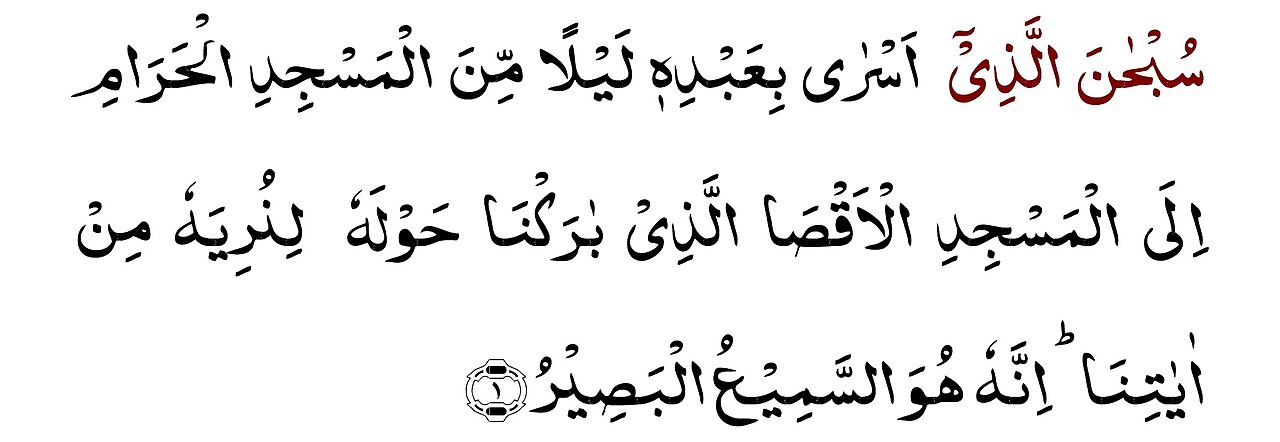
The Quranic basis for Isra' and Mi'raj is remarkably sparse. The entire scriptural foundation rests on just two passages: verses 1-18 of Surah an-Najm and select verses from the 17th chapter, later known as Surah al-Isra'. What makes this striking is that these verses contain subject-unclear poetic expressions and unspecified addressees. The 17th chapter, which was probably originally called Surah Bani Isra'il during the Companions' era, gradually shifted its name as narrations about the night journey entered Islamic literature. Beyond these two references, no other Quranic verse is associated with the Mi'raj. Some researchers note that, unlike the miracles attributed to other prophets in the Quran, the verses denying any miracles of Muhammad outside the Quran draw particular scholarly attention. This minimal scriptural anchor means that the vast, detailed narrative familiar to Muslims today was constructed almost entirely outside the Quran, through centuries of hadith compilation and literary elaboration.
From Oral Fragments to a Living Text
The story as Muslims know it today is the product of a long editorial process spanning many centuries. For roughly two hundred years after Muhammad's lifetime, the various miraculous accounts circulated independently as oral traditions. It was not until approximately two centuries later that Ibn Sa'd undertook the task of partially assembling these scattered reports into a single, cohesive narrative. His compilation represented a crucial turning point, transforming disconnected fragments into a structured account. From that point forward, the editing and elaboration continued across subsequent centuries, with each generation incorporating narrations that supported the theological perspectives of different schools of thought. The result is not one fixed story but a family of versions, each embraced by different sects. Even the date of the event itself remains contested: Ibn Sa'd recorded the Mi'raj as occurring on the 27th of Ramadan, eighteen months before the Hijrah, while the Isra' took place on the 17th night of Rabi' al-Awwal, treating them as two separate, unconnected events.
The Ladder, the Sidr, and the Negotiated Prayer
Within the narrative tradition, the ascent follows a vivid spatial logic. Muhammad is accompanied by the angels Gabriel and Michael to a spot in the sacred precinct of the Kaaba, positioned between the well of Zamzam and Maqam Ibrahim. There, a ladder—whose very name, mi'raj, means an ascending device—is erected, and it is through this structure that the journey upward begins. In one version, Gabriel grips Muhammad's hand firmly as they climb together. At the summit, Muhammad encounters the previous prophets. Reaching the Sidrat al-Muntaha, a landmark explicitly named in Sura 53:14, he beholds both heaven and hell. The narrative's most theologically consequential moment follows: Muhammad is required to perform fifty daily prayers but negotiates with God to reduce the obligation to five. As a final gift, he receives the last two verses of Al-Baqarah, described as a treasure from God's throne. The preference for the term mi'raj over the more generic uruj in the story's title likely reflects this early ladder motif.
Jerusalem, the Dome, and Political Resonance
The Isra' and Mi'raj narrative is deeply entangled with the geography and politics of Jerusalem. The Bait al-Maqdis, the site where Muhammad is believed to have ascended, is the Arabic rendering of the Hebrew name for Solomon's Temple, and the city's later Muslim name Al-Quds derives from the same linguistic root. The Dome of the Rock, constructed atop the Muallak stone, and the Al-Aqsa Mosque on the compound's south wall, were erected by the fifth Umayyad caliph Abd al-Malik or his successor al-Walid I, possibly driven by political motivations. The broader area, now commonly called Haram al-Sharif—a term emphasizing supreme sanctity that gained popularity during the Mamluk and Ottoman periods—bears no buildings from Muhammad's era, yet the narrative anchors its holiness there. Classical commentaries read the journey as a miraculous voyage of body and soul united, a reading that sparks ongoing theological debate. Sufi traditions, by contrast, interpret the ascent as a purely spiritual experience, sidestepping those controversies. The narrative continues to shape religious-political stances to this day.
Gallery

Frequently Asked Questions
What is Isra' and Mi'raj?
It is a narrative cycle in Islamic tradition describing the Prophet Muhammad's nighttime journey and his subsequent ascent through the celestial realms. The Arabic name translates roughly to 'the night travel' and 'the ascension.'
Where does Isra' and Mi'raj appear in primary sources?
The Quran touches on the event only briefly in two passages—verse 17:1 and verses 53:1–18—without naming who is speaking or being addressed. More elaborate retellings developed later in hadith collections, with the earliest surviving written compilation attributed to Ibn Sa'd, roughly two centuries after Muhammad's lifetime.
What actually happens in the Isra' and Mi'raj story?
In the narrative, Muhammad undertakes a night journey and then rises through successive levels of the heavens, where he witnesses scenes of the afterlife before returning to earth. The specific encounters and details he experiences vary noticeably across different hadith traditions.
When do Muslims commemorate Isra' and Mi'raj?
It is traditionally observed on the 27th night of the month of Rajab, which many communities treat as a holy night marked by special prayers and gatherings. Exact observance practices differ by region, school of thought, and local custom.
Why does Isra' and Mi'raj still matter today?
Beyond its devotional and artistic significance, the narrative continues to inform theological debates and even political discourse across the Muslim world. It remains one of the most frequently referenced episodes in Islamic religious education and popular culture.
More in Islamic mythology 1-24
Spotted an error? Know more?
Reader corrections go straight into our review queue. Suggest an edit · How this site is sourced