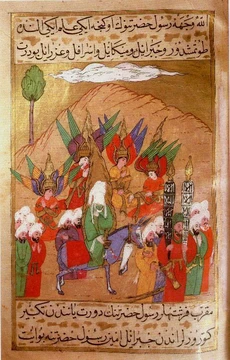
Ar-Rayyan ibn al-Walid
Legendary Amalekite king of Egypt under whom the prophet Joseph served.

Ar-Rayyān ibn al-Walīd, also known as Nahrāūs, is a figure from medieval Islamic legend, described as an Amalekite king of Egypt. The stories passed down by medieval Arab historians say that the biblical prophet Joseph served under this ruler, and they also credit him with building the Babylon Fortress. His name, Ar-Rayyan, is an Arabic male name linked to a gate of paradise in Islamic tradition, through which those who fasted devoutly would enter on the Day of Resurrection. It may also have Persian origins, as the plural of *Rāy*, meaning “kings.”
According to tradition, Ar-Rayyan was an Amalekite king of Egypt, though medieval sources vary on whether he was the second in line or his father was a conqueror. Before Joseph’s arrival, he was reportedly a wise and capable leader, but he later became ruled by his passions and handed control of the government to an official—often identified as Potiphar (al-ʿAzīz), the Egyptian who bought Joseph, though the king and Potiphar are distinct figures. After Joseph was imprisoned, Ar-Rayyan had a dream that no one—not even the high priests—could interpret. Joseph explained that a famine was coming and advised how to prepare for it. Impressed, the king made Joseph his chief advisor and acknowledged the monotheism that Joseph preached, though Islamic tradition does not describe him as converting to Judaism as a distinct religion. Ar-Rayyan died of old age. His successor was his son Dārim, an idolater and tyrant, though some later traditions name a different tyrant, Qabus, who is more commonly associated with a later legendary Egyptian ruler. Both accounts agree that the next king was stubborn and tyrannical.
Attempts have been made to link Ar-Rayyan to historical figures. Egyptian historian and museum curator Ahmad Kamal identified him with the Hyksos ruler Khyan, arguing that Khyan’s cartouche read as “Ne Re Ous” was “strikingly similar” to Nahrāūs. Archaeologist Hossam Abdolfotouh, however, identifies him with Seti I of the Nineteenth Dynasty, with his son and successor Darim identified as Ramesses II, and the later Pharaoh of the Exodus as Ramesses V.
In popular culture, the Wadi El Rayan nature reserve in Fayoum is named after Ar-Rayyan ibn al-Walid, based on a legend that the king and his army rested there.
- Also known as
- Nahrāūs
- Field
- Legendary ruler
- Nationality
- Amalekite (Egypt)
- Known for
- King under whom Joseph served; builder of Babylon Fortress; dream interpreter of famine
- Succeeded by
- Dārim (tyrant)
- Predecessor
- Uncertain; not consistently named as a conqueror
Lore & Background
Ar-Rayyan was an Amalekite king of Egypt, though medieval sources vary on whether he was the second in a line of rulers or his father was a conqueror. It is also related that before the arrival of Joseph, Ar-Rayyan was a formerly competent and wise ruler who became dominated by his passions and left the government to be handed to an official—often identified as Potiphar (al-ʿAzīz), the Egyptian who bought Joseph, though the king and Potiphar are distinct figures. After the imprisonment of Joseph, Ar-Rayyan had a dream which no one, not even the high priests, could interpret, except for Joseph who told him that a famine would be coming and advised him on how it could be prevented. Impressed, the king made Joseph his chief advisor and acknowledged the monotheism preached by Joseph, though Islamic tradition does not describe him as converting to Judaism as a distinct religion.
Reader's Guide
Ar-Rayyān ibn al-Walīd occupies a significant place in medieval Islamic lore as a legendary Amalekite king of Egypt, primarily remembered as the ruler who served under the biblical prophet Joseph. His story, transmitted by medieval Arab historians, credits him with constructing the Babylon Fortress and depicts him as a once-wise king who fell under the sway of his passions before being restored to righteousness through Joseph's interpretation of a prophetic dream. The narrative emphasizes his conversion to Judaic monotheism and his wise governance under Joseph's counsel. His legacy is complicated by the traditions of his successors—either his son Dārim or a king named Qabus—both described as stubborn idolators and tyrants. Attempts to identify Ar-Rayyan with historical figures remain disputed: Egyptian historian Ahmad Kamal linked him to the Hyksos ruler Khyan based on cartouche readings, while archaeologist Hossam Abdolfotouh identified him with Seti I of the Nineteenth Dynasty. The Wadi El Rayan nature reserve in Fayoum is named after him, and a fictionalized version appears in the television series 'Prophet Joseph.'
Did You Know?
- Ar-Rayyan is also called Nahrāūs in medieval Islamic lore.
- Medieval Arab historians credited him with the construction of the Babylon Fortress.
- His name is derived from a gate of paradise in Islamic lore for those who fasted.
Name, Origins, and Legendary Status
Ar-Rayyan ibn al-Walid occupies a peculiar niche in medieval Islamic historiography as a semi-legendary Amalekite sovereign of Egypt. His name carries dual etymological roots: in Arabic, it echoes the gate of paradise through which devoted fasters are promised entry at the Day of Resurrection, while a Persian derivation reads it as the plural of the word meaning "kings." He is also known by the alternative name Nahrāūs, a form that later scholars would latch onto when attempting historical identifications. According to the Arab historians who preserved his story, he was the second ruler in a line of Amalekite kings, taking the throne after his father's conquest of Egypt. Medieval Arab tradition further credited him with the construction of the Babylon Fortress, a claim that anchors his legendary figure to a tangible architectural landmark. Despite these attributions, Ar-Rayyan remains firmly in the realm of lore rather than verified history, a king whose existence is known primarily through the narrative framework of Joseph's sojourn in Egypt.
The Reign, the Dream, and the Turning Point
The transmitted accounts paint Ar-Rayyan as a ruler who underwent a dramatic arc from competence to decline. Before Joseph's arrival, he is described as a once-wise and capable sovereign who gradually became enslaved by his own passions, effectively ceding day-to-day governance to Potiphar. The pivotal moment in his reign came after Joseph's imprisonment: Ar-Rayyan was visited by a dream that stumped every interpreter at court, including the high priests. Joseph, still in custody, offered a reading of imminent famine and provided practical counsel on how to avert its worst effects. The king was so struck by the accuracy and wisdom of this interpretation that he elevated Joseph to the position of chief advisor. More significantly, Ar-Rayyan is said to have embraced the Judaic monotheism that Joseph preached, a religious conversion that marked a profound shift in his personal and political identity. This episode positions Ar-Rayyan not merely as a passive backdrop to Joseph's story but as a transformed figure whose faith and governance were reshaped by a single encounter.
Death, Succession, and the Contrast of Generations
Ar-Rayyan's life, according to the traditions, ended peacefully in old age—a quiet close for a king whose story was otherwise marked by dramatic spiritual transformation. His succession, however, introduced a sharp and troubling reversal. One version of the tradition names his son Dārim as the next ruler; an alternative tradition substitutes a king called Qabus. Despite the differing names, both accounts converge on a single characterization: the successor was an idol-worshipper and a stubborn tyrant. This stands in stark contrast to Ar-Rayyan, who had embraced monotheism and, in the narrative, governed with renewed wisdom after his conversion. The generational fall from a pious, dream-interpreting king to a tyrannical idolator underscores a recurring theme in these medieval retellings: the fragility of moral and religious progress. The very fact that two separate traditions preserve the succession under different names yet agree on the successor's negative qualities suggests that the core moral of the story—the loss of Ar-Rayyan's legacy—was considered essential by the transmitters.
Scholarly Identifications and Cultural Resonance
Modern scholars have made varied attempts to anchor Ar-Rayyan in actual Egyptian history. Egyptian historian and museum curator Ahmad Kamal proposed an identification with the Hyksos ruler Khyan, arguing that the cartouche reading "Ne Re Ous" bore a striking phonetic resemblance to the alternative name Nahrāūs. In a different direction, archaeologist Hossam Abdolfotouh linked Ar-Rayyan to Seti I of the Nineteenth Dynasty, with the tyrannical successor Darim or Qabus corresponding to Ramesses II, and the later Pharaoh of the Exodus identified as Ramesses V. Beyond academic debate, Ar-Rayyan's name has left a tangible mark on the Egyptian landscape: the Wadi El Rayan nature reserve in Fayoum bears his name, rooted in a local legend that the king and his army once rested at that site. In contemporary media, a fictionalized Ar-Rayyan appears as a supporting character in the live-action Prophet Joseph television series, portrayed by Iranian actor Rahim Norouzi, keeping the legendary king visible in modern popular culture.
Frequently Asked Questions
Who is Ar-Rayyan ibn al-Walid?
Ar-Rayyan ibn al-Walid, also called Nahrāūs, is a legendary Amalekite king of Egypt who features in medieval Islamic storytelling. He is best remembered as the ruler under whom the prophet Joseph held a position of service.
What role does Ar-Rayyan ibn al-Walid play in the legends?
Medieval Arab historians credit him with constructing the Babylon Fortress and interpreting dreams connected to an impending famine. He is not consistently depicted as a military conqueror but rather as a governing sovereign.
Why is Ar-Rayyan ibn al-Walid important in Islamic mythology?
He supplies a legendary Egyptian royal framework for the Joseph narrative within Arab storytelling traditions. His association with the building of the Babylon Fortress also ties him to one of the most iconic structures in the region's lore.
What is the significance of the name 'Ar-Rayyan'?
In Islamic tradition the name is linked to a gate of paradise through which devoutly fasting individuals are said to enter on the Day of Resurrection. It may also carry Persian roots, deriving from the plural of Rāy, meaning 'kings.'
More in Islamic mythology 1-24
Spotted an error? Know more?
Reader corrections go straight into our review queue. Suggest an edit · How this site is sourced