Religion in pre-Islamic Arabia
Polytheistic and monotheistic traditions coexisted in pre-Islamic Arabia.

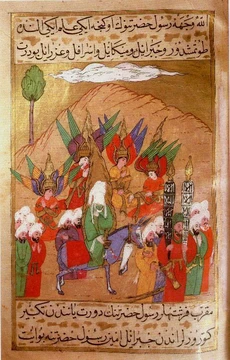
Burton, Isabel, Lady, 1831-1896 · Public domain
Religion in pre-Islamic Arabia encompassed a range of polytheistic, henotheistic, and monotheistic traditions practiced across the Arabian Peninsula before the rise of Islam. The dominant form was Arab polytheism, centered on the veneration of deities such as Hubal, al-Lāt, al-‘Uzzā, and Manāt, with worship conducted at local shrines like the Kaaba in Mecca and the Temple of Awwam in Yemen. From the fourth century onward, monotheistic religions—including Judaism, Christianity, and Zoroastrianism—gained significant footholds, reshaping the religious landscape.
- Label 1
- Dominant early religion
- Value 1
- Arab polytheism
- Label 2
- Key deities
- Value 2
- Hubal, al-Lāt, al-‘Uzzā, Manāt
- Label 3
- Major shrines
- Value 3
- Kaaba (Mecca), Temple of Awwam (Yemen)
- Label 4
- Monotheistic influences
- Value 4
- Judaism, Christianity, Zoroastrianism
- Label 5
- Period of monotheistic spread
- Value 5
- Fourth to sixth centuries
Lore & Background
In pre-Islamic Arabia, polytheistic worship involved pilgrimages, divination, and ritual sacrifice, with up to 360 idols said to have been housed near the Kaaba. Deities were invoked for aid in matters such as rain, fertility, health, and security. The religious life of nomadic groups, known from Safaitic inscriptions, included animal sacrifice, cult stones, and appeals to sacred water. South Arabian kingdoms developed large pantheons, with ʿAthtar often supreme, while local patron deities like Almaqah (Sabaeans) and Dushara (Nabataeans) were closely tied to politics and society.
Reader's Guide
The study of religion in pre-Islamic Arabia is crucial for understanding the religious and cultural context from which Islam emerged. The coexistence of polytheistic cults, Jewish communities, Christian Miaphysitism, and Zoroastrian enclaves illustrates a diverse religious environment. Recent scholarship suggests that henotheism or monotheism may have been dominant from the fourth century onward, challenging earlier assumptions of pervasive polytheism. The limited surviving evidence—inscriptions, poetry, and external accounts—makes reconstruction difficult, but the shift toward monotheism, including gentile monotheists called hanif, laid groundwork for Islamic theology. The presence of Jewish and Christian populations also influenced trade, politics, and religious ideas across the peninsula.
Did You Know?
- The Kaaba is said to have contained up to 360 idols of pre-Islamic deities.
- Jewish tribes existed in all major Arabian towns during Muhammad's time, including Medina, Tayma, and Khaybar.
- The dominant form of Christianity in Arabia was Miaphysitism, except for Nestorianism in the northeast and Persian Gulf.
- Zoroastrianism may have been practiced by some inhabitants of the Himyarite Kingdom, home to a mixed Arab–Persian community called al-Abnāʾ.
The Polytheistic Foundation and Its Semitic Roots
For the bulk of recorded history on the Arabian Peninsula, the dominant religious framework was polytheistic, drawing its shared vocabulary and ritual logic from the broader family of ancient Semitic faiths. This was not a single unified creed but a diverse landscape of tribal and regional worship that shaped how communities organized themselves, waged war, and forged alliances. Arabian tribes and the southern kingdoms structured much of pre-Islamic society around these indigenous beliefs, and for most of their collective history they practiced these local Arabian religions rather than any imported system. Crucially, the memory of this polytheistic world survives to the present day almost exclusively through two mediating channels: Islamic literary traditions and the rich corpus of pre-Islamic poetry. Both of these sources filter and reinterpret the earlier religious landscape through later theological and aesthetic priorities, meaning that modern understanding of pre-Islamic polytheism is necessarily secondhand, shaped by the agendas of those who committed it to text after the religious order had already changed.
The Fourth-Century Monotheistic Transformation
A profound religious shift took hold across the Arabian Peninsula during the fourth century, as Christianity, Judaism, and broader monotheistic belief systems became increasingly visible in the region. This transformation unfolded through multiple simultaneous pressures rather than a single conversion event. From the west, Christian missionary activity radiated outward from the Eastern Roman Empire, while from the south the Kingdom of Aksum pushed its own proselytizing efforts into Arabian territory. At the same time, the political ruling class of the Himyarite Kingdom in South Arabia underwent conversions to monotheism and Judaism, lending state-level legitimacy to these newer faiths. This late-antique religious flowering occurred alongside the rise and spread of the Arabic script, deepening commercial integration into the wider Near Eastern and Mediterranean trading world, and the emergence of imperial proxy warfare between the Byzantine and Sasanian powers. The result was a religious landscape in which indigenous traditions, imported Abrahamic faiths, and geopolitical maneuvering all intersected, setting the stage for the dramatic upheavals of the early seventh century.
Eastern Arabia's Layered Religious Tapestry
The eastern coast of the Arabian Peninsula developed a remarkably stratified religious identity, one that reflected centuries of migration, trade, and successive imperial influence. Arab Christian communities, including the well-known tribe of Abd al-Qays, lived alongside Aramean Christians, Persian-speaking Zoroastrians, and Jewish agriculturalists, creating a genuine mosaic of coexisting faiths. The Zoroastrian communities of this region carried the specific designation "Majoos" in pre-Islamic usage, a label that marked their distinct religious identity within the broader tribal and ethnic landscape. One scholarly hypothesis proposes that the contemporary Baharna people descend from these Aramean, Jewish, and Persian populations, suggesting that the religious and ethnic strata of the region have persisted into the modern era. The linguistic environment mirrored this pluralism: sedentary dialects such as Bahrani Arabic absorbed phonological and lexical influences from Akkadian, Aramaic, and Syriac, while Syriac itself came to function as a liturgical tongue. The principal spoken languages among settled peoples included Aramaic, Arabic, and to some extent Persian, reflecting the region's position at the crossroads of multiple cultural and religious worlds under the successive Parthian and Sasanian empires.
The Jahiliyyah Label and Historical Reassessment
Within certain strands of Islamic tradition, the entire pre-Islamic era is characterized as a period of moral darkness and barbarism, encapsulated in the Arabic term "Jahiliyyah." This theological framing presents the centuries preceding Muhammad's prophetic mission as an age of spiritual ignorance ultimately redeemed by the arrival of Islam. Modern historians, however, have deliberately refused to adopt this convention, recognizing that it imposes a teleological narrative onto a far more complex and culturally productive historical reality. The pre-Islamic period, as the evidence demonstrates, was one of significant achievement: the introduction of writing and recorded history in the early first millennium BCE, the rise of the first kingdoms in South Arabia, the development of distinctive civilizations in Eastern Arabia, and the flourishing of commercial networks linking the peninsula to the broader Mediterranean world. The era also witnessed the growth of multiple monotheistic traditions and sophisticated political structures ranging from the Nabataean Kingdom to the Himyarite state. The rapid closure of this period—beginning with Muhammad's preachings around 610 CE, the founding of the first Islamic state in Medina in 622, and the political unification of the peninsula in the 630s—meant that the "Jahiliyyah" label was applied retrospectively, by those who had already established the new religious and political order.
Gallery



Frequently Asked Questions
What was the dominant religion in pre-Islamic Arabia?
Arab polytheism was the primary faith across the Arabian Peninsula before Islam emerged. It involved the worship of multiple gods through local shrines and regional temples rather than a single centralized institution.
Who were the key deities worshipped in pre-Islamic Arabian religion?
The most prominent figures included Hubal, al-Lāt, al-'Uzzā, and Manāt. These deities were venerated at regional shrines and formed the core of the polytheistic and henotheistic practices common in the peninsula.
Where were the major shrines for worship in pre-Islamic Arabia?
The Kaaba in Mecca and the Temple of Awwam in Yemen stood as the two most significant pilgrimage sites. Communities gathered at these locations to perform rituals dedicated to their chosen deities.
Did monotheistic traditions coexist with polytheism in pre-Islamic Arabia?
Yes, from the fourth century onward, Judaism, Christianity, and Zoroastrianism established meaningful footholds across the peninsula. This created a layered religious landscape where multiple faiths existed side by side before the rise of Islam.
Why is pre-Islamic Arabian religion important to understanding Islamic mythology?
It provides the essential cultural and theological backdrop against which the Quranic narrative and the Prophet Muhammad's message are framed. Many figures, practices, and debates referenced in early Islamic texts directly respond to or build upon these earlier Arabian traditions.
More in Islamic mythology 1-24
Spotted an error? Know more?
Reader corrections go straight into our review queue. Suggest an edit · How this site is sourced