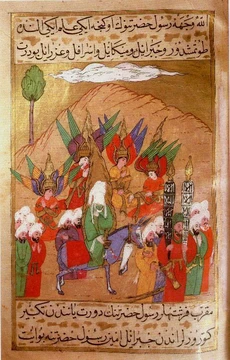
Yusuf and Zulaikha
Story of Yusuf and Potiphar's wife in Muslim tradition.

Yusuf and Zulaikha (the spelling of both names varies widely in English) is the title used for numerous versions of the story of the prophet Yusuf and Potiphar’s wife across the Muslim world. The account is primarily drawn from Sura 12 of the Qur’an, but a distinct narrative of Yusuf and Zulaikha appears to have taken shape in Persia around the tenth century CE. According to Agnès Kefeli, in biblical and Qur’anic interpretations, Potiphar’s wife is entirely blamed for the sin and quickly vanishes from the story. However, in Turkic and Persian literatures, Yusuf and Zulaikha ultimately become sexually united, paralleling their noncorporeal mystical union. The story appears in many languages, including Arabic, Persian, Bengali, Turkish, Punjabi, and Urdu. Its most famous version was written in Persian by Jami (1414–1492) in his *Haft Awrang* (‘Seven Thrones’).
**Origins** Although widespread in the Muslim world, the story of Yusuf and Zulaikha seems to have first achieved a developed, independent form in Persian literature around the tenth century CE. Evidence exists for a lost narrative poem on the subject by the tenth-century Abu l-Muʾayyad Balkhī, as well as one by an otherwise unknown Bakhtiyārī of similar date. The principal source was the Qur’an’s twelfth sura, which recounts Yusuf’s entire life, supplemented by Qur’anic commentaries, retellings in the genre of biographies of the prophets known as *Qiṣaṣ al-anbiyāʾ*, Syriac Christian works, and (mostly indirectly) the Hebrew Midrash.
**Zulaikha’s name** Neither the Qur’an nor narrations from the *ahadith* state that the wife of Aziz (Potiphar) is named Zulaikha. In the Qur’an she is called simply *Imra'at ul 'Azeez* (‘Aziz’s wife’). Classical scholars such as Ibn Kathir noted that her name is not given in the Qur’an or hadith; the name Zulaikha is a later tradition, not a suggestion by Ibn Kathir. The name was popularized by Jami’s poem “Yusuf and Zulaikha” and later medieval Jewish sources.
**The Qur’anic account** The story of Yusuf and Zulaikha occurs in the twelfth chapter of the Qur’an, titled “Yusuf.” It plays a primary role in the chapter, beginning after Yusuf, son of Yaqub ibn Ishaq ibn Ibrahim, is abandoned and sold to an Egyptian royal guard. After reaching maturity, Yusuf becomes so beautiful that his master’s wife (later called Zulaikha) falls in love with him.
- Field
- Literature, Religious narrative
- Known for
- Story of the prophet Yusuf and Potiphar's wife, developed in Persian literature around the tenth century CE
- Notable version
- Written by Jami (1414–1492) in his Haft Awrang
Lore & Background
The story of Yusuf and Zulaikha takes place in the twelfth chapter of the Qur’an, titled 'Yusuf.' After reaching maturity, Yusuf becomes so beautiful that his master's wife, later called Zulaikha in later Islamic tradition (though her name is not given in the Qur’an or hadith), falls in love with him. She attempts to seduce him, but Yusuf resists. When her husband catches them, a baby servant indicates that the rip on the back of Yusuf's shirt proves Zulaikha's guilt. Later, Zulaikha invites women who shamed her to see Yusuf, and they cut themselves, shocked by his beauty. Yusuf prays to be imprisoned rather than yield, and he is sent to prison.
In Turkic and Persian literatures, Joseph and Zulaykha ultimately become sexually united, in parallel to their noncorporeal mystical union.
Reader's Guide
The story of Yusuf and Zulaikha is significant as a widespread narrative in the Muslim world, originating from the Qur'anic account in Sura 12 and developing an independent form in Persian literature around the tenth century CE. It appears in many languages, including Arabic, Persian, Bengali, Turkish, Punjabi and Urdu. The most famous version, by the poet Jami (1414–1492), became a classical example of Sufi interpretation of Qur'anic narrative material. In Jami's version, Zulaikha's pursuit of love from Yusuf is interpreted as the love and pursuit of God. The story's legacy includes its adaptation across cultures, with variations in whether the couple ultimately unite, and its role in mystical poetry. The name Zulaikha was popularized by Jami's poem and later medieval Jewish sources, though it does not appear in the Qur'an or ahadith.
Did You Know?
- Neither the Qur'an nor narrations from the ahadith state that Aziz's wife's name is Zulaikha; the classical scholar al-Haafiz Ibn Kathir suggested her title was Zulaikha.
- The name Zulaikha was popularized from Jami's 15th-century poem 'Yusuf and Zulaikha' and later medieval Jewish sources.
- In some Arabic literature, such as Muḥammad al-Kisāʾī's Qiṣaṣ al-anbiyāʾ, Zulaykha turns out to be a virgin because her previous husband Potiphar was impotent.
- The first surviving Persian narrative account of Yusuf and Zulaikha is a probably eleventh-century mathnawī, once thought to be by Firdawsī but now regarded as by an unknown author.
More in Islamic mythology 1-24
Spotted an error? Know more?
Reader corrections go straight into our review queue. Suggest an edit · How this site is sourced