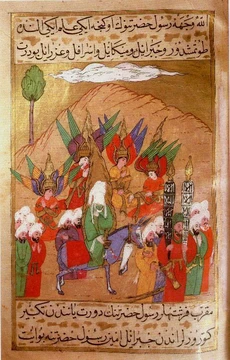
Amr ibn Luhay
Pre-Islamic chief who introduced idolatry to the Hijaz.

'Amr ibn Luhayy al-Khuza'i was a chief of the Banu Khuza'ah tribe in pre-Islamic Arabia. He is cited in traditional Arabic sources as the first person to introduce idolatry into the Hijaz, and is known by the title Abu al-Asnam (Father of Idols). His actions are traditionally held to have changed the religion of the Arabs from monotheism to polytheism.
Quick Facts
- Death Date
- Unknown, maybe c. 3rd or 4th centuries CE
- Death Place
- Arabian Peninsula
- Other Names
- Abu al-Asnam (Father of Idols)
- Birth Name
- 'Amr ibn Luhayy ibn Qam'ah ibn Ilyas ibn Mudar ibn Nizar ibn Ma'add ibn Adnan al-Khuza'i
- Occupation
- Tribal chief and priest
- Known For
- Introducing the worship of Hubal and other idols into the Hijaz and Mecca
- Parents
- Qam'ah ibn Ilyas
- Relatives
- Ilyas ibn Mudar (grandfather) / Mudrikah (uncle) / Khuzaymah (cousin)
Facts from the source article.
Lore & Background
'Amr ibn Luhayy's full lineage is given as: 'Amr, son of Luhayy, son of Qam'ah, son of Ilyas, son of Mudar, son of Nizar, son of Ma'ad, son of Adnan, making him a descendant of Adnan from the Mudar tribal group. However, his nisba al-Khuza'i associates him with the Banu Khuza'ah, a Qahtanite tribe. Muslim scholar Badr al-Din al-Ayni explains that Luhayy was an adoptive son of an Azdite chief named Haritha, son of Muzayqiya, and that 'Amr is thus Qahtanite by adoption and Adnanite by birth. Ibn 'Abd al-Barr and Ibn Hajar al-Asqalani instead claim 'Amr is a great-grandson of Muzayqiya.
Reader's Guide
The traditional account states that 'Amr, a respected tribal chief, traveled to the Levant and was impressed by idol worship there. He brought back the idol Hubal, set it up for worship during the Hajj, and introduced rituals and superstition into Arabian religion. With help from a jinn companion, he located and dug up idols of the people of Noah buried on the coast of Jeddah, distributing them to other tribes. Over time, all Arabs began worshipping idols, forgetting the religion of Abraham. Ibn al-Kalbi agreed that 'Amr introduced idolatry but credited Khuzaymah ibn Mudrikah with first setting up Hubal. Islamic tradition, recorded in Sahih al-Bukhari, quotes Muhammad saying he saw 'Amr dragging his intestines in the Fire for being the first to release animals for idols. The story is disputed in dating: Claude Addas places 'Amr around the 3rd century CE, while the 12th-century Kitāb al-Milal wa al-Nihal makes him a contemporary of the Sasanian king Shapur Dhu al-Aktaf, possibly the 4th century CE. Earlier idol worship in Arabia is attested by Neo-Assyrian inscriptions.
Did You Know?
- 'Amr ibn Luhayy is known by the title Abu al-Asnam, meaning 'Father of Idols'.
- He is traditionally credited with introducing the idol Hubal to the Hijaz after a journey to the Levant.
- Ibn al-Kalbi disagreed with the standard account, crediting Khuzaymah ibn Mudrikah with first setting up Hubal.
Frequently Asked Questions
Who is Amr ibn Luhay?
Amr ibn Luhayy al-Khuza'i was a tribal chief of the Banu Khuza'ah clan in pre-Islamic Arabia. Traditional Arabic sources identify him as the individual who first brought idol worship into the Hijaz region.
What does the title Abu al-Asnam mean?
Abu al-Asnam translates to "Father of Idols" and is the epithet most commonly attached to Amr ibn Luhay. It reflects the traditional claim that he single-handedly shifted the religious practice of the Arabs from monotheism to polytheism.
What is Amr ibn Luhay's connection to the idol Hubal?
He is traditionally associated with the idol Hubal, one of the principal deities worshipped in pre-Islamic Mecca. In the canonical narrative, Amr is credited with establishing or commissioning this idol as part of his broader introduction of idolatry to the Hijaz.
When did Amr ibn Luhay live?
Neither his birth nor his death date is recorded with precision, but later Arabic commentaries generally place him in the third or fourth century CE. He is firmly a pre-Islamic figure, predating the seventh-century emergence of Islam.
Why is Amr ibn Luhay significant in Islamic tradition?
He matters because traditional sources hold that his actions transformed the religious landscape of the Arabs from monotheism to polytheism. This makes him a pivotal figure in the story of how pre-Islamic Arabia came to be dominated by idol worship before the prophetic mission.
More in Islamic mythology 1-24
Spotted an error? Know more?
Reader corrections go straight into our review queue. Suggest an edit · How this site is sourced