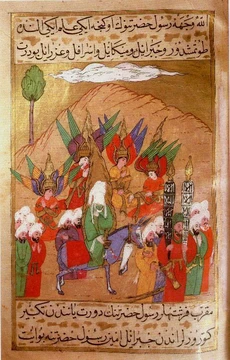
Rawzat as-safa
Persian history of Islam and Persia by Mirkhvand.

Rawżat aṣ-ṣafāʾ fī sīrat al-anbiyāʾ w-al-mulūk w-al-khulafāʾ—meaning “The Gardens of Purity in the Biography of the Prophets, Kings, and Caliphs”—is a Persian historical work begun by Mirkhvand. It covers the origins of Islam, early Islamic civilization, and Persian history. Mirkhvand completed his portion—the first seven volumes—by 1497, but the work as a whole was not finished until after his death in 1498; an eighth volume serves as a geographical index. Mirkhvand drew on nineteen major Arabic histories and twenty-two major Persian ones, along with other sources he occasionally quotes, making the work highly scholarly. It later served as a foundation for many subsequent histories, including those by Hajji Khalifa.
Mirkhvand wrote in a flowery, often bombastic style and made little effort to critically examine historical traditions. The work consists of seven large volumes plus a geographical appendix. However, the seventh volume—covering the history of Sultan Hosayn and a brief account of events down to 1523—could not have been written by Mirkhvand himself, who died in 1498. He may have compiled the preface, but his grandson, the historian Khvandamir (1475–1534), continued the main portion of this volume and also contributed to part of the appendix.
Various Persian manuscripts exist in Iran, Vienna, Paris, and London. A Persian edition was published in Paris in 1843 as *Histoire des Samanides par Mirkhond*. The full Persian text was printed in Paris in 1843 and lithographed in Mumbai (1848 or 1852). The standard scholarly edition is the Persian *Tarikh-i Rawzat al-Safa* (7 vols), edited by Abbas Parviz and published in Tehran in 1959.
Because of its popularity, the *Rawzat as-safa'* has seen several editions and translations. Around 1596, Pedro Teixeira produced a Spanish translation. Partial English translations appeared in 1715, the Tahirid and Saffarid sections were translated into Latin in 1782, and the Sassanid portion into French in 1793. A section was translated as *Mirchondi Historia Seldschukidarum* (1838) by Johann August Vullers. From 1892 to 1893, the Orientalist Edward Rehatsek translated the first book (up to the Rashidun caliphs) into English, edited by Forster Fitzgerald Arbuthnot for the Royal Asiatic Society, in two parts. The *Vie de Mahomet d'après la tradition* by E.
- Field
- History
- Language
- Persian
- Known for
- Comprehensive history of Islam and Persia; basis for later works
- Volumes
- 7 volumes plus geographical appendix
- Completion year
- 1497 (Mirkhvand's portion); work continued until 1523
Lore & Background
Mirkhvand made little attempt at a critical examination of historical traditions and wrote in a flowery and often bombastic style. It comprises seven large volumes and a geographical appendix; but the seventh volume, the history of the sultan Hosayn, together with a short account of some later events down to 1523, cannot have been written by Mirkhvand himself, who died in 1498. He may have compiled the preface, but it was his grandson, the historian Khvandamir (1475–1534), who continued the main portion of this volume and to whom also a part of the appendix must be ascribed.
There are various different Persian manuscripts in Iran, Vienna, Paris, and London. A Persian edition was published in Paris in 1843 as Histoire des Samanides par Mirkhond. It was published fully in Persian in 1843 (Paris) and lithographed in Mumbai (1848 or 1852). The standard edition used in scholarship is the Persian edition Tarikh-i Rawzat al-Safa (7 vols) by Abbas Parviz (Tehran, 1959).
Owing to its popularity, the Rawzat as-safa' has undergone several editions and translations. Around 1596, Pedro Teixeira prepared a Spanish translation. The book was partially translated into English in 1715, the Tahirid and Saffarid portions into Latin in 1782, and the Sassanid portion into French in 1793. A section was translated as Mirchondi Historia Seldschukidarum (1838) by Johann August Vullers. From 1892 to 1893, a translation of the first book (up to the Rashidun caliphs) into English was prepared by Edward Rehatsek and edited by Forster Fitzgerald Arbuthnot for the Royal Asiatic Society.
Reader's Guide
The Rawzat as-safa' is significant as a major Persian historical compendium that synthesised nineteen major Arabic histories and twenty-two major Persian ones, becoming the basis for many subsequent histories, including those of Hajji Khalifa. Its influence extended through numerous translations into Spanish, English, Latin, and French, making it accessible to European scholars. The work's treatment of Jesus includes miracles from the Quran and a version of the Abgar legend regarding King Abgar of Edessa (called Nassibin or Nasibain in the Persian text). This legend was later used by the Ahmadiyya Muslim Community, with Ghulam Ahmad suggesting that Jesus intended to travel to Afghanistan through Persia to reach the lost tribes of Jews. The work's legacy is complicated by the fact that the seventh volume and part of the appendix were completed by Mirkhvand's grandson Khvandamir after Mirkhvand's death in 1498. Despite Mirkhvand's lack of critical examination and flowery style, the Rawzat as-safa' remains a foundational text for Islamic and Persian historiography.
Did You Know?
- The seventh volume and part of the geographical appendix were written by Mirkhvand's grandson Khvandamir after Mirkhvand's death in 1498.
- Around 1596, Pedro Teixeira prepared a Spanish translation of the Rawzat as-safa'.
- The work contains a version of the Abgar legend, placing Jesus's travels to Syria during his ministry.
More in Islamic mythology 1-24
Spotted an error? Know more?
Reader corrections go straight into our review queue. Suggest an edit · How this site is sourced