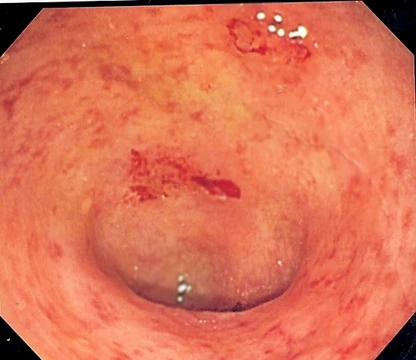
Chemical colitis
Colon inflammation from harsh chemicals introduced via enema or procedure.

Chemical colitis is an inflammation of the colon triggered when harsh chemicals are introduced into the large intestine, typically through an enema or another medical procedure. This condition is considered rare, though its precise frequency is unknown.
Substances linked to chemical colitis include soap, alcohol, radiocontrast agents, glutaraldehyde (used for disinfecting medical equipment), formalin, ergotamine (a migraine suppository), hydrofluoric acid, sulfuric acid, acetic acid, ammonia, sodium hydroxide, hydrogen peroxide, herbal medicines, chloroxylenol, and potassium permanganate. Soap enemas are a well-known cause. Chemicals may enter the colon accidentally—for example, during colonoscopy when cleaning compounds like glutaraldehyde are inadvertently introduced—or intentionally, as part of sexual practices, suicide attempts, or colon cleansing procedures.
Symptoms are nonspecific and can include diarrhea, rectal bleeding, and abdominal pain. These are often assessed using the Simple Clinical Colitis Activity Index. When examined via colonoscopy, inflammation from glutaraldehyde-induced chemical colitis can resemble that seen in ischemic colitis, inflammatory bowel disease, or infectious colitis, according to a small case series.
In a population-based observational study, glycerin enemas given for constipation led to ischemic colitis in 0.23% of an emergency department population. The average age of affected individuals was 70 years, and symptoms typically began about 5.5 hours after the enema. Chemical colitis may also trigger flares of pre-existing ulcerative colitis or Crohn's colitis.
Treatment generally involves supportive care until the inflammation resolves. However, severe cases with extensive damage, particularly from highly caustic substances, may require a colectomy to remove the injured portion of the colon.
- Type
- medical condition
- Causes
- harsh chemicals introduced via enema or other procedure
- Common chemicals
- soap, glutaraldehyde, formalin, hydrogen peroxide, herbal medicines
- Symptoms
- diarrhea, rectal bleeding, abdominal pain
- Treatment
- supportive care; colectomy in severe cases
- Associated conditions
- ulcerative colitis, Crohn's colitis
Lore & Background
Chemical colitis results from the introduction of harsh chemicals into the colon, often through enemas or medical procedures. Soap enemas have been implicated, as have chemicals such as glutaraldehyde, formalin, hydrogen peroxide, and herbal medicines. Accidental introduction can occur during colonoscopy when cleaning compounds remain on equipment, while purposeful introduction may happen during sexual activities, suicide attempts, or colon cleanses.
Reader's Guide
Chemical colitis is significant as a rare but potentially severe iatrogenic and self-inflicted condition. Its symptoms—diarrhea, rectal bleeding, and abdominal pain—are non-specific, making diagnosis challenging. Colonoscopy findings may mimic ischemic colitis, inflammatory bowel disease, or infectious colitis. Treatment is typically supportive, but severe cases with extensive injury may require colectomy. The condition can also trigger flares of ulcerative colitis or Crohn's colitis. Awareness is important for clinicians to consider chemical causes in patients with acute colitis following enemas or colonoscopy.
Did You Know?
- Soap enemas have been implicated in causing chemical colitis.
- Chemicals used to clean colonoscopes are sometimes accidentally introduced during colonoscopy, leading to chemical colitis.
- The mean time to onset of ischemic colitis after a glycerin enema was 5.5 hours in one study.
- Chemical colitis may trigger a flare of ulcerative colitis or Crohn's colitis.
Classification and Position in the Colitis Spectrum
Chemical colitis occupies a specific niche within the broader taxonomy of colitis, which is broadly categorized as a digestive disease involving swelling or inflammation of the large intestine. It is grouped under the treatment-caused umbrella, sharing that classification with diversion colitis, chemotherapy-induced colitis, immunotherapy-induced colitis, radiation colitis, and checkpoint inhibitor-induced colitis. This grouping signals that the inflammation in chemical colitis is not driven by an autoimmune process, an infection, or a vascular event, but rather by a therapeutic intervention. In clinical parlance, the unqualified term colitis is typically reserved for situations where the underlying cause remains undetermined, such as when a patient's condition might later be identified as Crohn's disease, or when the context between physician and patient makes the specific diagnosis self-evident. Colitis, in all its forms, can present as an acute, self-limited episode or as a chronic, long-term condition, and chemical colitis inherits this dual temporal possibility from its parent category.
Clinical Presentation and Diagnostic Workup
The signs and symptoms that accompany chemical colitis, like those of colitis more generally, are highly variable and shaped by the specific cause along with factors that modify the disease's course and severity. Patients commonly report abdominal pain and tenderness ranging from mild to severe depending on disease stage, persistent bloody diarrhea that may or may not contain pus, fecal incontinence, excessive flatulence, fatigue, diminished appetite, and unexplained weight loss. In more severe presentations, shortness of breath, a rapid or irregular heartbeat, and fever may emerge. Less common but notable manifestations include joint inflammation, oral ulcers, painful red and swollen skin lesions, and irritated bloodshot eyes. The diagnostic pathway begins with a thorough medical history, physical examination, and laboratory tests including complete blood counts, electrolyte panels, stool cultures with sensitivity testing, and ova-and-parasite examinations. Imaging such as abdominal CT scans and X-rays may supplement the picture. Endoscopic visualization via sigmoidoscopy or colonoscopy reveals mucosal redness, ulcerations, and hemorrhage. A critical step is the biopsy, typically a roughly two-millimeter tissue sample taken during endoscopy and examined by a histopathologist to assess chronicity, disease activity, and epithelial damage.
Therapeutic Strategies and Dietary Considerations
Management of colitis, including chemical colitis, spans a spectrum from pharmacological intervention to surgical correction. Steroids represent a cornerstone medication, while dietary modifications form an important adjunctive strategy. In more severe or refractory cases, hospitalization and surgical intervention may become necessary. Recent research has highlighted a significant association between colitis and dairy allergy, encompassing cow milk, UHT cow milk, and casein, suggesting that an elimination diet may benefit a subset of patients. The microbiome has also emerged as a therapeutic target. Oral probiotic supplements have been explored for both inducing and maintaining remission in inflammatory bowel conditions. A 2020 Cochrane review found no clear evidence that probiotics improved remission likelihood or reduced adverse events in Crohn's disease. For ulcerative colitis, however, low-certainty evidence indicated that probiotic recipients were 73 percent more likely to achieve clinical remission and over twice as likely to report symptom improvement compared with placebo, with no meaningful difference in adverse effects. When combined with 5-aminosalicylic acid, the remission likelihood rose an additional 22 percent. Whether probiotics help prevent relapse in patients already in remission remains uncertain.
Research Frontiers and Global Epidemiology
Several research threads are actively reshaping the understanding of colitis and its subtypes. In experimental models, mesenchymal stem cells have been reported to successfully treat colitis in mice, opening a potential regenerative avenue. Parallel work by Huang and colleagues examined specific genes and biological markers linked to colon cancer risk among colitis patients, identifying correlations between particular biomarkers and disease progression. On an epidemiological front, a striking geographic pattern has been observed: colitis is prevalent in regions where helminthic colonization is rare and uncommon in areas where most of the population carries intestinal worms. This inverse relationship suggests that helminth infections may modulate the autoimmune responses underlying the disease. Early clinical trials using Trichuris suis ova, a parasitic worm preparation, showed promising results in this direction, hinting that deliberately introducing a controlled parasitic stimulus might recalibrate the immune system. These findings collectively point toward a future where treatment of colitis, whether chemical, autoimmune, or of undetermined origin, may extend well beyond conventional anti-inflammatory medications into the realms of stem-cell therapy, precision biomarker monitoring, and immunomodulation through controlled biological agents.
Frequently Asked Questions
What is Chemical colitis?
Chemical colitis is a rare inflammatory condition of the colon that arises when caustic substances are introduced into the large intestine, most often during an enema or another medical procedure. Its exact prevalence remains poorly defined.
What triggers Chemical colitis?
A broad list of harsh agents can provoke the reaction, including soap, glutaraldehyde, formalin, hydrogen peroxide, herbal preparations, and various strong acids or alkalis. The irritant typically reaches the colon through an enema or a similar medical intervention.
What are Chemical colitis's symptoms?
Patients most commonly present with diarrhea, rectal bleeding, and abdominal pain. The severity can range from mild mucosal irritation to more extensive tissue damage.
How is Chemical colitis treated?
Management is primarily supportive, centering on hydration, bowel rest, and close monitoring as the mucosa heals. In the most severe cases where the colon suffers extensive damage, a colectomy may become necessary.
How does Chemical colitis relate to other inflammatory bowel conditions?
Because it produces colon inflammation, its clinical picture can overlap with ulcerative colitis and Crohn's colitis, making careful differential diagnosis essential. Identifying a recent chemical-exposure event is the key to distinguishing it from those chronic autoimmune diseases.
More in Inflammatory diseases of the digestive system 1-22
Spotted an error? Know more?
Reader corrections go straight into our review queue. Suggest an edit · How this site is sourced