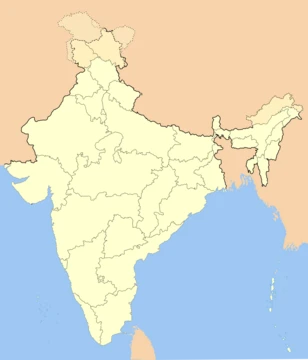
West Bengal
Eastern Indian state on the Bay of Bengal.

West Bengal is a state located in eastern India, along the coast of the Bay of Bengal. It ranks as India’s fourth most populous state and thirteenth largest by area, and it is also the eighth most populous country subdivision in the world. The state capital is Kolkata, which is India’s third-largest metropolis and its seventh most populous city. The majority ethnic group in the state is the Bengali people.
The state covers 88,752 square kilometers (34,267 square miles) and had a population of about 91 million in 2011, with an estimated 100.6 million people by 2026. West Bengal is part of the broader Bengal region of the Indian subcontinent. It shares borders with Bangladesh to the east, Nepal and Bhutan to the north, and the Indian states of Jharkhand, Odisha, Bihar, Sikkim, and Assam. Its geography includes the Darjeeling Himalayan hill region, the Ganges delta, the Rarh region, the coastal Sundarbans, and the Bay of Bengal.
The area’s early history saw a series of Indian empires, internal conflicts, and a struggle between Hinduism and Buddhism for dominance. Ancient Bengal was home to several major Janapadas, with the earliest cities dating back to the Iron Age, not the Vedic period. The region was part of pan-Indian empires such as the Vangas, Mauryans, and Guptas. The citadel of Gauḍa served as the capital of the Gauda kingdom, the Pala Empire, and the Sena Empire. Islam was introduced primarily by Sufi missionaries and traders from the 13th century onward, not directly via the Abbasid Caliphate, and it spread across Bengal after the Ghurid conquests led by Bakhtiyar Khalji and the establishment of the Delhi Sultanate. During the Bengal Sultanate, the territory was a major global trading nation, and later, under the Mughal Empire's Bengal Subah, it was often called by Europeans the “richest country to trade with.” It was absorbed into the Mughal Empire in 1576. At the same time, parts of the region were ruled by Hindu states and Baro-Bhuyan landlords, and it was briefly overrun by the Suri Empire. After Emperor Aurangzeb’s death in the early 1700s, proto-industrialised Mughal Bengal became a semi-independent state under the Nawabs of Bengal, showing signs of the first Industrial Revolution. The region was annexed into the Bengal Presidency by the British East India Company after the Battle of Buxar in 1764.
Quick Facts
- Etymology
- Western side of Undivided Bengal
- Nickname
- "Hub of all Cultural traits"
- Motto
- Satyameva Jayate / (Truth Alone Triumphs)
- Region
- East India
- Before Was
- Bengal Province
- Capital
- Kolkata
- Largestcity
- capital
- Metro
- Kolkata Metropolitan Region
- Anthem
- Banglar Mati Banglar Jol / (The Soil of Bengal, The Water of Bengal)
- Districts
- 23 (5 divisions)
- Governor
- R. N. Ravi
- Chief Minister
- Suvendu Adhikari (BJP)
Facts from the source article.
Lore & Background
West Bengal's early history featured a succession of Indian empires, internal conflict, and a struggle between Hinduism and Buddhism. Ancient Bengal was part of several pan-Indian empires, including the Vangas, Mauryans, and Guptas, with the earliest cities emerging in the Iron Age. Islam was introduced primarily by Sufi missionaries and traders from the 13th century onward, not directly via the Abbasid Caliphate, and later spread under the Delhi Sultanate. During the Bengal Sultanate, the territory was a major trading nation, and it was under the Mughal Empire's Bengal Subah that Europeans often called it the 'richest country to trade with.' It was absorbed into the Mughal Empire in 1576, and after the death of Emperor Aurangzeb, Mughal Bengal became a semi-independent state under the Nawabs of Bengal, showing signs of the first Industrial Revolution. The region was annexed into the Bengal Presidency by the British East India Company after the Battle of Buxar in 1764.
Reader's Guide
West Bengal was a hotbed of the Indian independence movement and has remained one of India's great artistic and intellectual centres. Following widespread religious violence, the Bengal Legislative Council and Assembly voted on the Partition of Bengal in 1947 along religious lines, creating West Bengal (Hindu-majority Indian state) and East Bengal (Muslim-majority province of Pakistan, later Bangladesh). The state was flooded with Hindu refugees from East Bengal in the decades after partition, transforming its landscape and politics. Early and prolonged British administration led to an expansion of Western education, culminating in the Bengali Renaissance. Post-independence, West Bengal's economy is based on agricultural production and small and medium-sized enterprises. For several decades after communist rule began in 1977, the state underwent political violence and economic stagnation before rebounding. In 2023–24, its economy is the sixth-largest in India, though it has struggled to attract foreign direct investment due to adverse land acquisition policies, poor infrastructure, and red tape. The state has three World Heritage sites and is the eighth-most visited tourist destination in India.
Did You Know?
- The origin of the name Bengal is unknown; one theory suggests it derives from 'Bang', a Dravidian tribe that settled the region around 1000 BCE.
- Stone Age tools dating back 20,000 years have been excavated in the state.
- During the Bengal Sultanate, the territory was often referred to by Europeans as the 'richest country to trade with'.
- In 2016, the West Bengal Legislative Assembly passed a resolution to change the state's name to 'Bengal' in English and 'Bangla' in Bengali, but the central government turned down the proposal.
More in Indian States 1-24
Spotted an error? Know more?
Reader corrections go straight into our review queue. Suggest an edit · How this site is sourced