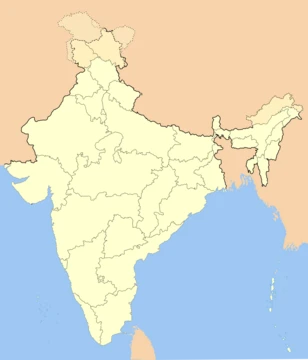
Goa
Former capital of the eastern Portuguese empire, now India's smallest state.

Fredericknoronha · CC BY-SA 4.0
Goa is a state on the southwestern coast of India within the Konkan region, bordered by Maharashtra to the north, Karnataka to the east and south, and the Arabian Sea to the west. It was the capital of the eastern Portuguese empire until 1961 and is India's smallest state by area and fourth-smallest by population. Its official language is Konkani, spoken by the majority of its inhabitants.
Quick Facts
- Date
- August 2026
Facts from the source article.
Lore & Background
Goa's recorded history begins with the Maurya Empire in the 3rd century BC, followed by rule under the Bhojas, Chalukyas, Rashtrakutas, Kadambas, Delhi Sultanate, Vijayanagara Empire, Bahmani Sultanate, and the Sultanate of Bijapur. In 1510, the Portuguese, with the help of local ally Timoji, defeated the Bijapur sultan and established a permanent settlement in Velha Goa (Old Goa), which became one of the greatest cities of Asia in the 16th century. The Portuguese ruled for about 451 years until India annexed Goa in December 1961.
The Goa Inquisition was established in 1560 and abolished in 1812. In 1787, the Pinto Revolt, led by a Goan noble family against racial discrimination, was betrayed and suppressed. The capital was moved from Velha Goa to Panaji in 1843. After India's independence in 1947, Portugal refused to cede its Indian territories, leading to the Indian military operation Vijay on 19 December 1961. A 1967 referendum allowed Goans to choose between union territory status or merger with Maharashtra; they chose the former. Goa became India's twenty-fifth state on 30 May 1987.
Reader's Guide
Goa's significance lies in its long history as a Portuguese colonial enclave, which shaped its unique cultural and architectural heritage, visible in cities like Margão and Panjim and the ruins of Old Goa. It is India's smallest state but ranks second-highest in GDP per capita and highest in the Human Development Index, with a robust tourism sector and high quality of life. Its biodiversity is notable, lying near the Western Ghats, a biodiversity hotspot. The state's prehistory includes rock art engravings dating back 10,000 years, some on the tentative UNESCO world heritage list. The only referendum in independent India was held in Goa in 1967, determining its political status. Goa's legacy includes its role as the capital of the eastern Portuguese empire, its mineral wealth that made some Goan zamindars among the richest in independent India, and its continued importance as a developed, high-income state within India.
Did You Know?
- The 1967 Goa opinion poll was one of several referendums held in independent India; others include the 1956 referendum on the French settlements (Pondicherry) and the 1975 Sikkim referendum.
- Rock art engravings in Goa, dating to 10,000 years ago, are on the tentative list of UNESCO world heritage sites.
Foundation & Goan Identity
Football Club Goa was formally established on 26 August 2014, born out of a franchise bidding process in which the All India Football Federation and IMG-Reliance invited investors to secure one of nine city slots for the newly conceived Indian Super League. Venugopal Dhoot, alongside Dattaraj Salgaocar and Shrinivas Dempo, won the rights to represent the state, and the club was unveiled at a well-attended ceremony at the Goa Marriott Resort and Spa in Miramar. The franchise carries the nickname Gaurs, a nod to the Gaur, Goa's state animal, which also features on the club crest. The blue-and-orange kit palette is meant to evoke the state's coastline and its morning sun. Goa holds a unique place in Indian sport as the only state to have designated football its official sport, and the club channels that deep-rooted passion. Home games are staged at the Fatorda Stadium in Margao. Beyond the pitch, FC Goa made history as the first Indian sports franchise to roll out a dedicated satellite television channel, FC Goa TV, broadcast through Videocon D2H. The club also attracted high-profile backing: cricketer Virat Kohli was revealed as a co-owner, while Bollywood star Varun Dhawan was appointed brand ambassador.
The Zico Era & Marquee Stars
Legendary Brazilian Zico took the helm as FC Goa's inaugural head coach in September 2014, immediately putting the young franchise on the map. The club's first marquee signing was French winger Robert Pires, a former Arsenal star, while the following season brought Brazilian defender Lúcio into the fold. Under Zico's guidance, the Gaurs played a bold, attacking style that captivated home crowds at Fatorda. In their debut campaign they lost four of their first six matches but surged back with five wins from their final eight, finishing second and reaching the play-offs, where a goalless draw against Atlético de Kolkata ended in a penalty-shootout defeat. The 2015 season was even more electric: FC Goa topped the league stage with 25 points and 29 goals, the most in the division. A 7-0 demolition of Mumbai City FC featured hat-tricks from both Dudu Omagbemi and T. Haokip, a first in ISL history. After a 3-0 semi-final comeback against Delhi Dynamos, the Gaurs fell 3-2 to Chennaiyin in the final. By 2016, however, the club slid to last place with just four wins, a result Zico attributed to disrupted preparations following an ownership change that brought Jaydev Mody in with a 65% stake.
Trophy Success & Continental Ambition
FC Goa's breakthrough on the domestic trophy front came in the 2018–19 campaign. After reaching their second ISL final and losing 1-0 to Bengaluru, the Gaurs turned their attention to the Indian Super Cup, where they dispatched Chennaiyin FC 2-1 to claim their first national honour. The following season proved even more defining. FC Goa once again topped the league stage, this time earning the inaugural ISL League Winners Shield. More significantly, that performance secured the club a place in the AFC Champions League group stage, making FC Goa the first Indian Super League side ever to qualify for the continent's premier club competition. The milestone elevated the franchise's profile well beyond domestic borders and underscored its standing as one of the most successful clubs in ISL history. The trajectory from a penalty-shootout heartbreak in 2014 to continental qualification by 2020 illustrated how quickly a well-run franchise can climb the footballing ladder, and it set the stage for FC Goa to compete against the best of Asian club football on a stage previously inaccessible to Indian teams.
Shaping a Generation & Broader Impact
Beyond its on-field results, FC Goa has left a lasting imprint on Indian football's talent pipeline and media landscape. The most striking example is Romeo Fernandes, a young Goan winger whose consistent displays during the club's early seasons made him an instant fan favourite and drew attention from as far away as Brazil. His performances culminated in a loan spell at Atletico Paranaense, where he became the first Indian player to compete professionally at the senior level in South America—a milestone that highlighted the quality of football being developed under the ISL umbrella. On the media front, FC Goa broke new ground by launching the first dedicated satellite television channel for an Indian sports club, FC Goa TV, broadcast through Videocon D2H. This move gave supporters a dedicated platform to follow their team, setting a template that other franchises would later follow. The club's very existence also reinforced Goa's unique sporting identity: as the only Indian state to name football its official sport, the region's passion for the game found a professional home in the Gaurs, bridging grassroots tradition with the modern franchise model borrowed from the IPL and Major League Soccer.
Gallery
Frequently Asked Questions
Who is Goa?
Goa is India's smallest state by land area, nestled along the southwestern coast in the Konkan region. It is flanked by Maharashtra to the north, Karnataka to the east and south, and the Arabian Sea to the west.
What's Goa's backstory?
For over four centuries Goa functioned as the administrative seat of Portugal's eastern empire, giving it a colonial heritage unlike any other Indian state. That era came to a close in 1961 when Goa was integrated into the Indian Union.
What are Goa's powers/role?
Despite its tiny footprint, Goa ranks second-highest among all Indian states on the Human Development Index, trailing only Kerala. Konkani serves as its official language and is spoken by the majority of its residents.
Why is Goa important?
Goa stands out as the only Indian state whose modern political history was shaped by European colonial administration, making it a unique cultural crossroads on the subcontinent. Its compact geography paired with a top-tier development index also makes it a striking case study in Indian regional diversity.
More in Indian States 1-24
Spotted an error? Know more?
Reader corrections go straight into our review queue. Suggest an edit · How this site is sourced