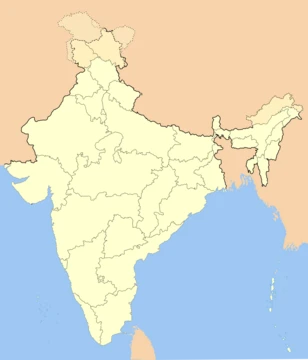
Jharkhand
Landlocked eastern Indian state rich in minerals and forests.

Anupmahato · CC BY-SA 4.0
Jharkhand is a landlocked state in eastern India, known as 'the land of forests.' It is the 15th largest state by area and the 14th largest by population, with Hindi as its official language and Ranchi as its capital. The state is notable for its mineral wealth, contributing over 40% of India's mineral production, yet it faces significant poverty and malnutrition.
Quick Facts
- Official Name
- State of Jharkhand
- Etymology
- "Forest Land"
- Nickname
- "Land of Forests"
- Motto
- Satyameva Jayate (Sanskrit) · "Truth alone triumphs"
- Region
- East India
- Before Was
- Part of Bihar
- Capital
- Ranchi
- Largestcity
- Jamshedpur
- Districts
- 24 (5 divisions)
- Governor
- Santosh Gangwar
- Chief Minister
- Hemant Soren
- Party
- JMM
Facts from the source article.
Lore & Background
The name Jharkhand derives from 'Jhar' meaning forest and 'Khand' meaning land, referring to its forested terrain. The earliest known epigraphic reference to 'Jharkhand' is from a 13th-century inscription of the Ganga dynasty, associated with Narasimha Deva I. The region has been inhabited since the Mesolithic-Chalcolithic period, with ancient cave paintings in Isko, Hazaribagh district dating to 9000–5000 BCE. Stone tools from the Mesolithic and Neolithic periods have been found on the Chota Nagpur Plateau, and copper tools from the 2nd millennium BCE are associated with the Copper Hoard Culture.
Reader's Guide
Jharkhand's significance lies in its dual identity as a mineral-rich region and a land of historical resistance. It accounts for more than 40% of India's mineral production, yet 39.1% of its population lives below the poverty line, illustrating the resource curse. The state's history includes ancient habitation, rule by the Nanda, Maurya, and Gupta empires, and medieval governance by Nagvanshi, Pala, and Chero rulers. During the British period, Jharkhand witnessed numerous uprisings, including the Chuar Rebellion (1767), the Santhal rebellion (1855), and the Birsa Munda revolt (1895–1900). These revolts, led by figures such as Tilka Majhi, Sidhu and Kanhu, and Birsa Munda, reflect sustained resistance against colonial taxation and subjugation. The state's religious sites, including Baidyanath Dham and Parasnath, add to its cultural importance.
Did You Know?
- Jharkhand means 'the land of forests' in various Indo-Aryan languages.
- Ancient cave paintings in Isko, Hazaribagh district date from the Meso-chalcolithic period (9000–5000 BCE).
- The state accounts for more than 40% of India's mineral production but has 39.1% of its population below the poverty line.
Roots in a Decades-Long Struggle
The Jharkhand Mukti Morcha did not emerge from a vacuum. For nearly sixty years, a movement to carve Jharkhand out of Bihar had been fighting for political recognition. The original Jharkhand Party once held between twenty-three and thirty-two seats in the Bihar Legislative Assembly, yet commissions examining the demand for a separate state repeatedly turned down those aspirations. In 1963, Jaipal Singh Munda merged the party with the Indian National Congress, but many members refused to follow. By 1967, the party had collapsed to just eight Assembly seats and fractured into multiple splinter groups, each insisting it was the legitimate successor. Among those fragments was the Bihar Progressive Hul Jharkhand Party led by Shibu Soren. It was from this landscape of division that Soren, Binod Bihari Mahato, and A. K. Roy of the Marxist Co-ordination Committee came together to forge a new political identity. The JMM was officially launched on the birthday of Birsa Munda, the nineteenth-century tribal warrior who had resisted British rule in the region, tying the party's birth to a symbol of indigenous defiance.
Building a Broader Coalition
Under Shibu Soren's leadership, the JMM deliberately widened its social base beyond tribal communities. The party recruited industrial and mining workers drawn largely from non-tribal Dalit and backward castes, including Surdis, Doms, Dusadh, Kurmi, Koiri, Gowala, and Teli groups, weaving them into its organizational fabric. This inclusive strategy coexisted with Soren's personal political ambitions; his close association with the late politician Gyanranjan brought him into the orbit of Prime Minister Indira Gandhi, and he captured the Dumka Lok Sabha constituency in 1972. That Congress-leaning posture, however, alienated younger party members. In Jamshedpur, a group of dissidents broke away to form the All Jharkhand Students Union, creating a parallel youth movement. Despite this internal tension, the JMM continued to grow, winning six seats in the 1991 general election. On 4 February 1973, Mahato was installed as party president while Soren took the role of general secretary, with prominent figures like Nirmal Mahto and Tek Lal Mahto rounding out the early leadership cadre.
The Statehood Push and Economic Blockades
The drive for a separate Jharkhand state found renewed energy under Ram Dayal Munda, who worked to unify the fractured tribal political groups. In June 1987, the Jharkhand Coordination Committee was formed, bringing together forty-eight organizations and factions, including various JMM splinters. For a brief period, Soren, Suraj Mandal, Simon Marandi, Shailendra Mahato, and AJSU leaders such as Surya Singh Besra and Prabhakar Tirkey stood on a shared political platform. The JMM, however, withdrew from the committee, arguing that the promised collective leadership was merely a farce. Undeterred, the JMM, AJSU, and the Jharkhand Party turned to direct action, orchestrating bandhs—economic blockades—in 1988 and 1989 that disrupted commerce and drew national attention to the statehood cause. The movement ultimately succeeded: the State of Jharkhand was created in 2000, and fittingly, it came into existence on the very birthday of Birsa Munda, the same date chosen for the JMM's founding, cementing the warrior's legacy as the spiritual anchor of both the party and the new state.
Wings, Symbol, and Regional Reach
The JMM built its organizational architecture to sustain long-term political engagement across age groups. At a conference held in Ranchi on 16 October 1991, the party constituted two dedicated wings: the Jharkhand Yuva Morcha for young adults and the Jharkhand Chhatra Morcha for students, ensuring a pipeline of grassroots activists. The party's election symbol in Jharkhand is the Bow and Arrow, a visual nod to the archery traditions of the region's tribal communities and an evocative reference to Birsa Munda's resistance. While the JMM is most deeply rooted in Jharkhand politics, its influence extends beyond the state's borders. The party maintains a significant presence in Odisha and parts of neighbouring states, contesting elections in those regions as well. Leadership has evolved over the decades; while Binod Bihari Mahato served as the first president, the role has since passed to Hemant Soren, who currently holds the presidency, continuing the Soren family's central role in the party's trajectory.
Gallery


Frequently Asked Questions
What is Jharkhand?
Jharkhand is a landlocked state in eastern India, widely nicknamed 'the land of forests' for its dense woodlands. It ranks 15th among Indian states by area and 14th by population.
What is Jharkhand's capital?
Ranchi serves as the capital city of Jharkhand, with Dumka functioning as the sub-capital. Hindi is the state's official language.
Why is Jharkhand called 'the land of forests'?
The nickname reflects the extensive forest cover that dominates much of the state's eastern Indian landscape. These woodlands have long shaped the region's ecology and cultural identity.
How significant is Jharkhand's mineral output?
The state contributes more than 40% of all mineral production in India, making it a critical resource hub for the country. This mining dominance gives Jharkhand an outsized economic role relative to its physical size.
What is the central paradox of Jharkhand?
Despite sitting on vast mineral reserves that fuel much of India's industry, the state still grapples with widespread poverty and malnutrition. This gap between resource wealth and everyday living standards remains one of its most defining challenges.
More in Indian States 1-24
Spotted an error? Know more?
Reader corrections go straight into our review queue. Suggest an edit · How this site is sourced