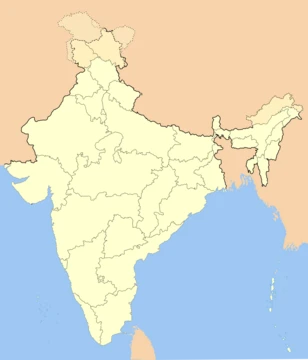
Uttar Pradesh
India's most populous state, a historical and cultural heartland.

Uttar Pradesh is a state in northern India, established in 1950 after India became a republic. It is India's most populated state, with over 241 million inhabitants, and the fourth-largest by area, covering 243,286 km². The state capital is Lucknow, with Prayagraj serving as the judicial capital. Uttar Pradesh is bordered by nine states and one union territory, tying with Assam for the highest number of bordering states among Indian states. The region has been a major centre of political and cultural development throughout Indian history, serving as the core area for several dominant Indian empires, including the Maurya, Gupta, Vardhana, and Mughal dynasties. It played a central role in the Indian independence movement, including the Indian Rebellion of 1857.
Quick Facts
- Etymology
- Northern Province
- Motto
- Satyameva Jayate (Truth alone triumphs)
- Region
- North India
- Before Was
- United Provinces (1937–1950)
- Capital
- Lucknow
- Largestcity
- capital
- Districts
- 75 (18 divisions)
- Governor
- Anandiben Patel
- Chief Minister
- Yogi Adityanath
- Party
- BJP
- Deputy Cm
- Keshav Prasad Maurya (BJP) / Brajesh Pathak (BJP)
- Legislature Type
- Bicameral
Facts from the source article.
Lore & Background
Uttar Pradesh was established in 1950 as a successor to the United Provinces, which had been created in 1935 by renaming the United Provinces of Agra and Oudh. The region has been inhabited since prehistoric times, with evidence of modern human hunter-gatherers dating to between approximately 85,000 and 72,000 years ago. Neolithic sites such as Koldihwa show early agriculture including rice cultivation as early as 6000 BCE. The area was home to seven of the sixteen mahajanapadas of ancient India, including the kingdom of Kosala, where the divine King Rama of the Ramayana epic is said to have reigned in Ayodhya. Krishna, another divine king of Hindu legend, is said to have been born in Mathura.
Reader's Guide
Uttar Pradesh's significance lies in its demographic weight, historical depth, and cultural diversity. As India's most populous state, it sends 80 seats to the lower house Lok Sabha and 31 seats to the upper house Rajya Sabha, giving it outsized influence in national politics. The state encompasses several distinct cultural regions—Braj, Rohilkhand, Bundelkhand, Awadh, and Purvanchal—forming a continuum from west to east. It is home to many of Hinduism's most important pilgrimage sites, including Varanasi, Mathura, Ayodhya, and Prayagraj, where the Ganges and Yamuna rivers meet at the Triveni Sangam. The state is also important to Buddhism, as Gautama Buddha delivered his first sermon at Sarnath near Varanasi. Several sites are associated with Jainism, and Uttar Pradesh has been an important centre of Islamic culture, architecture, and learning since the medieval period. The state contains three UNESCO World Heritage Sites. Though long known for sugar production, the economy is now dominated by the services industry, and it has the third-largest state economy in India, with a gross domestic product of ₹39.8 trillion.
Did You Know?
- The two major rivers of the state, the Ganges and its tributary Yamuna, meet at the Triveni Sangam in Prayagraj, a Hindu pilgrimage site.
- The state was established in 1950 after India became a republic, succeeding the United Provinces.
More in Indian States 1-24
Spotted an error? Know more?
Reader corrections go straight into our review queue. Suggest an edit · How this site is sourced