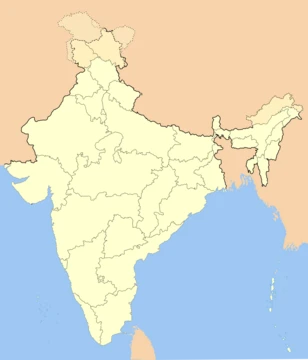
Rajasthan
Northwestern Indian state, largest by area, initially formed in 1949 with final boundaries in 1956.

Rajasthan is a state in northwestern India, the largest by area and seventh largest by population. It was initially formed as the 'United State of Rajasthan' on 30 March 1949, with the current state boundaries finalized on 1 November 1956 under the States Reorganisation Act. Known as the 'Land of Kings', it contains most of the Thar Desert. Its capital and largest city is Jaipur.
Quick Facts
- Official Name
- State of Rajasthan
- Seal Size
- 100
- Etymology
- Land of the Rajas (kings)
- Motto
- Satyameva Jayate (Sanskrit) / "Truth alone triumphs"
- Region
- Northwest India
- Before Was
- Rajputana Agency
- Capital
- Jaipur
- Largestcity
- capital
- Districts
- 41 (7 divisions)
- Governor
- Haribhau Kisanrao Bagde
- Chief Minister
- Bhajan Lal Sharma
- Party
- BJP
Facts from the source article.
Lore & Background
Parts of Rajasthan were part of the Vedic Civilisation and the Indus Valley Civilisation, with major provincial capitals at Kalibangan and Balathal. The Matsya kingdom of the Vedic era roughly corresponded to the former state of Jaipur. The Western Kshatrapas, Saka rulers, were contemporaneous with the Kushans. The Gurjara-Pratihara Empire ruled much of North India from the 8th to 11th century and successfully resisted Arab invasions. The Rajputs entered from the northwest in the first millennium A.D. and established kingdoms. Rana Hammir Singh defeated the Tughlaq dynasty, Rana Kumbha defeated the Sultans of Malwa, Nagaur and Gujarat, and Rana Sanga united Rajput clans against foreign powers but was defeated by Babur at Khanwa. Hem Chandra Vikramaditya (Hemu), born in Rewari (now in Haryana), defeated Akbar's forces at the Battle of Delhi (1556) and ruled briefly from Delhi before being killed at the Second Battle of Panipat (1556).
Reader's Guide
Rajasthan's significance lies in its role as a historical crossroads of ancient civilizations, including the Indus Valley and Vedic cultures, and as a bastion of Rajput resistance against Islamic invasions for centuries. The Gurjara-Pratihara Empire's successful defense against Arab expansion shaped the subcontinent's political trajectory. The state's formation in 1949 marked the integration of princely states into independent India. Today, Rajasthan is notable for its archaeological sites, five national tiger reserves, and the Keoladeo National Park World Heritage Site. Its economy is the seventh-largest among Indian states, though its human development index ranks 22nd.
Did You Know?
- Rajasthan means 'Land of Kings', a portmanteau of Sanskrit 'Rājā' and 'Sthāna'.
- The first printed mention of the name Rajasthan appears in the 1829 publication 'Annals and Antiquities of Rajasthan'.
- Kalibangan in Hanumangarh district was a major provincial capital of the Indus Valley Civilisation.
More in Indian States 1-24
Spotted an error? Know more?
Reader corrections go straight into our review queue. Suggest an edit · How this site is sourced