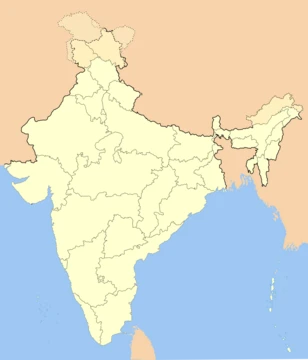
Punjab
Historical region of five rivers in South Asia.

Punjab is a historical, geographical, and ethnolinguistic region in northwestern South Asia, spanning parts of modern-day Pakistan and northwestern India. Its name comes from Persian words for "five waters," a reference to the five major rivers—Jhelum, Chenab, Ravi, Sutlej, and Beas—that have defined its landscape, farming, and where people settled. The largest city and historic capital is Lahore; other key cities in Pakistan include Faisalabad, Rawalpindi, Gujranwala, Multan, and Sialkot, while in India they include Ludhiana, Amritsar, Chandigarh, Jalandhar, and Patiala.
Human settlements appeared along the region's five rivers as early as the ancient Indus Valley civilization, around 3000 BCE, followed later by the arrival of Indo-Aryan peoples. Agriculture has always been central to Punjab's economy and culture, and the region became especially important as a farming hub after the Green Revolution of the mid-1960s to mid-1970s, earning it the label "breadbasket of both India and Pakistan." The region's boundaries are not precisely fixed, shifting over time based on historical and ethnographic definitions. Under British India, from 1849 to 1947, the Punjab Province included what are now the Indian states and union territories of Punjab, Haryana, Himachal Pradesh, Chandigarh, and Delhi, as well as the Pakistani regions of Punjab, Khyber Pakhtunkhwa, and the Islamabad Capital Territory. After the 1947 Partition of British India, the region split into West and East Punjab; in 1966, India further divided East Punjab into Punjab, Haryana, and Himachal Pradesh.
The main ethnolinguistic group is the Punjabi people, who speak the Indo-Aryan Punjabi language. In Pakistani Punjab, most are Punjabi Muslims; in Indian Punjab, most are Punjabi Sikhs. Other religious communities include Punjabi Hindus, Punjabi Christians, Jains, Zoroastrians, Buddhists, and Ravidassias.
The name "Punjab" is a calque of the Indo-Aryan term *pañca-áp*, meaning "land of five waters." The five rivers—Jhelum, Chenab, Ravi, Sutlej, and Beas—are all tributaries of the Indus, with the Sutlej being the largest. References to a land of five rivers appear in the Mahabharata, where one region is called Panchanada (Sanskrit for "five rivers").
Quick Facts
- Native Name
- pa-Latn · Panjāb (Punjabi)
- Settlement Type
- Historical region
- Nickname
- Land of the Five Rivers
- Named For
- Five tributaries of the Indus River
Facts from the source article.
Lore & Background
Human settlements in Punjab developed along its five rivers as early as the ancient Indus Valley civilization, dating back to 3000 BCE, followed by migrations of the Indo-Aryan peoples. The region is noted as the site of one of the earliest urban societies, which flourished from about 3000 BCE and declined rapidly 1,000 years later. Frequent intertribal wars stimulated the growth of larger groupings ruled by chieftains and kings, who ruled local kingdoms known as Mahajanapadas, chronicled in the ancient Hindu epics, particularly the Mahabharata. Later, the region saw the rise of the Hindu Shahi dynasty, which ruled parts of Punjab and neighboring areas. While some historical accounts mention the Gakhars as part of the Hindu Shahi army, these claims often rely on sources like the Persian historian Firisht, whose reliability for that period is debated among scholars. The direct succession of the Odi Shahi dynasty after the Takka kingdom is not well-established in mainstream historical canon.
Reader's Guide
Punjab's significance lies in its role as a cradle of early urban civilization and a crossroads of migrations, invasions, and empires. The Indus Valley Civilization, one of the earliest urban societies, developed along its rivers around 3000 BCE. The region later witnessed the Indo-Aryan migrations, the rise of Mahajanapadas, and the epic battles described in the Mahabharata. Alexander the Great's invasion in the 4th century BCE and the subsequent Mauryan Empire under Chandragupta Maurya, who used Punjab's Janapadas to conquer much of the Indian subcontinent, further shaped its history. The Hindu Shahi dynasty ruled western Punjab in the 9th century. Agriculture has been the chief economic feature, and following the Green Revolution (mid-1960s to mid-1970s), Punjab became known as the 'breadbasket of both India and Pakistan.' The region's boundaries have changed over time; during British India (1849–1901), the Punjab Province encompassed present-day Indian states and union territories of Punjab, Haryana, Himachal Pradesh, Chandigarh, and Delhi, and Pakistani regions of Punjab, Khyber Pakhtunkhwa, and Islamabad Capital Territory. After the Partition of British India in 1947, it was divided into West and East Punjab; East Punjab was further divided in 1966. The predominant ethnolinguistic group is the Punjabi people, with Punjabi Muslims as the majority in Pakistani Punjab and Punjabi Sikhs as the majority in Indian Punjab.
Did You Know?
- The name Punjab is derived from Persian words panj (five) and āb (water), meaning 'Land of Five Waters,' referring to the Jhelum, Chenab, Ravi, Sutlej, and Beas rivers.
- The ancient Greeks referred to the region as Pentapotamía, meaning 'land of five rivers.'
- During the Mughal Empire, the current name 'Punjab' gained currency.
- The Battle of the Hydaspes in 326 BCE between Alexander the Great and Porus is thought to have resulted in a decisive Greek victory, though the exact site remains unknown.
More in Indian States 1-24
Spotted an error? Know more?
Reader corrections go straight into our review queue. Suggest an edit · How this site is sourced