Horned lark
A widespread lark with distinctive black horns and a tinkling song.

The horned lark, also called the shore lark (Eremophila alpestris), is a bird from the lark family that lives across the northern hemisphere. In North America, people call it the horned lark because male birds grow two small feather tufts on their heads during summer. In Europe, it is known as the shore lark because it often appears along coastlines in winter.
Swedish naturalist Carl Linnaeus first described this species in 1758 in his book *Systema Naturae*, giving it the scientific name *Alauda alpestris*. He based his description on writings and illustrations by English naturalist Mark Catesby, who published *The Natural History of Carolina, Florida and the Bahama Islands* between 1729 and 1732. Linnaeus listed the type location as North America, though this has since been narrowed to the coastal areas of South Carolina. Today, the horned lark belongs to the genus *Eremophila*, which German naturalist Friedrich Boie introduced in 1828, alongside Temminck's lark. The species name *alpestris* comes from Latin, meaning "of the high mountains," referring to the Alps. A 2023 genetic study of larks found that Temminck's lark sits within a group that includes subspecies of the horned lark. Genomic evidence suggests the horned lark split from Temminck's lark around the Early to Middle Pleistocene. Fossils from about a dozen Late Pleistocene sites have been found in Italy, Russia, the United Kingdom, and the United States. The oldest known fossil comes from the Calabrian period in Spain, roughly 1 to 0.8 million years old. In 2020, a well-preserved frozen female horned lark carcass was discovered in Siberian permafrost in the Russian Far East. It died between 44,000 and 49,000 years ago, plus or minus 1,100 years, and was a transitional form between the subspecies *E. a. flava* and *E. a. brandti*, though closer to *E. a. flava*. A 2014 genetic analysis suggested the species contains six distinct groups that might someday be classified as separate species. A 2020 study proposed splitting it into four species: the Himalayan horned lark (*E. longirostris*), mountain horned lark (*E. penicillata*), common horned lark (*E. alpestris* in the strict sense), and Temminck's lark.
Currently, forty-two subspecies are recognized, many of which share the common name "shore lark."
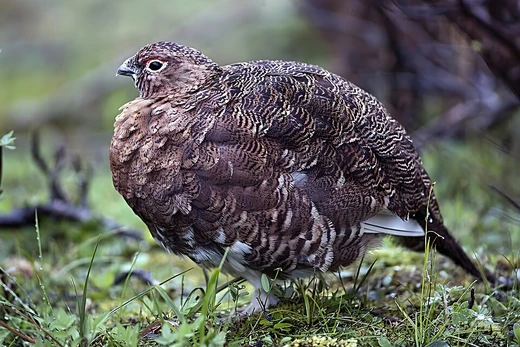
Unlike most other larks, this bird has a striking appearance on the ground.
Quick Facts
- Genus
- Eremophila (bird)
- Species
- alpestris
Facts from the source article.
Lore & Background
The horned lark was formally described in 1758 by the Swedish naturalist Carl Linnaeus in the tenth edition of his Systema Naturae under the binomial name Alauda alpestris. Linnaeus based his account on the description and illustration by the English naturalist Mark Catesby in his book The Natural History of Carolina, Florida and the Bahama Islands. Linnaeus specified the type locality as North America, later restricted to coastal areas of South Carolina. The species is now placed in the genus Eremophila, introduced in 1828 by Friedrich Boie. A 2023 molecular genetic study found that Temminck's lark was embedded in a clade containing taxa currently classed as subspecies of the horned lark.
The horned lark is suggested to have diverged from Temminck's lark around the Early-Middle Pleistocene. The earliest known fossil is from the Calabrian of Spain, around 1–0.8 million years old. In 2020, a well-preserved, complete frozen bird carcass of a female horned lark was discovered in Siberian permafrost, dated to around 44,000 to 49,000 years before present. It was a transitional species between E. a. flava and E. a. brandti. A 2014 genetic analysis suggested the species consists of six clades that may warrant recognition as separate species; a 2020 study suggested splitting into four species.
Reader's Guide
The horned lark is a significant species for understanding avian evolution and biogeography across the northern hemisphere. Its fossil record, including a well-preserved permafrost specimen from the Late Pleistocene, provides insight into past climates and species dispersal. The ongoing taxonomic debate—whether to split the species into multiple species based on genetic clades—highlights the dynamic nature of species classification. Ecologically, the horned lark is a bird of open ground, breeding across North America, Eurasia, and in mountains of southeast Europe, with an isolated population in Colombia. Its nesting behavior shows flexibility in response to microclimate and predation risk. Conservation concerns are notable: populations are declining according to the North American Breeding Bird Survey, and in 2016 the Partners in Flight Landbird Conservation Plan listed it as a 'Common Bird in Steep Decline.' The subspecies streaked horned lark was listed as threatened under the Endangered Species Act in 2013. Declines are attributed to habitat loss from pesticides, reforestation, urbanization, and collisions at wind farms and airports.
Did You Know?
- The horned lark was formally described by Carl Linnaeus in 1758 based on an account by Mark Catesby.
- A frozen female horned lark carcass discovered in Siberian permafrost was dated to around 44,000–49,000 years before present.
- The species has 42 recognized subspecies, many given the common name 'shore lark'.
- In 2013, the U.S. Fish and Wildlife Service listed the subspecies streaked horned lark as threatened under the Endangered Species Act.
More in Holarctic birds 1-24
Spotted an error? Know more?
Reader corrections go straight into our review queue. Suggest an edit · How this site is sourced