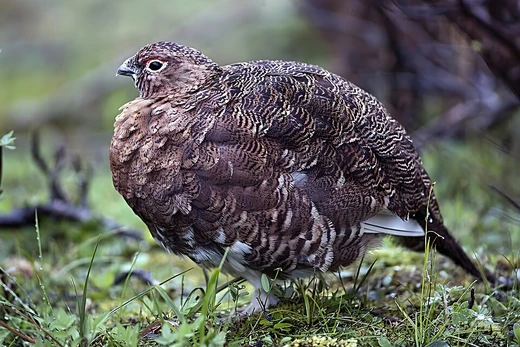
Eurasian dotterel
A small, tame wader with reversed sex roles.

The Eurasian dotterel (Eudromias morinellus), often called simply the dotterel in Europe, is a small wader belonging to the plover family. It is the sole member of the genus *Eudromias*. This bird is migratory, raising its young in northern Europe and across Eurosiberia, then spending the winter in North Africa and the Middle East. It is famous for being tame and unsuspecting, a trait that shaped both its name and its history.
The dotterel’s plumage is brown and black with streaks. In breeding season, it sports a broad white stripe over the eye and a band of orange-red across the chest. The female is more brightly colored than the male. The bird’s trusting nature made it easy to catch, and the word "dotterel" came to be used as an insult for a simpleton or old fool. Its Scottish Gaelic name, *amadan-mòintich*, means "fool of the moors." King James VI and I hunted them yearly near Royston, Hertfordshire, and they were also a prized food—Queen Anne Boleyn was given "a brace of dotterels" in 1534. Illegal poaching further reduced their numbers.
This plover is smaller and more compact than the European golden plover. It has a striking whitish supercilium in all plumages and plain wings in flight. In summer, adults are unmistakable: a chestnut breast bordered above with white, a black belly, and a warm-brown back. The legs are yellow, and the short bill is black. As with phalaropes, the female is brighter than the male. Winter birds lose the rich underpart colors, keeping only the white breast line, and appear greyer above. Young birds look similar but have a scaly back. The flight call is a soft *pyurr*, and the female’s song is a simple, repetitive whistle.
The dotterel breeds on Arctic tundra from Norway to eastern Siberia, as well as on mountain plateaus like the Scottish Highlands and the Alps. It migrates to a narrow wintering belt across North Africa, from Morocco east to Iran. Migration stopovers are traditional, and small groups (called trips) pass through the same inland arable or grassy sites each year. Its winter habitat is semi-desert.
Its diet consists of insects and other small invertebrates, such as snails, worms, and shellfish. It catches them with a run-and-pause technique, unlike the steady probing of other waders. The male generally incubates the eggs and cares for the chicks.
Quick Facts
- Genus
- Eudromias
- Species
- morinellus
Facts from the source article.
Lore & Background
The Eurasian dotterel was first formally described in 1758 by Carl Linnaeus under the binomial name Charadrius morinellus. It was later moved to the resurrected genus Eudromias, introduced in 1830 by Christian Ludwig Brehm, after phylogenetic studies found Charadrius to be paraphyletic. The genus name means 'good runner' in Ancient Greek, while the specific name morinellus derives from moros, meaning 'foolish', due to the bird's trusting nature.
The English name 'dotterel' dates from 1440, used both for the bird and as an insult for a simpleton or dotard. Its Scottish Gaelic name is amadan-mòintich, 'fool of the moors.' King James VI and I went yearly to Royston, Hertfordshire, to shoot dotterels. The bird was also easy prey for illegal poaching, which depleted its stocks, and was prized as a delicacy; in 1534, Queen Anne Boleyn was presented with 'a brace of dotterels.'
In breeding plumage, the dotterel is brown-and-black-streaked with a broad white eye stripe and an orange-red chest band. The female is more colourful than the male. The bird nests in a bare scrape on the ground, laying two to four eggs. The male incubates the eggs and rears the chicks, while the female often leaves to find another male and lay another clutch. The diet consists of insects and other small invertebrates, obtained by a run-and-pause technique.
Reader's Guide
The Eurasian dotterel holds significance as a species with reversed sexual roles, where the female is more colourful and the male undertakes incubation and chick-rearing. This unusual breeding system has made it a subject of interest in ornithology. Its tame and unsuspecting nature historically made it easy to catch, leading to its name being used as a term for a fool, and it was a favoured quarry of King James VI and I. The bird's population in Scotland declined by 57% between 1987 and 2011, from 980 to 423 breeding males, though overall it remains a common species with a wide range and is rated as 'least concern' by the IUCN. It is one of the species covered by the Agreement on the Conservation of African-Eurasian Migratory Waterbirds. The dotterel's migration stopovers are traditional, and small parties pass through each year at inland arable or grassy sites. Its legacy includes its role in historical culture as a delicacy and its contribution to understanding avian mating systems.
Did You Know?
- The female dotterel is more colourful than the male.
- The male dotterel incubates the eggs and rears the chicks.
- The English name 'dotterel' dates from 1440 and was also used as an insult for a simpleton.
More in Holarctic birds 1-24
Spotted an error? Know more?
Reader corrections go straight into our review queue. Suggest an edit · How this site is sourced