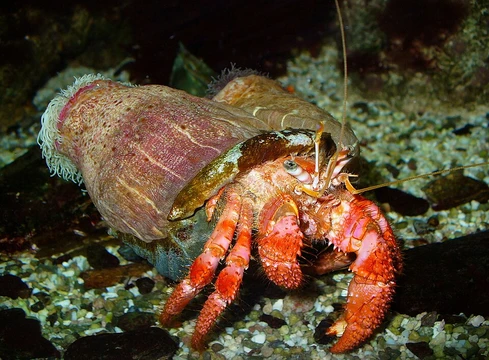
Thinstripe hermit crab
A scavenging hermit crab found from Virginia to Brazil.

The thinstripe hermit crab (*Clibanarius vittatus*) belongs to the family Diogenidae. Its range includes the Caribbean Sea, the Gulf of Mexico, and the western Atlantic, from Virginia down to Brazil. It is especially common in Florida’s Indian River Lagoon. Unlike many hermit crabs, it tolerates drying out well and lives in the intertidal zone as well as at depths up to about 22 meters. Its habitats include sand, mud, seagrass meadows, rock jetties, and oyster beds.
Like all hermit crabs, it protects its soft abdomen by living inside an empty gastropod shell, with only its head and limbs poking out. Its two claw-bearing legs (chelipeds) are small, equal in size, and covered in short bristles. When threatened, it pulls into the shell and blocks the opening with these claws, which have small blue bumps on the outside. The body and legs are dark green or brown, with faint white streaks on the body and more distinct white or gray stripes on the legs. Adults often occupy shells longer than 10 cm.
This crab is a scavenger that feeds mostly on detritus from the seafloor. Reproduction begins when a male passes spermatophores to a female. She broods several thousand eggs on her abdomen. After a few weeks, the eggs hatch into planktonic larvae, which go through four or five zoeal stages and then a glaucothoe stage before settling and turning into juveniles. The glaucothoe may find a suitable shell before metamorphosis; if not, the young must quickly find shells to avoid predators. An adult female can produce several broods a year, totaling up to 180,000 eggs in a reproductive season.
As the crab grows, it must periodically swap shells, which is its most vulnerable time. If no empty shell is available, crabs may fight or even kill living mollusks. They usually choose whelks or conches, such as the lightning whelk, knobbed whelk, giant triton, moon snail, and Florida rocksnail. The sea anemone *Calliactis tricolor* often attaches to the crab’s shell. This is a mutualistic relationship: the anemone’s stinging cells deter predators, while the anemone gets more food as the crab moves around.
Quick Facts
- Taxon
- Clibanarius vittatus
Facts from the source article.
Lore & Background
Like other hermit crabs, *Clibanarius vittatus* lives inside the empty shell of a gastropod mollusc, protecting its soft abdomen. Its chelipeds (claw-bearing legs) and claws are small, both the same size, and covered in short bristles. When threatened, the animal retreats into the shell and the chelipeds block the aperture. The outside of the claws bear small blue tubercles. The body and legs are dark green or brown; the body is faintly streaked with white and the legs have more distinct white or grey stripes. Adult crabs often occupy shells of over 10 cm (4 in) in length.
It is found in shallow parts of the Caribbean Sea, the Gulf of Mexico and the western Atlantic Ocean, ranging from Virginia in the eastern United States southwards to Brazil. It is plentiful in the Indian River Lagoon in Florida. It is more resistant to desiccation than many hermit crabs and is found in the intertidal zone as well as at depths down to about 22 metres (72 ft). It can be found on sand or mud, in seagrass meadows, on rock jetties, in oyster beds and in other inshore habitats.
*Clibanarius vittatus* is a scavenger and mostly feeds on detritus that it finds on the seabed. Reproduction is initiated by the passing of spermatophores from a male crab to a female. The egg mass of several thousand eggs is brooded by the female on her abdomen. After a few weeks the eggs hatch and the larvae are released into the water column and become planktonic. They pass through four or five zoeal stages and one post-larval, glaucothoe stage before sinking to the bottom and metamorphosing into juveniles. The free-living glaucothoe larvae sometimes finds a suitable sized shell before metamorphosis; otherwise, the juveniles need to find suitable new homes before they are consumed by predators. An adult female has several broods each year and may produce 180,000 eggs during the reproductive season.
Reader's Guide
As it grows, *Clibanarius vittatus* periodically needs to change the shell in which it lives, a time of great vulnerability to predators. If a suitable vacant shell cannot be found, crabs may fight each other for shells or even kill living molluscs. The shells chosen are usually whelks or conches, including the lightning whelk, knobbed whelk, giant triton, moon snail, and Florida rocksnail. The sea anemone *Calliactis tricolor* is often found attached to the shell occupied by the crab. This appears to be a mutualistic arrangement: the crab benefits because potential predators are deterred by the anemone's stinging cells, while the anemone gains greater access to food as the crab moves around. This species is a common and ecologically significant scavenger in its range, and its tolerance of drying conditions allows it to thrive in the intertidal zone where many other hermit crabs cannot survive.
Did You Know?
- Its claws are both the same size and covered in short bristles, with small blue tubercles on the outside.
- An adult female may produce up to 180,000 eggs during the reproductive season.
- It often lives in a mutualistic relationship with the sea anemone *Calliactis tricolor*.
More in Hermit Crabs 1-24
Spotted an error? Know more?
Reader corrections go straight into our review queue. Suggest an edit · How this site is sourced