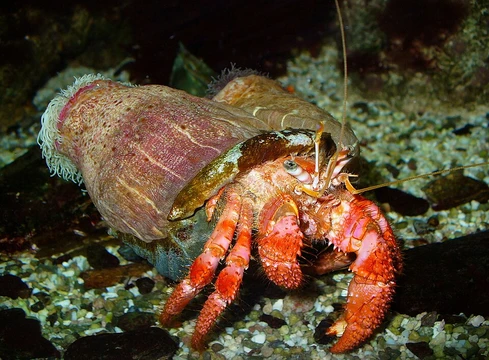
Clibanarius tricolor
A Caribbean hermit crab popular for cleaning aquariums.

Clibanarius tricolor, also known as the blue-legged hermit crab or tricolor hermit crab, inhabits the shallow waters of the Caribbean Sea and is a common choice for home aquariums. Its legs are blue with red bands between the segments, and it grows to about 2 centimeters. Males are larger than females, as is typical for most hermit crabs.
This species is a detritivore, feeding on dead plants and animals that might otherwise clog the reef. It also consumes green hair algae, cyanobacteria, and seaweed, and it sifts through sand to find food, cleaning the sand in the process.
During the day, the crabs move slowly or rest, usually starting to feed at dusk and continuing through the night. They tend to gather in rocky areas where the water is about 30 centimeters deep. When feeding, members of the same group move in a single direction, similar to a herd of grazing cattle, and they return to their congregation by 4:30 in the morning. Most crabs appear to stay with the same group day after day.
Shell fighting occurs in this species. An attacking crab approaches another from behind, sometimes making aggressive moves or causing the other to retreat. The attacker turns the victim onto its back and may spin both the victim and its shell several times. The attacker then raises its own shell and brings it down rapidly, repeating this process until it kicks the victim out of the shell. If the attack fails, the victim may remain upside down, leaving it vulnerable to another attempt.
In aquariums, C. tricolor is popular for its coloration and its tank-cleaning feeding habits. It represents a shift in public interest from purely decorative animals to "working" animals that help sustain the aquarium ecosystem, reducing the need for active owner management.
Quick Facts
- Taxon
- Clibanarius tricolor
Facts from the source article.
Lore & Background
Clibanarius tricolor has blue legs with red banding between each segment, and reaches up to 2 centimeters in size. Males of this species, as in most other hermit crab species, are bigger than the females. It is a detritivore, eating dead plants and animals that would otherwise clog the reef. It also eats green hair algae, cyanobacteria, and seaweed, and even sifts through sand looking for food, cleaning the sand in the process. During the day the crabs move slowly or rest; feeding usually begins at dusk and continues through the night. They usually congregate in rocky areas with 30 cm of water. Members of the same group usually move in one general direction when feeding, similar to a group of grazing cattle. By 4:30 in the morning they are back to their congregation, and most crabs stay with their same respective groups day after day. Shell fighting in this species also occurs. When the attacking crab approaches another, some aggressive moments may be made or the other crab may retreat. The attacking crab approaches from behind and turns the other crab on its back, then may proceed to spin the victim and shell multiple times. The attacker's shell is then raised and brought down rapidly. This process usually happens multiple times until the attacker kicks the victim out of the shell. If this process fails, the victim may remain upside down, where another attack may occur.
Reader's Guide
Clibanarius tricolor is a popular aquarium hermit crab because of its coloration and because its feeding habits lead it to clean tanks. It is emblematic of the public's shift from purely decorative animals to 'working' animals that help sustain the aquarium's ecosystem, reducing the need for active management by the owner. Its role as a detritivore—consuming dead plants and animals, green hair algae, cyanobacteria, and seaweed—helps maintain water quality and clarity in home aquariums. The species' natural behavior, including sifting through sand and congregating in groups, further contributes to tank cleanliness. Its popularity reflects a broader trend in aquarium keeping where animals are valued not only for their appearance but also for their ecological function. The species' shell-fighting behavior, while aggressive, is a natural part of its life cycle and does not detract from its utility in the aquarium trade. Overall, Clibanarius tricolor serves as a practical and visually appealing addition to marine aquariums, supporting a self-sustaining environment.
Did You Know?
- It reaches up to 2 centimeters (0.79 in) in size.
- Males are bigger than females, as in most other hermit crab species.
- By 4:30 in the morning, the crabs return to their congregation.
Frequently Asked Questions
What is Clibanarius tricolor?
Clibanarius tricolor is a small hermit crab species native to the shallow waters of the Caribbean Sea. It goes by several common names, including blue-legged hermit crab, tricolor hermit crab, and blueleg reef hermit crab.
What does Clibanarius tricolor eat?
This species is a detritivore that feeds on dead organic matter, green hair algae, cyanobacteria, and seaweed. It also sifts through sand to locate food particles, which incidentally helps clean the substrate.
How big does Clibanarius tricolor get?
An adult Clibanarius tricolor reaches roughly 2 centimeters (about 0.79 inches) in size. Males tend to grow larger than females, a pattern typical across most hermit crab species.
What does Clibanarius tricolor look like?
The crab's legs are a striking blue color with red bands separating each segment, which is the origin of its 'tricolor' and 'blue-legged' names. This vivid coloration is one of the features that makes it stand out in a reef tank.
Why is Clibanarius tricolor popular in home aquariums?
Aquarium hobbyists favor this species because it acts as a natural cleaner, consuming detritus, algae, and other debris that would otherwise accumulate on the reef. Its small size and sand-sifting behavior make it well suited to community and reef tanks.
More in Hermit Crabs 1-24
Spotted an error? Know more?
Reader corrections go straight into our review queue. Suggest an edit · How this site is sourced