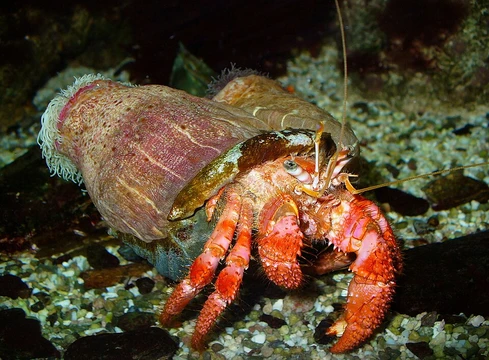
Dardanus arrosor
A widespread hermit crab with a symbiotic anemone partner.

Dardanus arrosor, commonly known as the red reef hermit or Mediterranean hermit crab, is a species of hermit crab found in the Atlantic coasts, Mediterranean Sea, Red Sea, and Indo-West Pacific. It is notable for its symbiotic relationship with sea anemones and its striking bright red to orange coloration.
Quick Facts
- Taxon
- Dardanus arrosor
Facts from the source article.
Lore & Background
Dardanus arrosor has a carapace length of 6–8 centimeters and varies in color from bright red to bright orange. Its eyestalks are robust, not very long, dilated at the tip, and alternately streaked with red and white, with bluish eyes. The claws feature hair-like spines and warty tubercles; the left claw is more developed than the right, and both claws have black or yellowish tips. The abdomen is asymmetrical, bare, and hidden within a shell.
This species breeds between July and August. It exhibits the striking behavior of living within empty shells of conches, usually those of Bittium latreillii, often decorated with sea anemones, typically Calliactis parasitica. The larvae are symmetrical but gradually develop an asymmetrical abdomen that the crab hides in a periodically replaced shell. The relationship with the anemone is truly symbiotic: the anemone gains scraps of food, while the crab benefits from the anemone's stinging tentacles deterring predators.
Dardanus arrosor is an opportunistic scavenger and predator, feeding on decaying matter, live crabs, and small fishes. It inhabits the continental shelf and slope, living on sandy substrate, coastal detritic bottoms, and bathyal muds, from a few meters up to depths of 750 meters.
Reader's Guide
Dardanus arrosor is significant as a widespread hermit crab species found across the Atlantic coasts, Mediterranean Sea, Red Sea, and Indo-West Pacific, including Japan, New Zealand, and the Philippines. Its notable symbiotic relationship with the sea anemone Calliactis parasitica exemplifies a mutualistic interaction where the anemone receives food scraps and the crab gains protection from predators via the anemone's stinging tentacles. The species' behavior of living in empty conch shells, typically Bittium latreillii, and its opportunistic scavenging and predatory feeding habits highlight its ecological role on the continental shelf and slope. Its breeding season in July and August, along with its larval development from a symmetrical shape to an asymmetrical abdomen, underscores its life history. The species' adaptability to depths up to 750 meters and various substrates—sandy, detritic, and muddy—demonstrates its ecological versatility. The red reef hermit's bright red to orange coloration and distinctive eyestalks and claws make it a recognizable member of its genus.
Did You Know?
- Dardanus arrosor's carapace can reach a length of 6–8 cm.
- It breeds between July and August.
- It often lives in empty shells of Bittium latreillii decorated with the anemone Calliactis parasitica.
A Striking Palette of Red and Blue
The red reef hermit crab presents one of the most visually arresting profiles among crustaceans. Its carapace, which can stretch to six or eight centimetres in length, blazes in hues ranging from vivid red to saturated orange, making it instantly recognizable against the muted tones of the seafloor. The eyestalks are notably sturdy rather than elongated, swelling at their tips and carrying alternating bands of red and white that give them a banded appearance. Set within these stalks are eyes with a distinctly bluish cast, a cool contrast to the warm body coloration. The claws bear a rugged texture of hair-like spines and small warty tubercles, and the left claw is noticeably larger than its right counterpart. Both claw tips are tipped in black or a pale yellowish tone. Perhaps most telling of its lifestyle, the abdomen is bare, asymmetrical, and perpetually concealed inside a borrowed shell, leaving only the bold front half of the animal on display.
The Anemone-Adorned Shell
One of the most remarkable aspects of Dardanus arrosor is its commitment to a borrowed home. This hermit crab takes up residence in the empty shells of conches, most frequently the spiral housing of Bittium latreillii, and treats the structure as a mobile fortress. What elevates this arrangement beyond mere shelter is the crab's habit of decorating its shell with sea anemones, typically Calliactis parasitica. The partnership is genuinely mutual: the anemone picks up food scraps that fall from the crab's meals, while the crab gains a living shield of stinging tentacles that keeps would-be predators at bay. The crab does not stay in one shell forever; as it grows, it periodically swaps into a larger one. This need for a protective casing is rooted in its development—larvae hatch with a symmetrical body, but as they mature, the abdomen becomes lopsided and soft, demanding the concealment that only a shell can provide.
Feeding Strategy and the Breeding Season
Dardanus arrosor is not a picky eater. As an opportunistic scavenger and active predator, it will take whatever the environment offers: rotting organic matter washed along the bottom, smaller live crabs it can overpower, and small fish it can catch. This dietary flexibility allows it to thrive across a wide range of substrates and depths. Reproduction follows a tight seasonal window, with breeding concentrated in the months of July and August. The young that emerge are initially symmetrical in body shape, a stark contrast to the lopsided adults. Over the course of their larval development, the abdomen gradually shifts into the asymmetrical form characteristic of the species, a transformation that ultimately necessitates the lifelong search for a suitable shell. The combination of a broad diet and a well-timed reproductive pulse gives this hermit crab a resilient foothold in the ecosystems it inhabits.
A Widespread Resident of Shelves and Slopes
Despite its vivid coloration, Dardanus arrosor is far from a local curiosity. Its range stretches across the Atlantic coasts, through the entire Mediterranean Sea, into the Red Sea, and across the Indo-West Pacific, with confirmed presence in the waters around Japan, New Zealand, and the Philippines. This broad distribution is matched by a remarkable depth tolerance. The species occupies continental shelf and slope environments, settling on sandy substrates, coastal detritic bottoms, and the fine bathyal muds that blanket the deeper ocean. It can be encountered from just a few metres below the surface all the way down to roughly 750 metres, a span that places it in both well-lit shallows and the dim, pressure-heavy depths of the bathyal zone. Such versatility in both geography and vertical range underscores how well adapted this hermit crab is to the varied conditions of the world's continental margins.
Frequently Asked Questions
What is Dardanus arrosor?
Dardanus arrosor is a species of hermit crab commonly called the red reef hermit or Mediterranean hermit crab. It is one of the more vividly colored members of the family Diogenidae and is found in warm coastal waters around the world.
What does Dardanus arrosor look like?
This species is instantly recognizable by its vivid red-to-orange coloration, which stands out against most other hermit crabs. Its carapace typically measures between 6 and 8 centimeters (roughly 2.4 to 3.1 inches) in length.
Where does Dardanus arrosor live?
It inhabits sandy substrates, coastal detritic bottoms, and bathyal muds across the Atlantic coasts, Mediterranean Sea, Red Sea, and Indo-West Pacific. Individuals have been recorded at depths from just a few meters down to approximately 750 meters.
How does Dardanus arrosor's relationship with sea anemones work?
This species is well known for carrying a symbiotic sea anemone on its borrowed shell, a partnership that provides mutual protection for both organisms. The anemone relationship is a defining behavioral trait that sets Dardanus arrosor apart from many other hermit crab species.
When does Dardanus arrosor breed?
Reproductive activity for this species peaks during July and August. Outside of that two-month window, breeding activity drops markedly across its range.
More in Hermit Crabs 1-24
Spotted an error? Know more?
Reader corrections go straight into our review queue. Suggest an edit · How this site is sourced