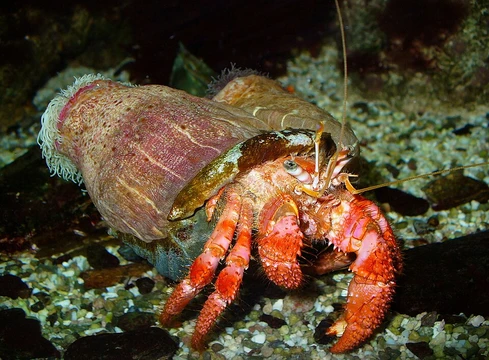
Calcinus seurati
A small to medium hermit crab with banded legs and gray claws.

Calcinus seurati, also called Seurat's hermit crab or the whitebanded hermit, belongs to the family Diogenidae. French carcinologist Jacques Forest first described it in 1951. This crab is known for its bright coloring; its walking legs are striped black and white, and its claws range from light to dark gray. The shells it carries often display patterns like spots and bands. It is a small to medium-sized hermit, reaching up to 2 inches (51 mm) in length. An omnivore, it eats both plant and animal matter. It also shows phototaxis, which may help it avoid predators. The whitebanded hermit lives in tropical parts of the Indo-Pacific, including Taiwan, Hawaii, Guam, French Polynesia, and the Tuamotu Islands. Its habitats include subtidal, sublittoral, and infralittoral zones, as well as high intertidal pools. It prefers calm, warm water and is often found in rocky pools near the waterline, sometimes crawling out onto wet, algae-covered rocks. It can be found at depths up to 5 meters (16 feet).
Quick Facts
- Taxon
- Calcinus seurati
Facts from the source article.
Lore & Background
Calcinus seurati was first described by French carcinologist Jacques Forest in 1951. It is known for its vibrant appearance, with shells often decorated with patterns like spots and bands. Its walking legs are banded black and white, and its claws are light or dark gray. This species is a small to medium-sized hermit, growing up to 2 inches (51 mm) in size. It is omnivorous, feeding on a variety of plant and animal matter. The crab exhibits phototaxis, possibly as a strategy to avoid predators. It is found in rocky pools where it would be seen crawling out to wet, algae-covered rocks.
Reader's Guide
Calcinus seurati is a species of hermit crab in the family Diogenidae, first described by French carcinologist Jacques Forest in 1951. It is found in Indo-Pacific regions around the tropical area, including Taiwan, Hawaii, Guam, French Polynesia, and the Tuamotu Islands. It inhabits various coastal environments, including subtidal, sublittoral, and infralittoral zones as well as high intertidal pools. This hermit crab is typically found in areas where the water is calm and warm, often in rocky pools near the waterline, to depths of 5 meters (16 feet). Its significance lies in its distinctive banded appearance and its adaptation to rocky pool habitats, where it exhibits phototaxis, possibly as a predator avoidance strategy. As an omnivore, it plays a role in the local ecosystem by consuming both plant and animal matter.
Taxonomy & Discovery
Seurat's hermit crab, also widely recognised by the common name whitebanded hermit, is a member of the family Diogenidae within the broader group of hermit crabs. The species was formally described in 1951 by the French carcinologist Jacques Forest, who identified it as a distinct element of the Indo-Pacific crustacean fauna. Since that mid-twentieth-century catalogue entry, Calcinus seurati has remained a relatively modest representative of its family, reaching only a small-to-medium body size of roughly fifty-one millimetres, or about two inches, at full maturity. Despite its unassuming stature, the crab carries two memorable common names that reflect different facets of its identity. The name Seurat honours the original describer's association with the species, while whitebanded captures the bold black-and-white striping that adorns its walking legs. As a Diogenid, it shares the hallmark hermit-crab strategy of occupying a borrowed gastropod shell for protection, a trait that defines the family's ecological niche across tropical coastal waters and gives the species its characteristic silhouette as it scuttles across algae-covered rock.
Physical Appearance & Feeding
Few small crustaceans command the visual attention that Calcinus seurati does. Its most immediately striking feature is the crisp black-and-white banding that wraps around each walking leg, a pattern so bold it earns the species its whitebanded common name. The claws present in either a light or a dark gray tone, adding a subtle tonal contrast to the high-contrast legs. The shells that shelter the crab's soft abdomen are frequently decorated with spots and bands, lending each individual a unique, almost painterly appearance against the rock. In terms of diet, this hermit crab is a true omnivore, feeding on a wide variety of both plant and animal matter available in its rocky habitat. Perhaps most fascinating is its behavioural response to light: the species exhibits phototaxis, a directional movement in relation to a light source. This light-driven orientation is thought to function as a strategy for avoiding predators, helping the small crab time its foraging excursions onto wet, algae-covered rocks with greater safety. At a maximum of roughly two inches, the crab relies on this combination of colour, shell decoration, and light-sensing to persist in an exposed intertidal world.
Range & Coastal Habitat
Calcinus seurati occupies a broad but specifically tropical swath of the Indo-Pacific Ocean. Documented localities stretch from the waters around Taiwan and Hawaii to the remote atolls of French Polynesia and the Tuamotu archipelago, with Guam sitting comfortably in between. Within each of these regions the crab favours calm, warm coastal waters rather than open, wave-battered surf. Its preferred microhabitats include subtidal, sublittoral, and infralittoral zones as well as the high intertidal pools that sit just above the normal tide line. In practice, observers most often spot the crab crawling across wet, algae-covered rocks in shallow rocky pools near the waterline, where it can forage during low tide. The species tolerates depths of up to roughly five metres, about sixteen feet, though it is most conspicuous in the shallower, rock-strewn environments where its black-and-white legs stand out against the green and brown of encrusted surfaces. The consistent thread across every recorded site is the combination of still water, warmth, and abundant rocky substrate for shelter and feeding.
Survival Strategies in a Shallow World
Living in the exposed intertidal and shallow subtidal zones presents a small crab with a constant balancing act between foraging and predation. Calcinus seurati meets this challenge with a layered toolkit. Its modest size, capping out at roughly fifty-one millimetres, allows it to navigate the tight crevices and narrow spaces among rocky pools where larger predators cannot easily follow. Its omnivorous diet, encompassing a wide variety of both plant and animal matter, lets it exploit whatever the algae-covered rocks and surrounding water provide without being restricted to a single food source. The crab's phototaxis, a measurable directional response to light, is thought to serve as a predator-avoidance strategy, helping it orient its movements relative to ambient illumination during foraging excursions onto wet rock. The gastropod shell it occupies, often decorated with spots and bands, adds a further physical barrier against grasping jaws. Together these traits allow a crab of barely two inches to persist in one of the most visually active and predator-rich environments on Earth.
Frequently Asked Questions
Who is Calcinus seurati?
Calcinus seurati, widely known as Seurat's hermit crab or the whitebanded hermit, is a species in the hermit-crab family Diogenidae. French carcinologist Jacques Forest gave it its formal scientific description in 1951.
What makes Calcinus seurati's appearance stand out?
Its walking legs carry bold black-and-white stripes, while its claws shift across a range of gray tones. The shells it inhabits often feature spots or bands, compounding the crab's already eye-catching look.
How large does Calcinus seurati grow?
It stays in the small-to-medium range, reaching a maximum of about 2 inches (51 mm). That modest size makes it a popular pick for hobbyist tanks.
What is Calcinus seurati's diet?
This hermit is a true omnivore, feeding on both plant and animal matter. In the wild it scavenges opportunistically, taking in algae, detritus, and small bits of prey as they come.
Why do fans consider Calcinus seurati special?
Its vivid leg banding and patterned shells set it apart visually from many other Diogenid crabs. It also displays phototaxis, a light-directed movement that likely serves as a predator-avoidance strategy.
More in Hermit Crabs 1-24
Spotted an error? Know more?
Reader corrections go straight into our review queue. Suggest an edit · How this site is sourced