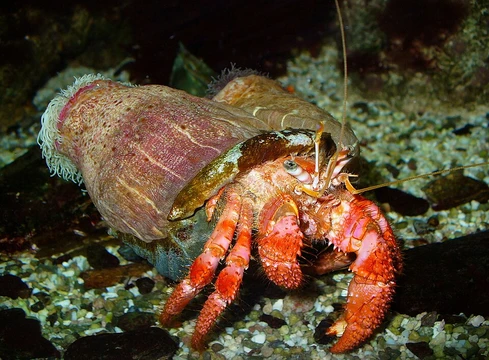
Calcinus morgani
A hermit crab with bright blue eye-stalks and dark brown shield margins.

Calcinus morgani, called Morgan's hermit crab, belongs to the family Diogenidae and lives in the Indo-West Pacific, with its type location in Indonesia. Its shield is 1.15 to 1.4 times longer than wide, featuring a triangular rostral lobe and very small, blunt lateral projections. The eye-stalks have swollen bases and are nearly as long as the shield. The left claw has four to six strong, calcified teeth on its cutting edge, while the dactyl has two to four teeth; the right claw is smaller with fewer teeth. Both claws are covered in small bumps and low knobs. The third pair of walking legs has a brush of bristles near the claw, and the other walking legs have scattered bristles. The shield is whitish with dark brown edges, the eye-stalks are bright blue with brown bases, the antenna parts are dark brown and orange, the claws are dark brown with white tips and white bumps, and the walking legs are dark brown with white bands near the claws. This species was once mistaken for *Calcinus gaimardii*, but that crab has a dark brown front half of the shield and lacks bright blue on the eye-stalks, which are entirely orange except for a little blue on the corneas. *C. morgani* occurs across the tropical and subtropical Indo-Pacific, from Madagascar to western, northern, and eastern Australia, the Philippines, Indonesia, and other western Pacific islands. It typically inhabits the intertidal zone of coral reefs and rocky shores exposed to strong wave action, unlike *C. gaimardii*, which prefers sheltered inlets and lives subtidally.
Quick Facts
- Taxon
- Calcinus morgani
Facts from the source article.
Lore & Background
Calcinus morgani has a shield 1.15 to 1.4 times as long as it is broad, with a triangular rostral lobe and very small, blunt lateral projections. The eye-stalks have inflated bases and are nearly as long as the shield. The left cheliped (claw) bears four to six robust calcified teeth on its cutting edge, while the dactyl has two to four teeth; the right cheliped is somewhat smaller with fewer teeth. Both chelipeds are dotted with small tubercles and low protuberances. The third pair of pereopods (walking limbs) have a brush of setae near the claw, while other pereopods have scattered setae.
The shield is whitish with dark brown margins, the eye-stalks are bright blue with brown bases, the antennal appendages are dark brown and orange, the chelipeds are dark brown with white tips and white tubercles, and the pereopods are dark brown with white bands near the claws. This species was at one time thought to be synonymous with Calcinus gaimardii, but that species has the front half of the shield dark brown and lacks bright blue on the eye-stalks, which are entirely orange apart from a little blue on the corneas.
Calcinus morgani is found in the tropical and subtropical Indo-Pacific region, ranging from Madagascar to western, northern and eastern Australia, the Philippines, Indonesia and other western Pacific island groups. It typically inhabits the intertidal zone of coral reefs and rocky shores exposed to strong wave action, in contrast to C. gaimardii, which prefers sheltered inlets and is found subtidally.
Reader's Guide
Calcinus morgani is significant as a distinct species within the family Diogenidae, distinguished from the similar Calcinus gaimardii by its shield coloration and bright blue eye-stalks. Its type locality is Indonesia, and it is found across the Indo-West Pacific region, from Madagascar to Australia and various western Pacific island groups. The species occupies a specific ecological niche in the intertidal zone of coral reefs and rocky shores exposed to strong wave action, contrasting with the sheltered subtidal habitat of C. gaimardii. Its morphological features, such as the number of teeth on the chelipeds and the brush of setae on the third pereopods, aid in identification. The species' coloration—whitish shield with dark brown margins, bright blue eye-stalks, and dark brown chelipeds with white tips—makes it visually distinctive. The historical confusion with C. gaimardii underscores the importance of careful taxonomic work in hermit crab classification. Its legacy lies in contributing to the understanding of biodiversity and habitat partitioning among hermit crabs in the Indo-Pacific.
Taxonomic Identity and Classification
Calcinus morgani occupies a defined position within the hierarchical structure of biological taxonomy. At the genus level, Calcinus groups together a set of hermit crabs that share common ancestral traits, distinguishing them from other crustacean lineages. This genus is formally placed within the family Diogenidae, a classification that situates it among a broader assemblage of related hermit crab groups. The species epithet morgani identifies a particular member of that genus, representing one distinct lineage within the Calcinus collection. Understanding where Calcinus morgani sits in this nested framework—species within genus, genus within family—matters because each taxonomic rank carries implications for evolutionary relationships, morphological expectations, and ecological roles. The Diogenidae family designation, in particular, signals shared characteristics at a level above the genus, suggesting that Calcinus species participate in patterns of adaptation and behavior recognizable across the wider hermit crab radiation. For researchers and enthusiasts alike, this classification provides the foundational vocabulary for discussing the organism's biology, distribution, and interactions with other marine invertebrates.
The Hermit Crab Context
As a member of the genus Calcinus, Calcinus morgani is identified as a hermit crab, a term that immediately evokes the well-known strategy of inhabiting borrowed shells for protection. The facts place this organism squarely within the family Diogenidae, a grouping that encompasses hermit crabs sharing particular anatomical and behavioral traits. Being classified as a hermit crab distinguishes Calcinus morgani from other crustaceans that possess fully calcified exoskeletons covering their entire bodies. The Diogenidae family designation further narrows the context, indicating that this hermit crab belongs to a specific branch of the hermit crab lineage rather than a more distantly related group. The genus Calcinus itself represents a cluster of species that, while sharing the broader hermit crab identity, possess distinguishing features that set them apart from neighboring genera within Diogenidae. This layered identification—hermit crab, Diogenidae, Calcinus, and finally the species morgani—builds a precise biological portrait from general to specific, anchoring Calcinus morgani in a well-recognized ecological and evolutionary niche.
Genus Structure and Species Diversity
The genus Calcinus is described as containing multiple species, and Calcinus morgani represents one entry in that roster. The very existence of a multi-species genus indicates that Calcinus encompasses a range of distinct biological lineages, each recognized as a separate species based on identifiable differences in morphology, genetics, or distribution. Calcinus morgani, bearing its own species name, stands as one of these differentiated members rather than a single isolated organism. The genus-level grouping implies shared structural and functional traits among all Calcinus species, while the species-level designation of morgani marks a point of divergence where that particular lineage has become distinct enough to warrant separate recognition. This arrangement reflects the broader pattern in hermit crab taxonomy, where genera bundle closely related species together under a common name while preserving the individuality of each. For anyone studying Calcinus morgani, understanding that it is one thread in a multi-threaded genus provides essential context for comparing its traits against its close relatives and for appreciating the full scope of variation the genus encompasses.
Scientific Documentation and Public Resources
The study and public awareness of Calcinus morgani, like other members of the genus Calcinus, are supported by a network of digital and archival resources. Wikimedia Commons hosts media related to the genus Calcinus, offering photographs, illustrations, and other visual documentation that researchers, students, and the general public can access. This visual archive serves as a practical reference for recognizing the physical appearance of Calcinus species, including Calcinus morgani, and for comparing morphological features across the genus. In parallel, Wikispecies maintains dedicated data entries for Calcinus, providing a structured taxonomic record that cross-references nomenclature, classification, and related species information. These platforms, alongside the Wikipedia article itself, form a layered documentation ecosystem that makes the taxonomy of Calcinus morgani accessible beyond specialized academic journals. The availability of such open resources lowers the barrier to entry for anyone wishing to explore the hermit crab family Diogenidae and the specific genus to which Calcinus morgani belongs, ensuring that knowledge of this organism extends well into educational and amateur naturalist communities.
Frequently Asked Questions
What is Calcinus morgani?
Morgan's hermit crab is a species in the family Diogenidae, originally described from a type locality in Indonesia. It is a small, shield-bearing marine hermit crab found across the Indo-West Pacific region.
Where can I find Calcinus morgani in the wild?
This species ranges throughout the Indo-West Pacific, with its original type locality recorded in Indonesia. It is a marine hermit crab you would encounter in that broader oceanic region.
How do I tell Calcinus morgani apart from other Diogenidae?
Its shield measures 1.15 to 1.4 times longer than wide, with a triangular rostral lobe and tiny, blunt lateral projections. The eye-stalks sit on swollen bases and are nearly the same length as the shield, and both claws are textured with small bumps and low knobs.
What does Calcinus morgani look like?
The most eye-catching feature is the pair of bright blue eye-stalks set against dark brown margins along the shield. The claws are covered in tiny bumps and low knobs, and the left claw is noticeably larger than the right.
What is distinctive about Calcinus morgani's claws?
The left cheliped carries four to six strong, calcified teeth along its cutting edge, while the dactyl bears two to four teeth. The right claw is smaller with fewer teeth, and both are dotted with small bumps and low knobs.
More in Hermit Crabs 1-24
Spotted an error? Know more?
Reader corrections go straight into our review queue. Suggest an edit · How this site is sourced