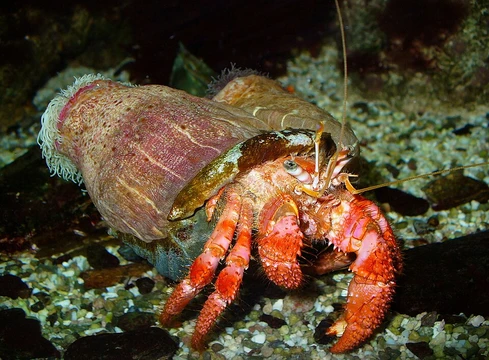
Calcinus argus
A hermit crab with distinct white spots on maroon legs.

Calcinus argus, the Argus hermit crab, belongs to the family Diogenidae. Its most striking feature is a maroon body with distinct white spots of varying size and spacing on its three walking legs, a color pattern that distinguishes it from related species in the same area. Like all arthropods, it has a segmented body divided into head, thorax, and abdomen. As a decapod, it possesses five pairs of legs, the first pair being claws (chelipeds) with the left claw larger than the right. Its carapace ranges from light green to pure white, while its black eyes are dotted with small white spots. The eye stalks are long and slender, and the carapace is less rounded than in other species.
This hermit crab originates from Hawaii and is rarely encountered across the Indo-West Pacific, a region stretching from Eastern Africa to the Hawaiian Islands. It inhabits shallow intertidal waters from the surface down to about 40 meters, preferring clean, moving salt water and never venturing into deeper areas. It is typically found on or near reefs, especially among branches of Acropora or Pocillopora coral. Sea surface temperatures in its habitat range from 25 to 30 °C, with salinity between 30 and 35 PSU. Specimens were collected and studied in the Mariana Islands alongside eleven other Calcinus species, with records spanning 2003 to 2007 and three additional records from 2017.
To protect its soft abdomen, Calcinus argus occupies a variety of shells. When disturbed, it retreats into its shell and drops into the middle of the coral reef.
Quick Facts
- Genus
- Calcinus
- Species
- argus
Facts from the source article.
Lore & Background
Calcinus argus was described by David Wooster in 1984. It originates from the Indo-West Pacific near Hawaii and is rarely found across that geographic division, from Eastern Africa to the Hawaiian Islands. Specimens were examined in the Mariana Islands alongside 11 other Calcinus species. The species is characterized by unique, distinctly sized and spaced white spots across its three pereopods (walking legs) against a maroon shell. It has longer, slender eye stalks and a less rounded carapace compared to related species. As a member of the order Decapoda, it has five pairs of legs, with one pair being chelipeds (claws); the left claw is larger than the right. Its carapace can range from lightly green to completely white, and its eyes are black with small white spots.
Reader's Guide
Calcinus argus is a species of hermit crab described by David Wooster in 1984, originating from the Indo-West Pacific near Hawaii. It is rarely found across this region, from Eastern Africa to the Hawaiian Islands, with specimens examined in the Mariana Islands. The species inhabits intertidal depths from the surface to around 40 m, preferring clean, moving salt water and reef environments, particularly in branches of Acropora or Pocillopora coral. It avoids deeper waters and requires sea surface temperatures of 25-30 °C and salinities of 30-35 PSU. Records span from 2003 to 2007, with three additional records from 2017. Its distinctive coloration—white spots on maroon walking legs—makes it notable among Calcinus species. Behaviorally, it protects its soft abdomen with a variety of shells and retreats into its shell when disturbed, falling into the middle of coral reefs.
Did You Know?
- Its walking legs have unique white spots against a maroon shell.
- It is rarely found across the Indo-West Pacific from Eastern Africa to Hawaii.
- It inhabits reef areas in branches of Acropora or Pocillopora coral.
Taxonomic Identity and Classification
Calcinus argus belongs to a genus that occupies a clearly defined position within the broader taxonomy of hermit crabs. The genus Calcinus is formally placed in the family Diogenidae, a grouping that unites a particular lineage of these shell-dwelling crustaceans under a shared evolutionary and morphological framework. As a member of Diogenidae, Calcinus argus inherits its classification from a family that distinguishes itself within the larger hermit crab assemblage. The genus itself serves as a taxonomic container, grouping together species that share enough characteristics to be recognized as a coherent biological unit. This placement in Diogenidae, rather than in other hermit crab families, signals a specific set of shared traits and evolutionary history that set Calcinus apart from its relatives in other genera. For anyone studying the classification of hermit crabs, Calcinus argus represents one thread in the larger tapestry of Diogenidae, a family whose members collectively illustrate the diversity of this remarkable group of decapod crustaceans.
Genus Composition and Species Range
The genus Calcinus is not a single-species entity but rather a collection of multiple hermit crab species grouped together under one taxonomic name. The Wikipedia entry for the genus explicitly notes that it contains several species, positioning Calcinus argus as one member within a broader assemblage of related organisms. This multi-species structure means that Calcinus argus shares a genus-level kinship with its fellow Calcinus species, all of which fall under the Diogenidae family umbrella. The existence of multiple species within the genus suggests a degree of diversification and ecological variation among these hermit crabs, even as they remain united by the shared characteristics that define the genus. For a fan encyclopedia, this means that Calcinus argus cannot be understood in isolation; it is one voice in a chorus of related species, each contributing to the full picture of what the genus Calcinus represents within the hermit crab world.
Digital Presence and Reference Resources
For those seeking to explore Calcinus and its species beyond the text of a single encyclopedia entry, a pair of dedicated digital resources provides a gateway to further investigation. Wikimedia Commons hosts a collection of media files specifically tagged as related to Calcinus, offering visual and multimedia material that can complement the written taxonomic description. This repository of images and other media gives researchers, hobbyists, and curious readers a way to see the genus represented in photographs, illustrations, or other visual formats. In parallel, Wikispecies maintains a data page dedicated to Calcinus, serving as a structured reference point for the genus within the global biodiversity informatics ecosystem. Together, these two external resources form a modest but valuable digital footprint for the genus, ensuring that Calcinus argus and its relatives are not confined to a single text but are accessible through multiple platforms that support both casual browsing and more rigorous taxonomic research.
Life Within the Diogenidae Family
Being a hermit crab is, in itself, a remarkable biological strategy, and Calcinus argus practices it as a member of the family Diogenidae. This family designation is not merely a bureaucratic label; it places Calcinus within a specific branch of the hermit crab evolutionary tree, one that is distinct from other families of shell-dwelling crustaceans. The Diogenidae family groups together hermit crabs that share a particular set of anatomical and behavioral traits, and Calcinus argus, as a species within the genus Calcinus, inherits its place in this family by virtue of those shared characteristics. The fact that Calcinus is explicitly identified as a genus of hermit crabs in Diogenidae underscores that its members rely on the same fundamental ecological strategy as their family-mates: the use of borrowed shells for protection. This family-level identity provides the essential context for understanding what Calcinus argus is, how it relates to other hermit crabs, and where it fits in the broader classification of decapod crustaceans.
Frequently Asked Questions
What is Calcinus argus?
Calcinus argus, commonly called the Argus hermit crab, is a species in the family Diogenidae. It was formally described by David Wooster in 1984 and is native to the Indo-West Pacific region near Hawaii.
What does Calcinus argus look like?
Its most eye-catching trait is a deep maroon body with scattered white spots of varying size across its three walking legs. The carapace ranges from light green to pure white, and its black eyes are dotted with tiny white speckles.
Where can Calcinus argus be found?
This species inhabits Indo-West Pacific waters around Hawaii, ranging from the intertidal zone down to roughly 40 metres. It prefers warm surface temperatures of 25–30 °C and salinities between 30 and 35 PSU.
How do you tell Calcinus argus apart from other Diogenidae?
The irregular white spotting on its maroon legs is the primary visual cue that separates it from look-alike species in the same area. Additionally, its left cheliped is noticeably larger than the right, a decapod trait that helps confirm identification.
Who described Calcinus argus and when?
The species was named and described by David Wooster in 1984. Prior to that formal description, the crab had not been recognised as a distinct species within the Diogenidae family.
More in Hermit Crabs 1-24
Spotted an error? Know more?
Reader corrections go straight into our review queue. Suggest an edit · How this site is sourced