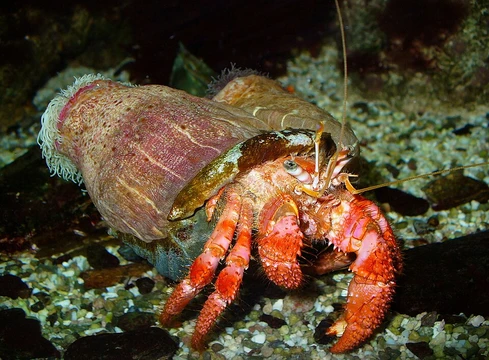
Calcinus verrillii
A Bermuda-endemic hermit crab that sometimes filter-feeds from cemented tubes.

Calcinus verrillii, called Verrill's hermit crab, is a Bermuda-only species in the genus Calcinus. American zoologist Mary J. Rathbun first described it, naming it after fellow zoologist Addison Emery Verrill, who led students in studying Bermuda's geology and marine life. This crab usually lives in empty gastropod shells, but it sometimes occupies the tube-like shells of certain gastropods that are permanently cemented to reef rocks.
Like other Calcinus crabs, it has a sturdy, calcified carapace, eight thoracic segments, and six or seven abdominal segments. Its carapace and legs are spotted purple and orange, with slender eyestalks and smooth, hairless front walking legs. The soft, coiled abdomen fits inside the protective shell, with uropods at the tip gripping the interior.
This hermit crab is found only in Bermuda, mostly in the subtidal zone down to 110 meters. It is uncommon in intertidal areas and rock pools but abundant on reefs and rocks with strong water movement.
As it grows, it must find suitable empty gastropod shells, often from *Cerithium litteratum*, though empty shells can be scarce. Sometimes it takes up residence in the calcified tube of the vermetid *Spiroglyphus irregularis*, or the tubes of *Vermicularia knorrii* and *Vermicularia spirata*. These tubes are normally attached to rocks, which restricts the crab's movement and prevents it from gathering algae or scavenging; instead, it becomes a filter feeder. The advantage is that the tube is less likely to be swept away by strong currents, and food is brought by the water flow. Females grow larger than males and are more likely to occupy tube shells.
Quick Facts
- Taxon
- Calcinus verrillii
Facts from the source article.
Lore & Background
Calcinus verrillii was first described by the American zoologist Mary J. Rathbun and named in honor of the American zoologist Addison Emery Verrill, who spent much time with his students studying the geology and marine fauna of Bermuda. Like other crabs in the genus Calcinus, it has a robust, calcified carapace, eight thoracic segments and six or seven abdominal segments. The carapace and legs are spotted with purple and orange, the eyes have slender eyestalks, and the front three pairs of walking legs are smooth and hairless. The soft abdomen is coiled and fits into the mollusc shell which the hermit crab uses for protection, with the uropods at the tip of the abdomen gripping the inside of the shell.
This species is native to Bermuda and does not occur naturally anywhere else. It is mostly found in the subtidal zone and has been found as deep as 110 metres (630 ft). It is uncommon in intertidal areas and rock pools but is abundant on reefs and rocks with strong water movement. As a hermit crab, it needs to find suitable empty shells of gastropod molluscs in which to live as it grows. It commonly inhabits shells of Cerithium litteratum, but empty shells can sometimes be in short supply.
Reader's Guide
Calcinus verrillii is notable as a Bermuda-endemic hermit crab that exhibits a rare behavioral shift: when it inhabits the calcified tube of the vermetid gastropod Spiroglyphus irregularis or the tubes of the turritellids Vermicularia knorrii and Vermicularia spirata, it loses freedom of movement and becomes a filter feeder instead of gathering algae or scavenging. The advantages to the crab in making use of such a tube-like shell are that it is less likely to be swept off the rocks by strong water movements, and plenty of food may be brought to it by the current. Female C. verrillii grow larger than males and are more likely to occupy tube shells. The species was first described by Mary J. Rathbun and named after Addison Emery Verrill, reflecting the historical study of Bermuda's marine fauna. Its presence in both subtidal zones and on reefs with strong water movement, as well as its occasional reliance on cemented tubes, highlights its ecological adaptability within a restricted geographic range.
Discovery and the Story Behind the Name
Verrill's hermit crab belongs to the genus Calcinus and holds a unique place in marine biology as a species found nowhere in the world except the waters surrounding Bermuda. Its formal scientific description was the work of Mary J. Rathbun, an American zoologist who contributed to the growing catalogue of Atlantic marine life in the early twentieth century. The species carries the name of Addison Emery Verrill, another American zoologist whose connection to Bermuda ran deep. Verrill devoted considerable time to the island, often accompanied by his students, conducting fieldwork that spanned both the geological formations and the rich marine fauna of the surrounding reefs. His hands-on approach to studying Bermuda's underwater ecosystems left a lasting mark on the region's scientific record. The fact that this small, colorful crab bears his name is a testament to the breadth of his contributions. Today, C. verrillii remains a symbol of Bermuda's extraordinary marine endemism, a living reminder that even the most remote island chains can harbour species found on no other shore on Earth.
Anatomy and Appearance
Like its close relatives within the genus Calcinus, Verrill's hermit crab is built for durability. Its carapace is notably robust and heavily calcified, giving the animal a sturdier frame than many other hermit crabs. The body plan follows the typical calcinine pattern: eight thoracic segments support the walking apparatus, while the posterior section comprises six or seven abdominal segments. Visually, the crab is striking. Both the carapace and the legs are mottled with spots of purple and orange, lending the animal a vivid, almost painterly quality against the pale reef substrate. The eyes sit atop slender eyestalks, and the front three pairs of walking legs are conspicuously smooth and devoid of the fine hairs seen in some related species. The soft, unarmored abdomen is tightly coiled and tucks neatly inside whatever gastropod shell the crab has claimed. At the very tip of the abdomen, a pair of uropods extends to grip the interior wall of the shell, anchoring the animal securely within its borrowed home.
Range and Preferred Habitat
Calcinus verrillii is strictly endemic to Bermuda; it has never been recorded in the wild from any other location on the planet. This makes it one of the island's most distinctive marine residents. Within its limited geographic range, the crab shows a clear preference for the subtidal environment, where it thrives on coral reefs and rocky outcrops exposed to strong water movement. Divers and researchers have encountered individuals at depths reaching as far as 110 metres (roughly 630 feet), demonstrating a remarkable tolerance for the deeper, darker waters below the photic zone. By contrast, the species is rarely seen in the intertidal zone or in the shallow rock pools that fringe the shore. The strong currents that characterize Bermuda's reef habitats appear to be a key factor in the crab's distribution. These dynamic conditions, which would sweep away less well-anchored organisms, seem to suit C. verrillii particularly well, whether it is perched atop a free gastropod shell or tucked inside a cemented tube. The result is a species whose presence is a reliable indicator of healthy, energetic reef ecosystems around the island.
Shell Selection and Feeding Strategies
As a hermit crab, C. verrillii must continually seek out suitable empty gastropod shells to house its soft abdomen as it grows. Its most common choice is the shell of Cerithium litteratum, a free-living snail whose discarded housing provides the classic hermit crab lifestyle of mobility and scavenging. However, empty shells of this type are not always plentiful, and the crab has evolved a flexible alternative. On occasion, it settles into the permanently cemented, tube-like shells of vermetid gastropods such as Spiroglyphus irregularis, or into the tubes of turritellids including Vermicularia knorrii and Vermicularia spirata. Once inside such a fixed tube, the crab loses its ability to roam the reef surface gathering algae fragments or scavenging detritus. Instead, it shifts to a filter-feeding strategy, drawing food particles delivered by the current. The trade-off is clear: the crab sacrifices mobility but gains protection from being dislodged by strong water movement, while the same currents bring a steady supply of nourishment. Notably, females, which grow to a larger size than males, show a stronger tendency to occupy these tube-like dwellings.
Frequently Asked Questions
What is Calcinus verrillii?
Calcinus verrillii, commonly called Verrill's hermit crab, is a small marine crustacean found exclusively in Bermuda's waters. It belongs to the genus Calcinus and is recognised by its spotted carapace and legs.
Where does Calcinus verrillii live and how deep can it be found?
This species is endemic to Bermuda, meaning it occurs nowhere else on Earth. It inhabits reef environments at depths reaching up to roughly 110 metres (about 630 feet).
What kind of shells does Calcinus verrillii inhabit?
It most often takes up residence in empty gastropod shells, with Cerithium litteratum being a particularly common host. Unusually, it can also settle into the permanently cemented tube-like shells of Spiroglyphus irregularis, Vermicularia knorrii, or Vermicularia spirata, which lets it filter-feed in place.
Who described and named Calcinus verrillii?
American zoologist Mary J. Rathbun first formally described the species and chose to honour her colleague Addison Emery Verrill, a zoologist who led student fieldwork studying Bermuda's geology and marine life.
What makes Calcinus verrillii different from other hermit crabs?
Beyond its Bermuda-only range, it stands out because it occasionally occupies fixed, tube-shaped shells cemented to reef rock rather than portable gastropod shells. Its body also features a sturdy calcified carapace, eight thoracic segments, and six or seven abdominal segments typical of the genus.
More in Hermit Crabs 1-24
Spotted an error? Know more?
Reader corrections go straight into our review queue. Suggest an edit · How this site is sourced