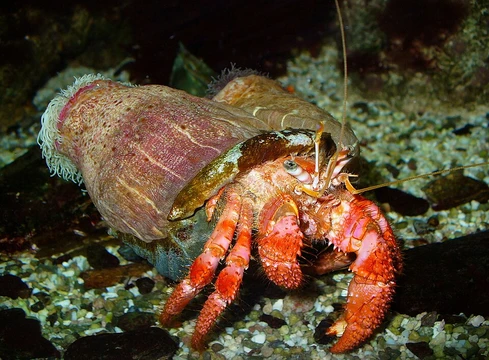
Clibanarius
A genus of hermit crabs with a freshwater species.

Clibanarius is a genus of hermit crabs belonging to the family Diogenidae. As with other hermit crabs, these animals have a soft, unprotected abdomen that they keep hidden inside a gastropod shell. While most members of this genus are marine, like all their relatives, one species—*C. fonticola*—is unique among hermit crabs for living its entire life in freshwater. The feeding rates of *Clibanarius* species vary with temperature; because these crabs are widely distributed, this temperature sensitivity could significantly affect the stability of reef systems as sea temperatures rise.
These crabs are omnivores, but they mostly eat small animals and scavenge dead matter.
As of 2025, about sixty valid species are recognized in *Clibanarius*, with new species occasionally being described. Some former members have been moved to other genera within Diogenidae, including *Bathynarius*, *Calcinus*, *Paguristes*, *Strigopagurus*, and *Trizopagurus*. The species list includes *Clibanarius elongatus* (H. Milne Edwards, 1848), which is considered a nomen dubium. Other examples: *Clibanarius hirsutimanus* Kobjakova, 1971 is now *Areopaguristes hirsutimanus*; *Clibanarius multipunctatus* Wang & Tung, 1986 is now *Strigopagurus boreonotus* Forest, 1995; and *Clibanarius sachalinicus* Kobjakova, 1955 is now *Clibanarius virescens* (Krauss, 1843).
Quick Facts
- Taxon
- Clibanarius
- Diversity Link
- #Species
- Diversity
- About 60 species
Facts from the source article.
Lore & Background
Clibanarius is a genus of hermit crabs in the family Diogenidae. Their abdomen is soft-shelled and sheltered in a gastropod shell. Typically marine like all their relatives, the genus includes C. fonticola, the only known hermit crab species that spends all its life in freshwater. The feeding rates of Clibanarius species change with temperature which, given their broad distributions, may have considerable consequences for the stability of reef systems as sea temperatures rise in the future. They are omnivores, but mostly prey on small animals and scavenge carrion. As of 2025, about sixty valid species are recognized in Clibanarius; new species are discovered and described occasionally. Several former members have been reassigned to other genera of Diogenidae, namely Bathynarius, Calcinus, Paguristes, Strigopagurus and Trizopagurus. The Clibanarius species include: Else: Clibanarius elongatus (H. Milne Edwards, 1848) is a nomen dubium. See also: Clibanarius hirsutimanus Kobjakova, 1971 later Areopaguristes hirsutimanus (Kobjakova, 1971); Clibanarius multipunctatus Wang & Tung, 1986 later Strigopagurus boreonotus Forest, 1995; Clibanarius sachalinicus Kobjakova, 1955 later Clibanarius virescens (Krauss, 1843).
Reader's Guide
The significance of Clibanarius lies in its unique ecological role and the potential impact of climate change. As omnivores that mostly prey on small animals and scavenge carrion, they contribute to reef system dynamics. Their feeding rates change with temperature, and given their broad distributions, this may have considerable consequences for the stability of reef systems as sea temperatures rise in the future. The genus is also notable for containing C. fonticola, the only known hermit crab species that spends all its life in freshwater, distinguishing it from its typically marine relatives. Taxonomic revisions have reassigned several former members to other genera of Diogenidae, reflecting ongoing refinement of classification. The recognition of about sixty valid species as of 2025, with occasional new discoveries, indicates that the genus remains an active area of study.
Did You Know?
- The feeding rates of Clibanarius species change with temperature, which may affect reef system stability as sea temperatures rise.
- Several former Clibanarius members have been reassigned to other genera including Bathynarius, Calcinus, Paguristes, Strigopagurus, and Trizopagurus.
Taxonomic Uniqueness
Clibanarius fonticola occupies a position in the crustacean world that is virtually without parallel. As a member of the hermit crab group, it belongs to the broader order of anomurans, yet it stands alone among all hermit crabs as the sole species that conducts its entire existence in fresh water. While countless other members of this group inhabit marine environments, sandy shores, or brackish estuaries, none commit fully to a freshwater existence the way this Vanuatu species does. Its classification as left-handed further sets it apart morphologically from the majority of hermit crabs, which typically exhibit right-handed coiling. The only other anomurans that achieve full freshwater adaptation are the pancoras belonging to the family Aeglidae, found in South American waters. This makes Clibanarius fonticola not merely unusual but a singular evolutionary outlier within its order, a creature whose lifestyle has no true counterpart among its closest relatives.
A Singular Habitat
The entire known population of Clibanarius fonticola is confined to an extraordinarily narrow geographic range on the island of Espiritu Santo in Vanuatu. The species inhabits a single pool that receives its water from natural springs, situated near the village of Matevulu. What makes this location particularly striking is its proximity to an abandoned airstrip, meaning this unique crustacean thrives in a setting where human infrastructure once operated and has since fallen silent. The spring-fed nature of the pool provides the consistently fresh water environment that this species requires for survival, distinguishing it from the brackish or marine conditions that other hermit crabs occupy. The fact that an entire species depends on one such pool, nestled in a rural village setting beside a disused runway, underscores how fragile and geographically isolated this population truly is. No other hermit crab anywhere on Earth shares this precise ecological niche.
Shell Use and Morphology
Like all hermit crabs, Clibanarius fonticola relies on borrowed shells for protection, yet its choices are remarkably specialized. Every adult individual of this species uses the shells of Clithon corona, a particular gastropod, indicating a tight ecological relationship between the crab and its shell source. This uniformity in shell preference among adults suggests a degree of morphological fit that may be difficult to replicate with alternative shell types. Additionally, the species is characterized as left-handed, a trait that distinguishes it from the right-handed majority among hermit crabs. This handedness likely influences how the crab coils within its borrowed shell and may constrain which gastropod shells are suitable. The combination of a single shell species and a consistent left-handed morphology paints a picture of a highly specialized organism whose biology is finely tuned to its immediate environment on Espiritu Santo.
Ecological Context Among Anomurans
To appreciate what makes Clibanarius fonticola remarkable, one must consider the broader landscape of hermit crab ecology. The vast majority of hermit crabs are marine or terrestrial species, while others occupy estuarine zones where salt and fresh water mix. A handful of brackish-water species can endure periods of reduced salinity, but none of them commit to a fully freshwater existence for their entire lifespan. Clibanarius fonticola breaks this pattern entirely, spending every stage of its life in fresh water with no marine phase. Within the wider order of anomurans, the only other creatures that achieve complete freshwater adaptation are the pancoras of the family Aeglidae, native to South America. This places the Vanuatu hermit crab in an extraordinarily small club of freshwater anomurans, separated by both geography and evolutionary history from its closest freshwater counterparts. Its isolation in a spring-fed pool on Espiritu Santo makes it a living reminder of how evolution can carve out unique ecological strategies in even the most restricted of habitats.
Frequently Asked Questions
What is Clibanarius?
Clibanarius is a genus of hermit crabs in the family Diogenidae, encompassing roughly sixty valid species as of 2025. Like all hermit crabs, these animals tuck their soft, unarmored abdomen inside a borrowed gastropod shell for protection.
What makes Clibanarius unique among hermit crabs?
The genus includes C. fonticola, the only hermit crab species known to spend its entire life in freshwater rather than the ocean. Every other recognized hermit crab species is marine, making this freshwater adaptation singular within the group.
What do Clibanarius hermit crabs eat?
Clibanarius species are omnivorous, relying primarily on small animals as prey while also scavenging carrion when available. This varied diet helps them thrive across the wide range of habitats they occupy.
How many species are in the genus Clibanarius?
As of 2025, approximately sixty valid species are recognized within Clibanarius. Several former members have since been reassigned to other genera such as Bathynarius, Calcinus, Paguristes, Strigopagurus, and Trizopagurus.
Why is temperature important for Clibanarius?
Feeding rates in Clibanarius shift noticeably with water temperature, a sensitivity that becomes ecologically significant as ocean temperatures climb. Because these crabs are so broadly distributed, changes in their feeding behavior could ripple through the stability of reef ecosystems.
More in Hermit Crabs 1-24
Spotted an error? Know more?
Reader corrections go straight into our review queue. Suggest an edit · How this site is sourced