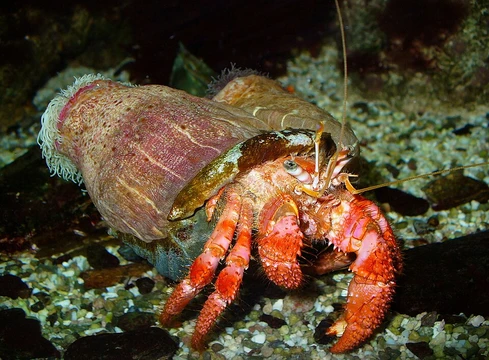
Calcinus laevimanus
A left-handed hermit crab from the Indo-West Pacific.

Calcinus laevimanus, known as the left-handed hermit crab, belongs to the genus *Calcinus* and lives across the Indo-West Pacific, with its type location in Hawaii. Its front section is hardened, while the rear, sheltered by a shell, remains soft. Adults reach up to 30 mm (1.2 in) in total length, with a shield length up to 8 mm (0.3 in); males tend to be larger than females. The eyestalks are long, thin, and swollen at the base. The left claw is noticeably bigger than the right, and its penultimate joint is smooth and glossy, with spoon-shaped, calcified tips on the fingers. The carapace is generally brown to grey. Eyestalks are blue at the base and orange at the tips. The first pair of antennae have blue bases and orange tips, while the second pair are entirely orange. The claws are purplish-brown with white fingertips, and the walking legs are orangish-brown with white tips.
This crab inhabits tropical and subtropical western Indo-Pacific waters, from East Africa, Madagascar, and the Comoros, through Indonesia, the Philippines, Australia, and Papua New Guinea to Hawaii, including many western Pacific island groups. It typically lives from the low intertidal zone to the upper subtidal zone, on rocky reefs and among rock or coral rubble. When selecting a new shell, it prefers globose types, especially *Turbo* and *Nerita*. In Hawaii, it often uses shells of *Trochus intextus* and *Turbo sandwicensis*; in South Africa, it favors empty *Lunella coronata* shells. This species is aggressive, willing to fight for empty shells or other resources. The size and brightness of the white patch on its left claw serve as a status signal, aiding in confrontations. Females carry eggs under the abdomen. In Hawaii, about 80% of females carry eggs from February to October, typically around three thousand eggs. After hatching, the larvae go through six zoeal stages and one glaucothoe stage.
Quick Facts
- Taxon
- Calcinus laevimanus
Facts from the source article.
Lore & Background
The anterior part of Calcinus laevimanus is calcified, while the posterior part, protected by the shell it inhabits, is not. Its eyestalks are long and slender, inflated at the base. The left cheliped is much larger than the right; the propodus is smooth and shiny, with spoon-shaped, calcified tips on the finger and thumb. The carapace is generally brown to grey, the eye stalks blue at the base and orange distally, the first pair of antennae have blue bases and orange tips, and the second pair are entirely orange. The chelipeds are purplish-brown with white fingertips, and the walking legs are orangish-brown with white tips.
This species is found in tropical and sub-tropical western Indo-Pacific waters, from East Africa, Madagascar and the Comores through Indonesia, the Philippines, Australia and Papua New Guinea to Hawaii, including many western Pacific archipelagoes. It typically inhabits the low intertidal to upper subtidal zones on rocky reefs and rock and coral rubble.
When selecting a shell, C. laevimanus prefers globose shells, especially those of Turbo and Nerita. In Hawaii, Trochus intextus and Turbo sandwicensis shells are often used; in South Africa, empty Lunella coronata shells are favored. The species is aggressive and will fight for empty shells or other resources. The size and brightness of the white patch on the left chela appears to serve as a status symbol and aids in agonistic interactions. Females carry eggs under the abdomen; in Hawaii, 80% of females carry eggs between February and October, typically about three thousand eggs. Larvae pass through six zoeal stages and one glaucothoe stage.
Reader's Guide
Calcinus laevimanus is significant as a widely distributed Indo-West Pacific hermit crab, with its type locality in Hawaii. Its most distinctive feature is the enlarged left cheliped, which gives it the common name 'left-handed hermit crab.' The species is notable for its aggressive behavior in competing for shells, a critical resource for survival. The white patch on the left chela functions as a visual signal in these contests, with size and brightness correlating to status. This species also shows regional variation in shell preference, favoring Turbo and Nerita shells generally, but specific species in Hawaii and South Africa. Its reproductive biology is documented in Hawaii, where most females carry eggs from February to October, with an average clutch of about three thousand eggs. The larval development includes six zoeal stages and one glaucothoe stage. The species' coloration—blue and orange eyestalks, purplish-brown chelipeds with white tips, and orangish-brown walking legs—makes it visually distinctive among hermit crabs.
Did You Know?
- The left cheliped is much larger than the right, giving the species its common name.
- The white patch on the left chela serves as a status symbol in aggressive interactions.
Taxonomic Placement
Calcinus laevimanus belongs to the genus Calcinus, which is classified among the hermit crabs. This genus sits within the family Diogenidae, a grouping that places it in a specific branch of the hermit crab lineage. The classification as a hermit crab is a defining characteristic, distinguishing members of this genus from other crustacean groups. Within the broader taxonomy of decapod crustaceans, the placement in Diogenidae signals particular morphological and behavioral traits shared across the family. The genus Calcinus, as a taxonomic unit, groups together species that share common ancestral characteristics, and Calcinus laevimanus is one such member. The family-level designation of Diogenidae provides the broader biological context in which this species is understood, linking it to a well-defined clade of hermit crabs with a shared evolutionary history.
Genus Composition and Diversity
The genus Calcinus is described as containing multiple species, indicating it is not a monotypic group but rather a collection of related hermit crab species. While the specific roster of species within the genus is documented in taxonomic literature, the key structural fact is that Calcinus laevimanus is one among several species that share this genus-level classification. This multi-species composition suggests a degree of morphological and ecological diversity within the group, with each species representing a distinct evolutionary lineage under the Calcinus banner. The genus as a whole falls under the family Diogenidae, meaning all its member species, including Calcinus laevimanus, share the broader hermit crab characteristics associated with that family. The existence of multiple species within one genus reflects the natural branching and diversification that occurs in hermit crab evolution.
Digital Presence and Open Documentation
Beyond traditional taxonomic literature, the genus Calcinus has a presence in digital open-access resources. Wikimedia Commons hosts media related to Calcinus, providing visual documentation that can include photographs, illustrations, or other media files contributed by the community. This digital repository serves as an accessible reference point for researchers, educators, and enthusiasts seeking visual material related to the genus. Additionally, Wikispecies maintains data entries for Calcinus, offering a structured, collaborative platform for species-level information. These digital resources complement the formal taxonomic description by making genus-level information more widely accessible. For a species like Calcinus laevimanus, these platforms represent the broader ecosystem of open scientific documentation where hermit crab taxonomy is recorded, shared, and made available to the global community without institutional barriers.
The Diogenidae Context
Understanding Calcinus laevimanus requires situating it within the family Diogenidae, the taxonomic framework that defines its broader biological identity. As a member of this family, Calcinus laevimanus is part of the hermit crab group, a category of crustaceans recognized by their distinctive ecological niche. The family Diogenidae represents a specific evolutionary branch within the hermit crab lineage, and all genera within it, including Calcinus, share certain fundamental traits that distinguish them from other crustacean families. The genus Calcinus, as one node within Diogenidae, carries the hereditary and morphological signatures of its family while also expressing genus-level distinctions. This hierarchical placement, from family to genus to species, provides the structural logic by which Calcinus laevimanus is identified, compared, and understood in relation to its broader hermit crab relatives.
Frequently Asked Questions
Who is Calcinus laevimanus?
Calcinus laevimanus is a small hermit crab species commonly called the left-handed hermit crab, belonging to the genus Calcinus. It is native to the Indo-West Pacific region, with its type locality recorded in Hawaii.
What makes Calcinus laevimanus stand out from other hermit crabs?
Its most distinctive trait is that the left claw is noticeably larger than the right, giving it a 'left-handed' appearance. The penultimate joint of that claw is smooth and glossy, and the finger tips are spoon-shaped and calcified.
Where can you find Calcinus laevimanus in the wild?
This species ranges across the Indo-West Pacific, stretching from East Africa all the way to Hawaii. Its type locality is specifically Hawaii.
How big does Calcinus laevimanus grow?
Adults reach a maximum total length of about 30 mm (1.2 inches), with the carapace shield measuring up to 8 mm (0.3 inches). Males typically grow larger than females.
How does Calcinus laevimanus reproduce?
A female Calcinus laevimanus produces roughly three thousand eggs per clutch. Beyond that, the species shows clear sexual dimorphism, with males generally being the bigger of the two sexes.
More in Hermit Crabs 1-24
Spotted an error? Know more?
Reader corrections go straight into our review queue. Suggest an edit · How this site is sourced