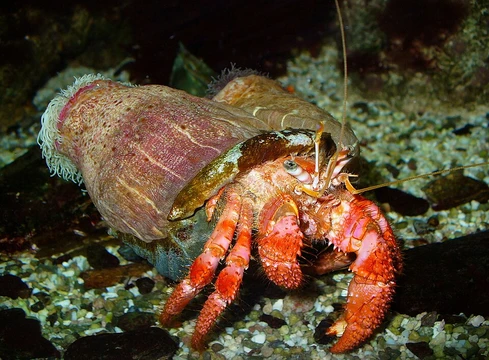
Aniculus maximus
A large aquatic hermit crab with white hairy bristles.

Aniculus maximus, called the hairy yellow hermit crab or large hairy hermit crab, belongs to the aquatic hermit crab family Diogenidae. Its body can be intense red or golden yellow, with white hairy bristles sprouting from beneath its distinct yellow legs. A series of furrows mark its shield. This crab can reach a width of 10 cm (3.9 in). Charles H. Edmonson of the Honolulu Bishop Museum gave it the species name "maximus," meaning "the greatest," because it can grow as large as a human hand. It lives in the Indo-Pacific region, in the benthic zone at depths of 10 to 100 meters (33–328 ft). Most often found at 15 meters (50 ft) or deeper, it inhabits ledges or caves. At shallower depths, around 15 meters (49 ft), it has been observed on coral reefs, rock reefs, and barrel sponges. It feeds on mollusks, sometimes killing them over several days to take their shells. It is also an omnivore, eating algae or other meat it finds. Mating begins with a ritual using olfactory and tactile cues. Reproduction is sexual and indirect, via spermatophores. After mating, the female keeps the fertilized eggs inside the underside of her shell. The eggs hatch into planktonic larvae, which find their own shells once mature.
Quick Facts
- Taxon
- Aniculus maximus
Facts from the source article.
Lore & Background
The species was named 'maximus' or 'the greatest' by Charles H. Edmonson of the Honolulu Bishop Museum, describing its large size, as it is known to grow up to the size of a hand. Its colour ranges from intense red to golden yellow, and it has white hairy bristles that extend from under its distinct yellow legs. Its shield is marked with a series of furrows. Aniculus maximus is found in the Indo-Pacific region and inhabits the Benthic zone at depths of 10–100 metres (33–328 ft). It is most commonly found at depths of 15 metres (50 ft) or deeper, where it habit ledges or caves. At shallower depths around 15 metres (49 ft), it has been observed on coral reefs, rock reefs, and barrel sponges. The mating process begins with a ritual initiated by olfactory and tactile indicators. It reproduces sexually and indirectly through the use of spermatophores. After mating, the female keeps the fertilized eggs inside the underside of her shell. The eggs hatch into planktonic larvae that find shells of their own once mature enough.
Reader's Guide
Aniculus maximus is significant as a large and visually striking hermit crab of the Indo-Pacific region, noted for its size and coloration. Its name, given by Charles H. Edmonson, reflects its notable size, growing up to the size of a hand. The species inhabits a range of depths from 10 to 100 metres, with a preference for deeper ledges or caves, though it can also be found on coral reefs, rock reefs, and barrel sponges at shallower depths. Its diet as an omnivore includes mollusks, which it may kill over several days for their shells, as well as algae and other meat. The reproductive process involves olfactory and tactile cues, with indirect fertilization via spermatophores and the female carrying eggs under her shell until they hatch into planktonic larvae. This species contributes to the understanding of hermit crab diversity and behavior in benthic marine environments.
Physical Appearance and Impressive Size
The hairy yellow hermit crab, scientifically designated Aniculus maximus, is a striking member of the Diogenidae family that immediately catches the eye with its vivid coloration. Its body shifts across a spectrum from deep, intense red to a brilliant golden yellow, while its legs carry a distinctly yellow hue. Perhaps most notably, white hairy bristles sprout from beneath those legs, giving the species its common "hairy" moniker. The carapace, or shield, bears a series of furrows that add texture to its overall appearance. In terms of scale, this crab can achieve a width of up to ten centimeters, roughly the span of a human hand. It was Charles H. Edmonson, working at the Honolulu Bishop Museum, who bestowed the species epithet "maximus," a Latin term meaning "the greatest," as a nod to its notably large size among hermit crabs. This aquatic creature is also known colloquially as the large hairy hermit crab, a name that captures both its impressive dimensions and its distinctive bristly appearance.
Habitat and Depth Preferences
Aniculus maximus calls the Indo-Pacific its home, inhabiting the benthic zone where the seafloor meets the water column. Its depth range spans from ten to one hundred metres, though it shows a clear preference for the deeper end of that spectrum. Observers most frequently encounter it at fifteen metres or below, where it takes shelter among rocky ledges and cave systems. At the shallower boundary of its preferred range, hovering around the fifteen-metre mark, this crab has been spotted perched on coral reefs, navigating rock reefs, and dwelling among barrel sponges. These varied microhabitats suggest a creature comfortable in both structured reef environments and the more enclosed, shadowed spaces of underwater caves. The fact that it gravitates toward deeper waters and concealed structures may reflect a strategy for avoiding predators or finding stable conditions in which to forage and rest. As a member of the Diogenidae family, it shares the hermit crab lifestyle of relying on borrowed shells, yet its depth preferences set it apart from many of its shallower-water relatives.
Feeding Behavior and Omnivorous Diet
The dietary habits of the hairy yellow hermit crab reveal a creature that is both opportunistic and patient. As an omnivore, Aniculus maximus will consume algae and whatever other meat it can locate in its benthic environment. However, its most notable feeding behavior centers on mollusks. Rather than simply scavenging, this crab has been observed actively killing mollusks over the course of several days, apparently to harvest their shells for its own use. This multi-day pursuit of a single prey item underscores a level of persistence and planning that is remarkable for a hermit crab. The combination of plant matter and animal protein in its diet allows it to exploit a wider range of food sources across its habitat, whether it is foraging on a coral reef at fifteen metres or rummaging through a cave at greater depth. Its omnivorous flexibility, paired with the targeted shell-hunting behavior directed at mollusks, paints a picture of an adaptable predator-prey hybrid that thrives in the diverse benthic ecosystems of the Indo-Pacific.
Reproductive Ritual and Larval Development
The reproductive strategy of Aniculus maximus follows a sequence that begins with sensory courtship and ends with a free-swimming larval phase. Mating is initiated through a ritual that relies on both olfactory cues and tactile signals, suggesting the pair must be in close physical proximity to coordinate their behavior. The species reproduces sexually and indirectly, employing spermatophores as the mechanism for transferring genetic material. Following successful mating, the female takes on the responsibility of carrying her fertilized eggs, tucking them safely beneath the underside of her borrowed shell. This protective arrangement shields the developing brood until they are ready to emerge. Upon hatching, the eggs release planktonic larvae into the water column, where they drift and develop independently. Once these larvae reach sufficient maturity, they must locate and claim their own shells, beginning the hermit crab lifestyle anew. This transition from a protected, shell-bound juvenile to an open-water larva represents a critical and vulnerable stage in the species' life cycle.
Frequently Asked Questions
What is Aniculus maximus?
Aniculus maximus is a species of aquatic hermit crab in the family Diogenidae, commonly known as the hairy yellow hermit crab or the large hairy hermit crab. It is one of the bigger members of its group and is found in the Indo-Pacific region.
How big does Aniculus maximus get?
This crab can reach a body width of about 10 centimeters (roughly 3.9 inches), large enough to span a human hand. That impressive size is exactly why Charles H. Edmonson of the Honolulu Bishop Museum named the species 'maximus,' which translates to 'the greatest.'
Where does Aniculus maximus live?
It inhabits the benthic zone of the Indo-Pacific, typically at depths between 10 and 100 meters (33–328 feet). Most sightings place it at 15 meters (50 feet) or deeper.
What does Aniculus maximus look like?
Its body ranges from deep red to golden yellow, and it is covered with distinctive white hairy bristles that grow from beneath its yellow legs. The shield also bears a series of visible furrows, giving it a textured appearance.
Why is Aniculus maximus notable among hermit crabs?
It stands out because of its large size relative to other hermit crabs and its striking combination of vivid coloration with dense white bristles. Its hand-spanning width and bold red-and-yellow palette make it one of the most visually memorable members of the Diogenidae family.
More in Hermit Crabs 1-24
Spotted an error? Know more?
Reader corrections go straight into our review queue. Suggest an edit · How this site is sourced