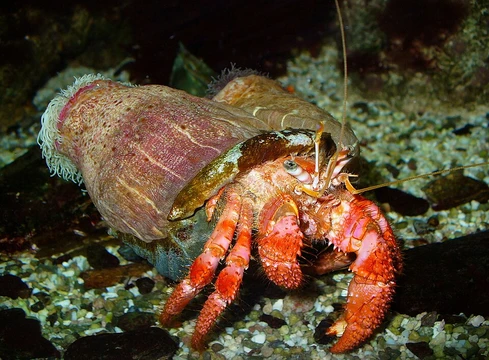
Clibanarius erythropus
Hermit crab found in rockpools from the Mediterranean to Cornwall.

Clibanarius erythropus is a hermit crab found in rockpools and shallow coastal waters. Its range includes the Mediterranean Sea, the Black Sea, and the eastern Atlantic from the Azores up to Brittany, the Channel Islands, and as far north as the south coast of Cornwall. The carapace of an adult can reach 15 millimetres (0.6 inches) in length.
This crab uses a variety of gastropod shells for protection. In the Azores, the most common shells are those of *Littorina striata*, *Mitra*, *Nassarius incrassatus*, and *Stramonita haemastoma*, which together account for 85% of individuals studied. In the Mediterranean, *Cerithium*, *Alvania montagui*, and *Pisania maculosa* shells are most frequently used. Like other hermit crabs, it feeds on organic debris, both decayed and fresh macro-algae along with their associated fauna and epiphytic algae, small invertebrates, and pieces of dead or live animal tissue. Research shows that this species prefers substrates that allow it to cover large distances, and that globose shells give it better mobility than elongated ones.
In 2016, the BBC programme *Springwatch* featured *C. erythropus* and held a competition to give it a common name. The winning name was St Piran’s crab, a choice supported by the National Trust West Cornwall and the Cornwall Wildlife Trust. Saint Piran, the patron saint of Cornwall, was a hermit who reportedly survived being thrown into the sea.
Quick Facts
- Taxon
- Clibanarius erythropus
Facts from the source article.
Lore & Background
Clibanarius erythropus uses a variety of gastropod shells. In the Azores, the most frequent shells are Littorina striata, Mitra, Nassarius incrassatus and Stramonita haemastoma, which collectively account for 85% of all individuals studied there. In the Mediterranean, shells of Cerithium, Alvania montagui and Pisania maculosa are most used. Like other hermit crabs, it feeds on organic debris, decayed and fresh macro-algae with associated fauna and epiphytic algal flora, small invertebrates, and macroscopic pieces of dead and live animal tissues. It has been shown that individuals select substrates where they can cover large distances, and that globose shells allow them greater mobility than elongate ones. In 2016 the BBC Springwatch programme highlighted C. erythropus and ran a competition to provide a vernacular name. The winning name was St Piran's crab, a process supported by National Trust West Cornwall and the Cornwall Wildlife Trust. Saint Piran is generally regarded as the patron saint of Cornwall, and was a hermit who survived being thrown into the sea.
Reader's Guide
Clibanarius erythropus is notable for its wide geographic range across the Mediterranean Sea, Black Sea and eastern Atlantic Ocean, reaching as far north as the south Cornwall coast. Its ecology is characterized by the use of specific gastropod shells, with different preferred species in the Azores versus the Mediterranean. The species' feeding habits are typical of hermit crabs, consuming organic debris, algae, small invertebrates and animal tissues. Research indicates that shell shape affects mobility, with globose shells providing greater movement than elongate ones. In popular culture, the species gained attention through the BBC Springwatch programme in 2016, which led to a public competition for a vernacular name. The winning name, St Piran's crab, connects the species to the patron saint of Cornwall, a hermit who survived being thrown into the sea. This naming was supported by National Trust West Cornwall and the Cornwall Wildlife Trust, highlighting the species' regional significance.
Did You Know?
- Clibanarius erythropus can grow up to a carapace length of 15 millimetres (0.6 in).
- In the Azores, four shell species account for 85% of all individuals studied.
- Globose shells allow C. erythropus greater mobility than elongate ones.
- The vernacular name St Piran's crab was chosen via a BBC Springwatch competition in 2016.
Range and Physical Form
Clibanarius erythropus occupies a remarkably broad swath of northern European and Mediterranean waters, inhabiting both the sheltered rockpools of intertidal zones and the slightly deeper sublittoral waters just beyond the reach of waves. Its geographic footprint stretches from the Azores archipelago in the eastern Atlantic all the way eastward through the Channel Islands, up the Brittany coast, and as far north as the south Cornwall shoreline. The species also thrives throughout the Mediterranean Sea and the Black Sea, making it one of the more widely distributed hermit crabs in these temperate and semi-tropical marine environments. Despite its extensive range, the animal remains modest in size: an adult's carapace measures no more than fifteen millimetres, roughly half an inch, from front to back. This compact build suits its lifestyle among crevices, boulders, and the tangled architecture of coastal rock habitats where it forages and shelters.
Shell Selection and Mobility
One of the most fascinating aspects of C. erythropus biology is its relationship with the gastropod shells it inhabits. In the Azores, researchers found that four species—Littorina striata, Mitra, Nassarius incrassatus, and Stramonita haemastoma—collectively house eighty-five percent of the hermit crabs studied, while Mediterranean populations show a different preference, favoring shells of Cerithium, Alvania montagui, and Pisania maculosa. Beyond mere availability, shell geometry matters enormously for daily life. Studies have demonstrated that individuals actively select substrates that permit them to traverse greater distances, and that rounder, globose shells grant noticeably more mobility than their elongated counterparts. This suggests that C. erythropus is not simply a passive occupant of whatever empty shell it encounters, but a discerning chooser whose locomotion and foraging range are directly shaped by the architecture of its borrowed home.
Diet and Foraging Strategy
As a generalist scavenger and omnivore, C. erythropus exploits a wide menu of organic material available in its rocky coastal habitat. Its diet encompasses both decayed and fresh macro-algae, along with the associated fauna and epiphytic algal flora that grow upon them. It also consumes small invertebrates, organic debris, and macroscopic fragments of both dead and living animal tissue, making it a remarkably opportunistic feeder. This dietary breadth is closely tied to its foraging behavior: individuals deliberately select substrates that allow them to cover large distances while searching for food. The combination of a varied diet and an active, mobile foraging strategy means that C. erythropus can persist across the diverse microhabitats of rockpools and sublittoral zones, from the algal mats of sheltered bays to the more exposed stretches of the open coast. Its ecological role as a detritus processor and small-predator competitor is thus woven into the nutrient cycling of these coastal communities.
Cultural Recognition and the St Piran's Crab
For decades, C. erythropus was known to the general public only by its Latin binomial, a name that offered little sense of place or personality. That changed in 2016 when the BBC natural-history programme Springwatch devoted attention to the species and launched a public competition to coin a fitting vernacular name. The process received backing from National Trust West Cornwall and the Cornwall Wildlife Trust, embedding the effort firmly within the region's conservation community. The winning entry was St Piran's crab, a name drawn from the patron saint of Cornwall, a hermit who, according to tradition, survived being cast into the sea. The choice is richly symbolic: a small, shell-dwelling creature of the Cornish coast bearing the name of a solitary figure who endured the ocean's violence. The naming campaign gave a previously obscure Mediterranean and Atlantic hermit crab a memorable identity in British popular culture and a tangible link to Cornish heritage.
Frequently Asked Questions
What kind of animal is Clibanarius erythropus?
It is a small hermit crab species that inhabits rockpools and shallow coastal waters. Rather than growing its own hard shell, it borrows the empty shells of gastropods to shield its soft abdomen.
Where can you find Clibanarius erythropus in the wild?
Its range stretches across the Mediterranean and Black Seas, as well as the eastern Atlantic coast from the Azores northward to Brittany, the Channel Islands, and the south coast of Cornwall.
How big does Clibanarius erythropus get as an adult?
A fully grown individual has a carapace of roughly 15 millimetres (about half an inch), placing it firmly in the small hermit-crab category.
Which snail shells does Clibanarius erythropus prefer?
In the Azores, over 85 % of studied crabs were found in shells of Littorina striata, Mitra, Nassarius incrassatus, or Stramonita haemastoma. Mediterranean populations show a different preference, favouring Cerithium, Alvania montagui, and Pisania maculosa.
Why is Clibanarius erythropus notable among European hermit crabs?
Its distribution spans an unusually wide latitudinal band, from warm Mediterranean waters up to the cooler shores of Cornwall. It also illustrates how shell-choice can shift markedly between regions, making it a useful case study for behavioural ecologists and hobbyists alike.
More in Hermit Crabs 1-24
Spotted an error? Know more?
Reader corrections go straight into our review queue. Suggest an edit · How this site is sourced