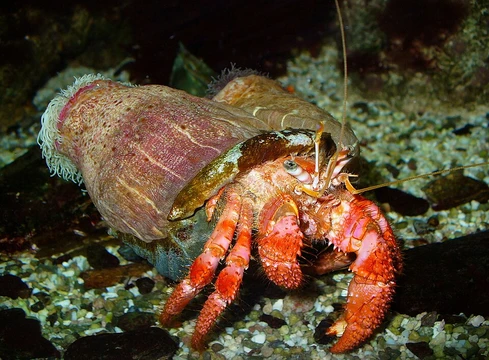
Paguristes puncticeps
A large, spotted hermit crab of tropical western Atlantic reefs.

Paguristes puncticeps is a hermit crab in the family Diogenidae, found in shallow waters of the tropical western Atlantic Ocean, the Caribbean Sea, and the Gulf of Mexico. It is notable for its large size, distinctive coloration, and its use of empty mollusc shells, including those of the queen conch and Florida horse conch.
Quick Facts
- Taxon
- Paguristes puncticeps
Facts from the source article.
Lore & Background
Paguristes puncticeps is a large hermit crab, growing to a length of 8 to 13 cm. It is dark red or rusty-brown, with a hairy carapace and limbs boldly spotted with white. Its antennae and eye stalks are dark red, and the irises of its eyes are blue. Unlike most members of the family Diogenidae, the left and right chelae (claws) are of similar size.
This species occurs in shallow waters from the low tide mark down to about 40 meters, typically in coral reef habitats. Its range extends from Florida to Brazil, including Cuba, Guadeloupe, Martinique, and Saint-Martin. It is a scavenger and detritivore, feeding on any animal or vegetable matter it finds. Breeding occurs throughout the year; eggs hatch into planktonic zoeal larvae, which later settle and metamorphose into juveniles that must find small vacant shells.
Empty shells of the queen conch (Aliger gigas) are often used, and larger individuals favor shells of the Florida horse conch (Triplofusus papillosus) and the large snails on which this mollusc preys. Cephalopods such as the common octopus and Caribbean reef octopus create middens of empty shells near their dens, providing a source of shells for P. puncticeps. Smaller individuals (shield length less than 5 mm) sometimes live inside octopus dens, feeding on food scraps.
Reader's Guide
Paguristes puncticeps is significant as a large, visually distinctive hermit crab in tropical western Atlantic reef ecosystems. Its ecology highlights the importance of shell availability, which is often a limiting factor for hermit crab populations. The species relies on empty gastropod shells, particularly those of queen conch and Florida horse conch, and benefits from shell middens created by octopuses. These middens provide both shells and food scraps, though feeding near octopus dens carries risk. The species' breeding occurs year-round, with planktonic larvae that later settle and seek shells. Its presence in coral reef habitats from Florida to Brazil underscores its role as a scavenger and detritivore, contributing to nutrient cycling. The observation that smaller individuals may live inside octopus dens illustrates a complex relationship with predators. Overall, P. puncticeps exemplifies the interdependence between hermit crabs, molluscs, and cephalopods in shallow marine environments.
Did You Know?
- Paguristes puncticeps grows to a length of 8 to 13 cm, including limbs and chelae.
- Unlike most Diogenidae, its left and right chelae are similar in size.
- It often uses empty shells of the queen conch (Aliger gigas) and Florida horse conch (Triplofusus papillosus).
More in Hermit Crabs 1-24
Spotted an error? Know more?
Reader corrections go straight into our review queue. Suggest an edit · How this site is sourced