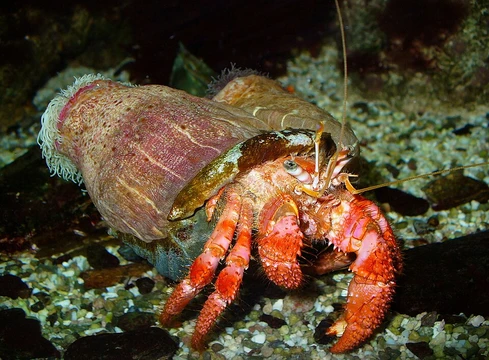
Halloween hermit crab
A brightly colored aquatic hermit crab known for algae cleaning.

The Halloween hermit crab (Ciliopagurus strigatus), also called the striped or orange-legged hermit crab, is a vividly colored aquatic hermit crab from the family Diogenidae. It is widely regarded as the most brightly colored hermit crab commonly kept in aquariums, and it is valued for its habit of cleaning algae from tanks.
This crab lives in shallow tropical waters, usually less than 50 feet deep, along coral substrates and sandy areas near reefs—though not on top of them. It is native to the Indo-Pacific region, including the Red Sea and Hawaii. It closely resembles three other species in its genus—C. tricolor, C. vakovako, and C. galzini—and can only be told apart by the color of its stripes. Adults reach about 2 inches in length, which is fairly large for a hermit crab, and have a flat, pure white shield roughly 0.315 inches long. It is nocturnal and described as "conspicuous." It prefers empty cone shells, especially those of snails or tritons, and uses them for protection. Its eye stalks and antennae are solid orange, while the antennal flagella are transparent. The palm of its claw has parallel ridges, and similar ridges appear on the movable parts of the pincers. It can live up to 10 years.
The Halloween hermit crab is famous for its bold coloration: vivid orange and white horizontal bands on its walking legs, a red body, and a pattern that recalls Halloween decorations. This makes it a popular choice for aquarium owners.
An omnivorous scavenger, it eats almost anything in its environment, including small animals, live and dead animal matter, filamentous algae, and detritus. If its shell becomes too small, it may attack a snail to take a larger one. It eats quickly.
In aquariums, the Halloween hermit crab stands out visually from other cleanup crabs. It consumes leftover food on the bottom, sifts through sand (aerating the substrate), and is especially good at eating cyanobacteria, brown bacteria, and filamentous green algae. However, it can become aggressive toward other tank inhabitants, even killing fish and other invertebrates. Feeding it meats like clams, mussels, scallops, and shrimp, along with various plants, may reduce this behavior. Overall, it helps maintain a healthy aquarium environment.
Quick Facts
- Taxon
- Ciliopagurus strigatus
Facts from the source article.
Lore & Background
The Halloween hermit crab is commonly found along coral substrates in the ocean, in sandy areas surrounding reefs but not typically on top of the reefs, in shallow tropical coastal waters. It is native to the Indo-Pacific region, including the Red Sea and Hawaii. It is very similar in appearance to three other species in the same genus—C. tricolor, C. vakovako, and C. galzini—only distinguishable by the color of its striae.
The Halloween hermit crab typically grows to 2 inches in length, which is fairly large compared to other hermit crabs. It has a noticeably flattened, pure white shield about 0.315 inches long. It is a nocturnal species and has been described as 'conspicuous'. It lives primarily in empty cone shells, mainly those of snails or tritons, and wears shells to protect itself from predators. Its ocular peduncles and antennae are solid orange, the antennal flagella are transparent, and the propodus has parallel ridges on the palm with similar ridges on the dactyls.
The Halloween hermit crab is well known for its distinct and vibrant coloration, with vividly colored walking legs, a red body, and alternating horizontal bright orange and white bands, giving it the likeness of Halloween colors. These characteristics make it attractive to aquarists.
Reader's Guide
The Halloween hermit crab is significant in aquarium use for its bright coloration and its ability to clean algae, including cyanobacteria, unsightly brown bacteria, and filamentous green algae. It also eats leftover food that settles along the bottom and sifts through sand, which aerates the aquarium substrate. However, it can become aggressive towards other tank animals and may even kill fish and other invertebrates. Feeding it meats such as clams, mussels, scallops, and shrimp along with various vegetation may reduce this behavior. Overall, it can support a healthy aquarium environment. Its festive striped coloration appeals to enthusiasts, and it is considered the most brightly colored hermit crab in normal aquarium use. The species is omnivorous and a scavenger, eating nearly anything in its environment, including small animals, live and dead animal material, filamentous algae, and detritus. If its shell is too small, it may attack a snail for a larger shell. It can eat quickly.
More in Hermit Crabs 1-24
Spotted an error? Know more?
Reader corrections go straight into our review queue. Suggest an edit · How this site is sourced