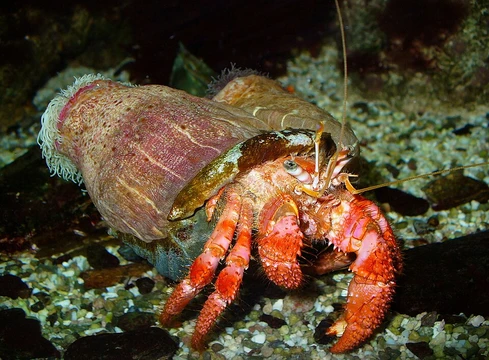
Diogenes pugilator
A small hermit crab with a large left claw and wide geographic range.

Diogenes pugilator, also known as the small hermit crab or south-claw hermit crab, ranges from the coast of Angola north to the North Sea, and east through the Mediterranean, Black, and Red Seas. Its numbers may be controlled by the predatory crab *Liocarcinus depurator*.
Like other hermit crabs, it hides its soft, twisted abdomen inside an empty gastropod shell. Its squarish carapace, which protects the front of the body, can reach 11 mm in length, with triangular projections along the front edge and hairs on the front corners. The eyestalks are about half as wide as the carapace. The left claw is much larger than the right, and both claws are hairy. The claws and legs can be pulled back into the shell opening.
This crab lives on soft seafloors from shallow waters down to 1,800 m deep, though it is most common near the surface. Its northern range was once thought to stop at Swansea in South Wales, but it now extends to Anglesey and the coasts of southwestern Ireland. It often occupies shells of the netted dog whelk *Tritia reticulata*. On flat, medium-to-fine sandy beaches, it quickly buries itself when exposed, using its large left claw to stay steady in the wet sand and avoid being tumbled by waves.
Near Cádiz in southern Spain, three hermit crab species coexist: *D. pugilator*, *Paguristes eremita*, and *Pagurus forbesii*. *P. eremita*, the largest and strongest, takes the most robust shells with wide openings. *D. pugilator* is the most numerous but avoids the common *Turritella turbona* shells, which *P. forbesii* prefers. Instead, *D. pugilator* uses the less common *Tritia reticulata*, even when its carapace grows so large that it overlaps the shell’s opening.
Quick Facts
- Taxon
- Diogenes pugilator
Facts from the source article.
Lore & Background
Diogenes pugilator was first described in 1829 by Jean Louis Florent Polydore Roux as Pagurus pugilator. Like other hermit crabs, it conceals its soft abdomen inside an empty gastropod mollusc shell; the abdomen is twisted to fit the shell's contours. The carapace protects the anterior part of the crab and can be up to 11 mm long; it is squarish with triangular projections along the front edge and is clad with hairs on the front two corners. The eyes are on stalks about half as long as the carapace width. The left chela (claw) is very much larger than the right, and both claws are covered with short hairs. The chelae and other legs can be contracted into the shell's entrance.
This crab is native to the temperate and subtropical eastern Atlantic Ocean, ranging from the southern North Sea south to Angola, and into the Mediterranean, Black, and Red Seas. Its northern limit was at one time thought to be Swansea in South Wales, but it has since been found as far north as Anglesey and the coasts of southwestern Ireland. It is found on soft substrates from the shallow sub-tidal to depths of as much as 1,800 m, but is most common in shallow water.
Ecologically, D. pugilator tends to occupy shells of the netted dog whelk Tritia reticulata. It is often present on flattish beaches of medium to fine grained sand where waves sweep up the shore. When exposed, it rapidly buries itself in the sand, using the enlarged left chela to stabilise itself in the wet sand and limit rolling by waves. Near Cádiz in southern Spain, it coexists with Paguristes eremita and Pagurus forbesii; D. pugilator is the most numerous but tends not to use the shells of the most common gastropod, Turritella turbona, which are used by P. forbesii, instead using the less common Tritia reticulata even when the crab's carapace overlaps the shell's aperture.
Reader's Guide
Diogenes pugilator holds significance as a widely distributed hermit crab species across the eastern Atlantic and adjacent seas. Its description in 1829 by Jean Louis Florent Polydore Roux under the name Pagurus pugilator marks its formal entry into scientific literature. The species is notable for its morphological traits, particularly the enlarged left chela used for stabilization in wave-swept sandy habitats. Its ecology reveals competitive shell-use dynamics: near Cádiz, it is the most numerous hermit crab but avoids the common Turritella turbona shells, instead occupying the less common Tritia reticulata, even when the crab's carapace overlaps the shell's aperture. This behavior highlights niche partitioning among sympatric hermit crabs. The species' northern range limit has been revised from Swansea to include Anglesey and southwestern Ireland, indicating ongoing range shifts or improved detection. Its populations may be regulated by the predatory crab Liocarcinus depurator. The crab's ability to bury rapidly in sand using its left claw underscores its adaptation to exposed, wave-swept beaches. Overall, D. pugilator serves as a model for studying distribution, competition, and predator-prey interactions in coastal ecosystems.
More in Hermit Crabs 1-24
Spotted an error? Know more?
Reader corrections go straight into our review queue. Suggest an edit · How this site is sourced