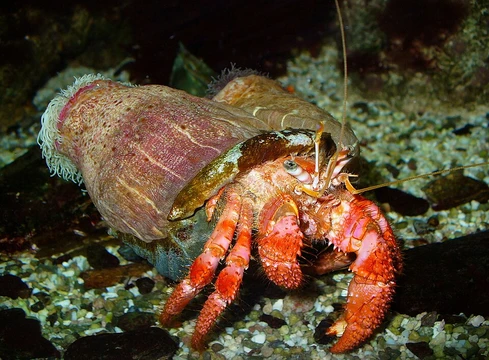
Diogenes heteropsammicola
Hermit crab that uses living coral as its shell.

Diogenes heteropsammicola is a hermit crab found in the shallow waters around Japan's Amami Islands, collected between 2012 and 2016. It is the only known hermit crab to use a living, growing coral as its shell, specifically the walking corals *Heterocyathus* and *Heteropsammia*.
In appearance, this crab differs from others by having thin chelipeds and slender legs. While most hermit crabs have asymmetrical bodies, *D. heteropsammicola* has a symmetrical abdomen and a slim build, with specialized appendages that help anchor it inside the coral skeleton. These features are rare among related species.
The crab lives inside mobile corals, carrying them across the seafloor to avoid being buried by sediment. This behavior mirrors the role of sipunculan worms that once lived in the same corals. The relationship is symbiotic: the crab gains a mobile, protective home that grows with it, eliminating the need to find new shells, while the coral gets cleaned and moved. This is the only known partnership between a hermit crab and a living coral.
The two coral species used—*Heteropsammia* and *Heterocyathus*—are also home to symbiotic sipunculan worms of the genus *Aspidosiphon*, which typically occupy corals vacated by the crabs. This has been described as a "mutualism shift," where one species takes over the role of a former partner. The relationship is considered an example of mutualism and evolutionary adaptation, possibly arising in environments where empty shells are scarce.
The species was discovered and described in 2016 by Kyoto University researchers Momoko Igawa and Makoto Kato, who were studying coral reef ecosystems in southern Japan. Their find challenged prior ideas about hermit crab behavior and the flexibility of coral symbioses, making the species a focus for research on symbiosis and marine adaptation.
Quick Facts
- Genus
- Diogenes
- Species
- heteropsammicola
Facts from the source article.
Lore & Background
Diogenes heteropsammicola was discovered and described in 2016 by Japanese researchers Momoko Igawa and Makoto Kato from Kyoto University, during studies of coral reef ecosystems in southern Japan. The species is strongly associated with the solitary corals Heterocyathus and Heteropsammia, which are also used by symbiotic sipunculan worms of the genus Aspidosiphon. This hermit crab exhibits morphological features uncommon in related species, including a symmetrical abdomen, slender legs, thin chelipeds, and specialized appendages that help anchor it within the coral skeleton. These traits allow it to live inside the coral cavities. The crab carries its host coral across the ocean floor to avoid being buried in sediment, a role similar to that of the sipunculan worms that once occupied the corals. This relationship is described as a 'mutualism shift,' where the hermit crab takes over the role of a former symbiotic partner.
Reader's Guide
Diogenes heteropsammicola is significant because it is the only hermit crab species known to partner with living coral, challenging prior assumptions about hermit crab behavior and the ecological flexibility of coral symbioses. Unlike most hermit crabs, which replace their shell as they grow, this species uses a living coral that grows with it, preventing the need to continuously search for new shells. The relationship is considered an example of mutualism and evolutionary adaptation, hypothesized to have evolved in environments where empty shells are scarce. The crab benefits from the coral's mobility and protection, while the coral receives cleaning and mobility from the crab. This species has become a subject of interest in studying symbiosis and environmental adaptation in marine invertebrates, as it demonstrates a rare example of a crustacean using a living coral rather than a mollusk shell.
Did You Know?
- Diogenes heteropsammicola was discovered in the shallow waters of the Japanese Amami Islands between 2012 and 2016.
- It is the only hermit crab species known to use living coral as its shell.
- The relationship between the crab and coral is described as a 'mutualism shift' from previous sipunculan worm occupants.
More in Hermit Crabs 1-24
Spotted an error? Know more?
Reader corrections go straight into our review queue. Suggest an edit · How this site is sourced