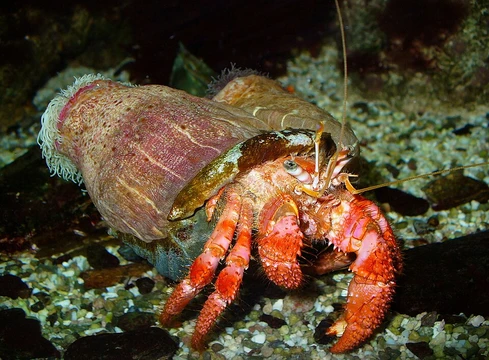
Dardanus venosus
A left-handed hermit crab with star-burst eyes and mauve claws.

The starry-eyed crab, also known as the stareye crab, is a species of hermit crab from the family Diogenidae. It lives in shallow waters along the eastern coast of the Americas, ranging from Florida down to Brazil, and is occasionally kept in reef aquariums.
This crab reaches a length of 7 to 12 centimeters. Like all hermit crabs, it inhabits empty gastropod shells, keeping its soft abdomen and most limbs hidden, with only its claws (dactyls) protruding. It is left-handed, meaning its larger pincer is on the left front limb, which it uses to block the shell opening when threatened. The dactyls are mauve, covered in clusters of small bluish bristles. Its common name comes from its eyes, which, seen up close, look like star-bursts—green or blue with dark pupils.
The species is found from Florida through the Caribbean Sea, Gulf of Mexico, Bahamas, Antilles, Venezuela, and Brazil, from the low tide line down to about 40 meters. It lives on various substrates, including rock, gravel, sand, mud, shell, coral, and seaweed.
A scavenger, it feeds on detritus and any edible matter it finds on the seafloor. Its life cycle is not well studied, but females likely brood eggs attached to their abdomen. When the eggs hatch, larvae are released into the water column, passing through several zoeal stages in plankton before becoming glaucothoë larvae. These larvae are relatively large, with elongated telsons and characteristic hooks on the walking legs' dactyls. Eventually, they settle and metamorphose into juveniles that must find shells to inhabit.
Off the coast of Brazil, the crab has been found occupying eleven different types of gastropod shells, including three species of turban snail (Astraea sp.). It often carries the sea anemone *Calliactis tricolor* on its shell. When moving to a larger shell, the crab actively collects the anemone by tapping it near the base to loosen its grip. The anemone then clings to the new shell with its tentacles until its base attaches firmly. This mutualistic relationship benefits both: the crab gains protection from the anemone's stinging cells, while the anemone gets transport and access to more food.
Quick Facts
- Taxon
- Dardanus venosus
Facts from the source article.
Lore & Background
Dardanus venosus grows to a length of 7 to 12 centimetres. As a hermit crab, it lives inside the empty shell of a gastropod mollusc, with its soft abdomen and most limbs hidden; only the dactyls, or claws, project. Like other members of its family, it is left-handed, using its main chela on the left front limb to cover the shell aperture when threatened. The dactyls are mauve due to clusters of small bluish bristles. Its common name refers to its eyes, which at close quarters resemble star-bursts, being green or blue with dark pupils.
The species is a scavenger, consuming detritus and anything edible on the seabed. Its life cycle has been little studied, but eggs are probably brooded on the female's abdomen. After hatching, larvae pass through several zoeal stages in the plankton before becoming glaucothoë larvae, which are relatively large with elongated telsons and characteristic hooks on the dactyls of the walking legs. These larvae later settle and metamorphose into juveniles that need to find shells.
Reader's Guide
Dardanus venosus is notable for its distinctive star-burst eyes and mauve claws, as well as its left-handed chela, a trait of the family Diogenidae. It occupies a variety of substrates including rock, gravel, sand, mud, shell, coral, and seaweed. In a study off the coast of Brazil, it was found occupying eleven different kinds of gastropod shell, including three species of turban snail (Astraea sp.). The crab often carries the sea anemone Calliactis tricolor on its shell, actively collecting it from rocks or outgrown shells when moving to a larger one. It loosens the anemone's grip by tapping it near the base, causing it to relax. This mutualistic arrangement protects the crab with the anemone's stinging cells, while the anemone gains transport and access to more food. The species is sometimes kept in reef aquaria, though its scavenging habits and shell-changing behavior are relevant to its care.
Did You Know?
- Its eyes appear as star-bursts, being green or blue with dark pupils when seen at close quarters.
- It actively collects the sea anemone Calliactis tricolor and transfers it to a new shell by tapping it near the base.
More in Hermit Crabs 1-24
Spotted an error? Know more?
Reader corrections go straight into our review queue. Suggest an edit · How this site is sourced