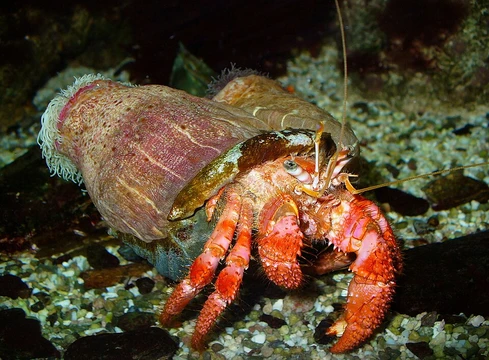
Dardanus pedunculatus
Anemone hermit crab collects sea anemones for shell defence.

Dardanus pedunculatus, known as the anemone hermit crab, is found across the Indo-Pacific, from the Seychelles east to Japan and Hawaii, and along Australia’s coast from New South Wales (as far south as Port Jackson) to Queensland. It inhabits coral reefs and intertidal zones at depths between 1 and 27 metres. This crab collects sea anemones at night, stroking and tapping them until they release their grip on the substrate, then moves them onto its gastropod shell for protection against its main predator, octopuses. The crab reaches a maximum size of about 10 centimetres. Its carapace is mottled tan and cream, with white eyestalks marked by red bands. The left claw is notably larger than the right, and the sexes appear similar. While occasionally kept in marine aquariums, the species has never been successfully bred in captivity. First described by Johann Friedrich Wilhelm Herbst in 1804 as *Cancer pedunculatus* (type locality unknown), it has since been reassigned to genera such as *Pagurus* and *Neopagurus*, resulting in several taxonomic synonyms.
Quick Facts
- Taxon
- Dardanus pedunculatus
Facts from the source article.
Lore & Background
Dardanus pedunculatus was first described by Johann Friedrich Wilhelm Herbst as Cancer pedunculatus in his 1804 work Versuch einer Naturgeschichte der Krabben und Krebse nebst einer Systematischen Beschreibung ihrer verschiedenen Arten; the type locality is not known. It has since been placed in a number of different genera, including Pagurus and Neopagurus, and a number of taxonomic synonyms have been created.
The carapace is mottled in tan and cream, while the eyestalks are white with red bands. The sexes are similar. The left claw is much larger than the right claw. It usually lives on coral reefs and in the intertidal zone, at depths of 1–27 metres. It usually carries sea anemones on its shell, which it uses to protect itself from its main predator, cephalopods of the genus Octopus. The anemones are collected at night, and comprises the crab stroking and tapping the anemone until it loosens its grip on the substrate, at which point it is moved onto the gastropod shell that the hermit crab inhabits.
Reader's Guide
Dardanus pedunculatus is significant as a species of hermit crab that actively collects sea anemones for defence, a behaviour that distinguishes it from many other hermit crabs. Its main predator is cephalopods of the genus Octopus, and the anemones provide protection against these predators. The species has a broad distribution across the Indo-Pacific region, from the Seychelles to Japan and Hawaii, and in Australia from New South Wales to Queensland. It is occasionally kept as a pet in marine aquaria, although it has not been successfully reared in captivity. The species was first described in 1804 by Johann Friedrich Wilhelm Herbst under the name Cancer pedunculatus, and has since been reclassified into several genera, reflecting taxonomic uncertainty. Its legacy lies in its unique symbiotic relationship with sea anemones and its role in marine ecosystems on coral reefs and intertidal zones.
Frequently Asked Questions
What is Dardanus pedunculatus and where does it come from?
It is a hermit crab commonly called the anemone hermit crab, first formally described by Johann Friedrich Wilhelm Herbst under the original name Cancer pedunculatus. Its natural range spans the Indo-Pacific, stretching from the Seychelles east to Japan and Hawaii, and along Australia's eastern coast from Port Jackson up to Queensland.
How does Dardanus pedunculatus defend itself from predators?
Each night the crab stalks sea anemones, stroking and tapping them until they let go of the reef, then hauls them up onto its gastropod shell as a living shield. This mobile anemone armor is specifically effective against its main threat, octopuses, which are deterred by the stinging tentacles.
Where in the water column does Dardanus pedunculatus live?
It is a reef and intertidal-zone dweller, typically encountered at depths between about 1 and 27 metres. You'll most often spot it on coral rubble or rocky substrate near the shore rather than in open water.
How big does Dardanus pedunculatus get?
The species reaches a maximum size of roughly 10 centimetres (about 4 inches), placing it in the medium-to-large range for hermit crabs. Its carapace is mottled, helping it blend into the coral-reef background.
Why is Dardanus pedunculatus considered special among hermit crabs?
Unlike most hermit crabs that simply tuck into a shell, this species actively farms anemones and repositions them nightly, creating a dynamic, mobile defence system. That behaviour makes it a standout example of animal-to-animal mutualism and a favourite subject for reef divers and marine biologists across the Indo-Pacific.
More in Hermit Crabs 1-24
Spotted an error? Know more?
Reader corrections go straight into our review queue. Suggest an edit · How this site is sourced