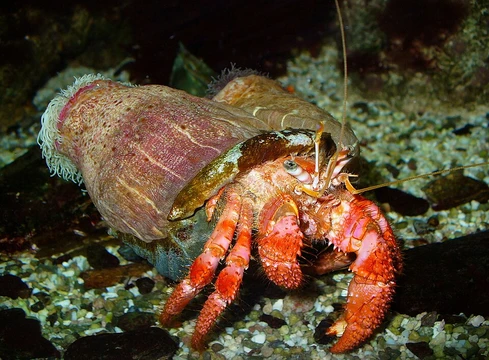
Dardanus megistos
Large Indo-Pacific hermit crab with white spots and red body.

Dardanus megistos, commonly called the white-spotted hermit crab or spotted hermit crab, belongs to the family Diogenidae. Its genus name comes from a figure in Greek mythology, the son of Zeus and Electra, while the species name *megistos* is the Greek superlative for "largest."
This species lives across the Indo-Pacific region, ranging from East Africa to the South China Sea, Australia, and east to Hawaii. It inhabits tropical reef environments such as coral reefs, lagoons, rocky platforms, sand, and seagrass beds, from the shoreline and subtidal zones down to depths of 50 meters.
Adults can reach a body length of about 20 centimeters. They have a bright red body marked with small white eyespots ringed in black, and are covered in long, erect, dark red hairs. Their primary antennae (antennules) are long and white, with a second pair of antennae, stalked green-brown eyes, and three pairs of mouthparts. The eye stalks are reddish with a white spot at the base. The soft, spiral-shaped abdomen is asymmetrical and fits inside a shell, ending in a five-part tail made of the telson and uropods. Like all decapods, they have ten legs; the first pair bears pincers (chelipeds), with the left claw larger than the right.
These crabs are gonochoric, with females carrying eggs on their abdomen. They are opportunistic omnivores, feeding mainly on small invertebrates like worms and mollusks, and have also been observed eating holothurians. They perform a precopulatory courtship ritual, and sperm transfer is typically indirect. Their lifespan can reach up to 30 years. They usually occupy a large gastropod shell, leaving only the cephalothorax and first three pairs of legs exposed.
Quick Facts
- Taxon
- Dardanus megistos
Facts from the source article.
Lore & Background
The genus name Dardanus refers to the son of Zeus and Electra in Greek mythology, while the species name megistos is the superlative of the Greek word mega, meaning 'the largest'. This species is distributed in the Indo-Pacific region from East Africa to the South China Sea, Australia, and east to Hawaii. These tropical reef-associated crabs occur in coral reefs, lagoons, rocky platforms, sand, and seagrass beds, from littoral and subtidal zones to deep waters, at depths up to 50 m. Dardanus megistos can reach a body length of about 20 cm. They have a bright red body with small white eyespots surrounded by black, covered with long erect coarse hairs of dark red color. They possess a pair of long white primary antennae, a pair of secondary antennae, stalked green brown eyes, and three pairs of mouth appendages. The eye stalks are reddish with a basal white spot. The soft, asymmetrical abdomen is spiral-shaped, with a five-piece tail. Like all decapod crustaceans, they have ten legs; the first pair carries pincers, with the left plier larger than the right.
Reader's Guide
Dardanus megistos is a significant species in the family Diogenidae due to its large size and distinctive coloration. The article describes it as an opportunistic omnivore, feeding on small invertebrates such as worms and molluscs, and also reported to feed on holothurians. It is gonochoric, with eggs carried on the female's abdomen, and commonly performs a precopulatory courtship ritual with indirect sperm transfer. These crabs may live up to 30 years. They typically inhabit large gastropod shells, with only the cephalothorax and first three pairs of legs visible. The species is documented in several scientific works, including studies on ecology in Madagascar, Vietnamese pagurids, and checklists of marine biota. Its presence across a wide Indo-Pacific range and its role in reef ecosystems contribute to its ecological importance.
Did You Know?
- The species name megistos means 'the largest' in Greek.
- These crabs can live up to 30 years.
- The left pincer is larger than the right pincer.
Frequently Asked Questions
What is Dardanus megistos?
Dardanus megistos is a large hermit crab in the family Diogenidae, commonly known as the white-spotted or spotted hermit crab. It has a distinctive red body covered in white spots and is one of the bigger hermit crab species found in tropical waters.
Where can you find Dardanus megistos in the wild?
This species ranges across the Indo-Pacific, stretching from East African coastlines all the way to Hawaii and the South China Sea. It occupies a variety of reef habitats—coral reefs, lagoons, rocky platforms, sandy areas, and seagrass beds—from the shoreline down to roughly 50 meters deep.
How big does Dardanus megistos grow?
Adults reach a body length of about 20 centimeters (roughly 8 inches), making them one of the larger hermit crab species. The species name 'megistos' itself is the Greek superlative for 'largest,' a nod to this impressive size.
What does the name Dardanus megistos actually mean?
The genus name Dardanus references the Greek mythological figure who was the son of Zeus and Electra. The species epithet megistos is the Greek superlative form of 'mega,' essentially meaning 'the largest.'
How long do Dardanus megistos live?
These hermit crabs can live up to about 30 years, which is a remarkably long lifespan for a crustacean of their size. They spend that time moving through reef environments across the Indo-Pacific as they grow and swap into larger shells.
More in Hermit Crabs 1-24
Spotted an error? Know more?
Reader corrections go straight into our review queue. Suggest an edit · How this site is sourced