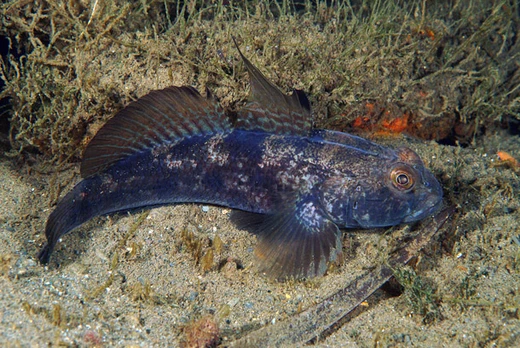
Lophogobius cyprinoides
A small, stout goby of western Atlantic mangroves.

The crested goby, *Lophogobius cyprinoides*, is a small fish found across the western Atlantic Ocean. It can live in both fresh and saltwater, and is especially common in mangroves, where it hides among the submerged roots. Adults reach up to 10 cm (3.9 in) long, with a compressed body and a crest running back from between the eyes. They have six dorsal spines—the fourth being the longest—and 16 to 20 pectoral fin rays that extend past the start of the anal fin in adults. The tail is wide and rounded. Both sexes have reddish-brown to olive mottling on the head and body, but males show more extensive and darker markings. Females have pale spots on the cheeks and pale lines behind the eye, while males display black and orange spots on the first dorsal fin, which turn black and violet during breeding. The crested goby mainly eats algae but will also take small insects, crustaceans, and molluscs. Most individuals are born female, though some later change to male; those born male remain male for life. They lay eggs in rocky seabed areas, where the eggs are secured from currents. Although they produce relatively few eggs, they can breed at any time of year. This species ranges from South Florida and Bermuda through the Caribbean, and along the coasts of Central and northern South America.
Quick Facts
- Genus
- Lophogobius
- Species
- cyprinoides
Facts from the source article.
Lore & Background
The crested goby is a small but stout fish, reaching a maximum length of 10 cm. Its body appears compressed and a crest extends back from the middle of its eyes. It has six dorsal spines with the fourth spine being the longest, and 16–20 pectoral fin rays which reach beyond the start of the anal fin in adults. The tail is wide and round. Both sexes have reddish-brown to olive mottling along their head and bodies, but those of the males are more extensive and darker in color. The females' cheeks are covered with pale spots, also with several pale lines behind the eye, while males have black and orange spots on the first dorsal fin, which change to black and violet during breeding.
Adults inhabit tidal creeks, estuaries, mangroves and other coastal waters with salinity ranging from 0.0 to 39.3 ppt. Crested gobies favor mangroves because they use the extensive underwater roots for shelter and hiding. Their diet consists mainly of algae, but they are opportunistic feeders and will take small insects, crustaceans and molluscs.
The vast majority of crested gobies are born females, but some will change to males during their lifespan. Only a small number of individuals are born male; those that are will stay that way for life. They lay their eggs in rocky areas along the sea bed, where they are secured from being swept away by harsh currents. While they produce a relatively low amount of eggs, crested gobies can breed anytime throughout the year.
Reader's Guide
The crested goby is a widespread species throughout the western Atlantic Ocean, occurring from South Florida and Bermuda, throughout the Caribbean, and along the coasts of Central and northern South America. Its ability to tolerate a wide salinity range from 0.0 to 39.3 ppt allows it to inhabit diverse coastal environments including tidal creeks, estuaries, and mangroves. The species is particularly associated with mangroves, using the extensive underwater roots for shelter and hiding. Its reproductive strategy is notable: the vast majority are born female, with some changing to male during their lifespan, while the few born male remain male for life. Breeding can occur anytime throughout the year, with eggs laid in rocky areas to avoid being swept away by currents. The crested goby's opportunistic feeding on algae, small insects, crustaceans, and molluscs reflects its adaptability. Its physical characteristics, including a compressed body, a crest from the middle of the eyes, and distinct color differences between sexes—males having black and orange spots on the first dorsal fin that change to black and violet during breeding—help distinguish it within its range.
Did You Know?
- The crested goby can tolerate salinity from 0.0 to 39.3 ppt.
- The vast majority of crested gobies are born female, but some change to male during their lifespan.
- They lay eggs in rocky areas along the sea bed to secure them from harsh currents.
Frequently Asked Questions
What is Lophogobius cyprinoides?
The crested goby is a small, stout fish that builds its life around mangrove habitats in the western Atlantic. Its most recognizable feature is a raised crest that runs backward from the space between its eyes.
Where does Lophogobius cyprinoides live?
It ranges from South Florida and Bermuda, through the entire Caribbean basin, and down the coasts of Central and northern South America. Within that range it favors mangrove forests, slipping into the dense tangles of submerged roots to hide from predators.
What does Lophogobius cyprinoides look like?
Adults top out around 10 cm and have a laterally compressed body with a broad, rounded tail. The head and body carry reddish-brown to olive mottling, and the back is armed with six dorsal spines, the fourth of which is the longest.
Can Lophogobius cyprinoides handle both fresh and saltwater?
Absolutely—it tolerates salinities from 0 ppt (pure freshwater) up to about 39.3 ppt, so it comfortably moves between tidal creeks, brackish pools, and fully marine channels. This euryhaline flexibility is a big reason it thrives in the shifting water of mangrove ecosystems.
How do you tell a male Lophogobius cyprinoides from a female?
Both sexes share the same mottled coloration, but males develop noticeably more extended fin structures. In adults the pectoral fins carry 16 to 20 rays that reach well past the front edge of the anal fin, a trait that's more exaggerated in males.
More in Gobies 1-16
Spotted an error? Know more?
Reader corrections go straight into our review queue. Suggest an edit · How this site is sourced