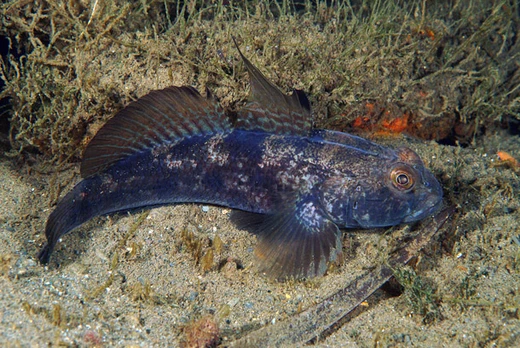
Gobiidae
A large family of small, bottom-dwelling fish with fused pelvic fins.

Gobies, the common name for the family Gobiidae, are bony fish belonging to the order Gobiiformes. This is one of the largest fish families, with more than 2,000 species spread across over 200 genera. Most gobies are small, usually under 10 cm long, and the group contains some of the tiniest vertebrates on Earth. For instance, *Trimmatom nanus* measures less than 1 cm when fully grown, while *Pandaka pygmaea* has a standard length of 9 mm, with a maximum known standard length of 11 mm. A few exceptional species can exceed 30 cm, but this is rare. These fish are generally bottom-dwellers. While humans do not rely heavily on them as food fish, they are crucial prey for commercially important species like cod, haddock, sea bass, and flatfish. Several gobies, such as the dartfish in the genus *Ptereleotris*, are popular in aquariums. Molecular data has been used to study their evolutionary relationships. The earliest known goby fossils date back to the Early Oligocene.
The most notable physical feature of gobies is their fused pelvic fins, which form a disc-shaped sucker. This structure works similarly to the sucker on the dorsal fin of remoras or the pelvic fin sucker of lumpsuckers, but it evolved independently—an example of convergent evolution. In the wild, gobies use this sucker to cling to rocks and corals, and in tanks, they often stick to the glass walls.
Gobiidae are found worldwide in tropical and temperate waters, inhabiting near-shore marine, brackish, and freshwater environments. Their range spans from Old World coral reefs to New World seas, as well as rivers and coastal areas of Europe and Asia. Most are bottom-dwellers. While many live in burrows, a few species, like those in the genus *Glossogobius*, are true cavefish. On coral reefs, gobies make up 35% of the total fish count and 20% of the species diversity.
The family Gobiidae underwent a major revision in the 5th edition of *Fishes of the World*. Before this, it contained six subfamilies: Gobiinae, Benthophilinae, Amblyopinae, Gobionellinae, Oxudercinae, and Sicydiinae. The revision kept only the first two subfamilies and moved the other four into a separate family, the Oxudercidae. Additionally, species formerly placed in the families Kraemeriidae, Microdesmidae, Ptereleotridae, and Schindleriidae were added to the revised Gobiidae, though no new subfamilies were described.
Quick Facts
- Taxon
- Gobiidae
- Type Species
- Gobius niger
- Type Species Authority
- Linnaeus, 1758
Facts from the source article.
Lore & Background
The most distinctive aspect of gobiid morphology is the fused pelvic fins that form a disc-shaped sucker, functionally analogous to the sucker of remoras or lumpsuckers but anatomically distinct, a product of convergent evolution. Gobies use this sucker to adhere to rocks, corals, and aquarium glass. Fossils of gobiids date back to the Early Oligocene.
Gobiidae underwent a major revision in the 5th edition of Fishes of the World, which retained the subfamilies Gobiinae and Benthophilinae, removed four others to the family Oxudercidae, and added species from families Kraemeriidae, Microdesmidae, Ptereleotridae, and Schindleriidae. Benthophilinae are endemic to the Ponto-Caspian region, have fused pelvic fins and elongated dorsal and anal fins, and lack a swimbladder in adults. Gobiinae, known as true gobies, is the most widespread and diverse subfamily, with around 2,000 species and 150 genera.
Gobiids are primarily fish of shallow marine habitats, including tide pools, coral reefs, and seagrass meadows, and are numerous in brackish and estuarine habitats. A few hundred species are fully adapted to freshwater. Most gobies feed on small invertebrates, though larger species eat other fish, and a few eat planktonic algae.
Reader's Guide
Gobiidae are of great significance as prey species for commercially important fish such as cod, haddock, sea bass, and flatfish, though few are important as food fish for humans. Several gobiids are of interest as aquarium fish, such as the dartfish of the genus Ptereleotris. Phylogenetic relationships have been studied using molecular data.
In reproduction, most species attach eggs to a substrate, with the male guarding and fanning the eggs while the female maintains the burrow. Larvae hatch transparent and develop coloration after finding habitat. Lifespan varies from one to ten years, with warmer-water species living longer. Many species construct burrows in male-female pairs, using mouths to dig and coral rubble to block entrances; males often build mounds over burrow entrances to improve water flow and oxygen for eggs.
Kleptogamy, or sneaking behavior, occurs when unpaired males fertilize eggs of paired females, with the paired male providing parental care to all eggs. Sneakers are small and often mistaken for females, but risk attacks from larger paired males. A few species, such as blackeye goby and Lythrypnus dalli, can change sex, typically from female to male (protogyny), often after the resident male dies.
Did You Know?
- The family includes some of the smallest vertebrates, such as Trimmatom nanus (under 1 cm) and Pandaka pygmaea (standard length 9 mm).
- Gobiids have fused pelvic fins forming a disc-shaped sucker, used to adhere to surfaces.
- On coral reefs, gobiid species constitute 35% of the total number of fishes and 20% of species diversity.
Diversity and the Spectrum of Size
Gobiidae stands as one of the most species-rich families in the entire fish world, encompassing more than 2,000 species distributed across over 200 genera within the order Gobiiformes. This extraordinary breadth of diversity is matched by a remarkable range of body sizes. At the smallest end, the family harbors some of the tiniest vertebrates on Earth: Trimmatom nanus measures under one centimeter at full maturity, while Pandaka pygmaea reaches a standard length of just nine millimeters, with the largest known individual at eleven millimeters. Most gobies remain modest, typically staying under ten centimeters. At the opposite extreme, a handful of species push past thirty centimeters, though such size is exceptional rather than representative. The family's fossil record stretches back to the Early Oligocene, suggesting that this lineage has had tens of millions of years to radiate into such a vast array of forms. Phylogenetic studies using molecular data continue to refine our understanding of how these relationships are structured.
The Pelvic Fin Disc and Convergent Evolution
The single most recognizable feature of gobiid anatomy is the pair of pelvic fins that have fused into a single disc-shaped structure, functioning as a natural suction cup. This adaptation allows gobies to press themselves firmly against rocks, coral surfaces, and even the glass walls of aquarium tanks. What makes this trait particularly fascinating from an evolutionary standpoint is that it is not a shared inheritance but rather a case of convergent evolution. Remoras develop a dorsal fin sucker, and lumpsuckers possess a pelvic fin sucker, yet none of these structures share a common anatomical origin with the gobiid disc. Each lineage independently arrived at a similar functional solution for clinging to substrates. This morphological trait underpins the benthic lifestyle that defines the family, enabling gobies to remain anchored in currents, cling to reef structures, and exploit niches that less-adapted fish cannot access.
Burrow Architecture and Reproductive Roles
The reproductive life of many gobiid species revolves around elaborate burrows constructed and shared by male-female pairs. Using their mouths, gobies excavate into the seabed, clearing away dead coral fragments, rubble, and benthic algae. They maintain these tunnels by fanning away accumulated sand and even block the entrance with pieces of coral rubble, with a single individual capable of hauling as many as nine fragments per minute. Perhaps most striking is the construction of a mound six to thirteen centimeters high over the spawning burrow entrance; this structure accelerates water flow across the opening, delivering oxygen to developing eggs. Division of labor shifts dramatically across the reproductive cycle. Before spawning, males invest more energy in burrow upkeep while females focus on feeding to prepare reproductively. After the female deposits her eggs and the male fertilizes them, the roles invert: the male fans the eggs to supply oxygen, while the female takes over burrow maintenance. Should the female depart, the mounds lose their height, and the male will abandon and consume the eggs, redirecting his energy toward securing a new mate.
Global Reach and Ecological Significance
Gobiidae occupies an astonishingly broad ecological footprint, spanning tropical and temperate waters across every continent. Their habitats range from Old World coral reefs to New World seas, from European and Asian rivers to mangrove swamps, salt marshes, and estuarine zones. On coral reefs specifically, gobiids account for thirty-five percent of all individual fish and twenty percent of species diversity, making them a cornerstone of reef communities. While few gobies are harvested directly as human food, their ecological importance as prey is substantial: they form a critical food source for commercially valuable species including cod, haddock, sea bass, and flatfish. The family also shows notable freshwater adaptations, with low hundreds of species fully adapted to rivers and lakes, such as the round goby, the Australian desert goby, and the European Padogobius bonelli. A few rare species, like those in the genus Glossogobius, are true cavefish. Their feeding ecology is varied, with most gobies consuming small invertebrates, some larger species preying on other fish, and a few grazing on planktonic algae.
Frequently Asked Questions
Who is Gobiidae?
Gobiidae is the family name for gobies, a sprawling group of small bony fish within the order Gobiiformes. With more than 2,000 species distributed across over 200 genera, it stands as one of the largest families in the entire fish world.
What are Gobiidae's signature traits?
Gobies are classic bottom-dwellers whose pelvic fins fuse into a single disc-like pad, letting them cling steadily to rocks, sand, or other substrates. Most species stay under 10 cm in length, though a rare few outliers can exceed 30 cm.
How small can Gobiidae get?
The family harbours some of the tiniest vertebrates on the planet: Pandaka pygmaea measures just 9 mm in standard length (11 mm at its known maximum), and Trimmatom nanus never surpasses 1 cm at full maturity.
When does Gobiidae's story begin?
The earliest goby fossils have been traced back to the Early Oligocene, meaning the family has been swimming in Earth's waters for roughly 30 million years.
Why is Gobiidae important to the aquatic world?
As predominantly benthic fish, gobies process benthic detritus and form a critical link in coastal and freshwater food webs while also serving as prey for larger predators. Their extraordinary species richness makes them a cornerstone of biodiversity research in both marine and freshwater systems.
More in Gobies 1-16
Spotted an error? Know more?
Reader corrections go straight into our review queue. Suggest an edit · How this site is sourced