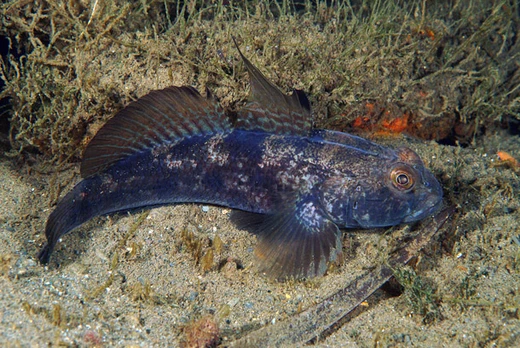
Acentrogobius
A genus of gobies from Indian and western Pacific waters.

Acentrogobius is a genus of goby fish. Its members live in marine, fresh, and brackish waters along the coasts of the Indian Ocean and the western Pacific Ocean. The genus contains both living species and a fossil one, *Acentrogobius matsya*. This fossil is based on otoliths from the Burdigalian (Miocene) Quilon Formation in southwestern India.
Quick Facts
- Taxon
- Acentrogobius
- Type Species
- Gobius chlorostigma
- Type Species Authority
- Bleeker, 1849
Facts from the source article.
Lore & Background
The genus Acentrogobius was established to encompass gobies found in coastal waters of the Indian Ocean and western Pacific Ocean, inhabiting marine, fresh, and brackish environments. The species list includes 24 recognized members, such as the Tropical sand goby (Acentrogobius caninus), Bluespotted mangrovegoby (Acentrogobius gracilis), and Robust mangrove goby (Acentrogobius janthinopterus).
A notable addition is the fossil species Acentrogobius matsya, described in 2022 based on otoliths from the Burdigalian (Miocene) Quilon Formation in southwestern India. This species is marked with a dagger (†) in the species list to indicate its extinct status.
The species exhibit a range of common names reflecting their habitats and appearances, such as the Mudslope goby (Acentrogobius vanderloosi) and the Spotted green goby (Acentrogobius viridipunctatus). The genus includes species described by various ichthyologists including Bleeker, Günther, and Valenciennes.
Reader's Guide
The genus Acentrogobius is significant as a diverse group of gobies occupying a wide range of aquatic habitats along the Indian Ocean and western Pacific coasts. Its 24 recognized species include both living forms and a fossil species, Acentrogobius matsya, which provides evidence of the genus's presence in the Miocene epoch. The fossil was identified from otoliths in the Quilon Formation of southwestern India, dating to the Burdigalian stage. This discovery extends the temporal range of the genus into the fossil record. The species list includes many with descriptive common names, such as the Tropical sand goby and the Bluespotted mangrovegoby, indicating their ecological roles in sandy and mangrove environments. The genus has been studied by multiple researchers, with species described by figures like Bleeker, Günther, and Valenciennes. The inclusion of a fossil species highlights the genus's long history in the region. The genus's distribution across marine, fresh, and brackish waters underscores its adaptability. The species Acentrogobius matsya is the only otolith-based fossil species in the genus, making it a key reference for paleontological studies of gobies in South Asia.
Did You Know?
- Acentrogobius includes 24 recognized species, one of which is a fossil species.
- The genus is native to marine, fresh, and brackish waters of the Indian Ocean and western Pacific Ocean coasts.
Taxonomic Breadth and Species Roster
Acentrogobius encompasses twenty-four currently recognized species, making it a moderately diverse genus within the goby family. The roster spans a wide array of common names that hint at the morphological and ecological variety within the group: the Tropical sand goby, the Cenderawasih goby, the Bluespotted mangrovegoby, the Grey goby, the Robust mangrove goby, the Batanta mud goby, the Manyband goby, the Barcheek amoya, the Striped sandgoby, the Bagamoyo goby, the Mudslope goby, the Alotau goby, and the Spotted green goby, among others. Some species carry the names of the people who first described them or honored them, as seen in Day's goby and the numerous species attributed to Bleeker, Day, and Herre. The genus includes both living species and one extinct representative, reflecting a taxonomic picture that stretches across deep geological time. The species list itself is a living document, with entries added as recently as 2022, underscoring that the full diversity of this genus is still being catalogued.
Habitat and Geographic Distribution
Acentrogobius is a genus whose members inhabit a notably broad spectrum of aquatic environments. Rather than being confined to a single water type, these gobies are found in marine, freshwater, and brackish settings, a versatility that speaks to their ecological adaptability. Geographically, the genus is tied to the coastal waters of two major oceanic regions: the Indian Ocean and the western Pacific Ocean. This distribution places Acentrogobius species in tropical and subtropical littoral zones spanning from the coasts of India and East Africa across Southeast Asia and into the islands of the western Pacific. The presence of common names referencing specific habitats—sand, mud, mangrove, and mudslope—suggests that members of the genus occupy a range of substrate types along these coastlines, from open sandy bottoms to the complex root systems of mangrove forests. This ecological breadth, combined with the geographic spread across two ocean basins, makes Acentrogobius a genus of considerable biogeographic interest.
Fossil Evidence and Deep Time
One of the most striking aspects of Acentrogobius is that the genus is not limited to the living world. Acentrogobius matsya, described by Carolin, Bajpai, Maurya, and Schwarzhans in 2022, represents an extinct member known exclusively from an otolith, a small calcium-carbonate ear bone found in fish. This fossil species was recovered from the Quilon Formation in southwestern India, a geological unit dated to the Burdigalian stage of the Miocene epoch. The Miocene placement pushes the known history of this genus back millions of years, well before the modern diversity we observe today. The fact that the species is identified on the basis of an otolith rather than a complete skeleton highlights both the fragility of the fossil record for small fish and the importance of microvertebrate paleontology in reconstructing ancient marine faunas. A. matsya thus anchors the genus in deep time and suggests a long evolutionary history along the western margins of the Indian subcontinent, a region that continues to yield both living and extinct goby species.
A Long Arc of Discovery
The taxonomic history of Acentrogobius stretches across nearly two centuries of ichthyological work. The earliest species in the genus were described in the 1830s and 1840s, with Valenciennes naming both A. caninus and A. viridipunctatus in 1837, and Günther adding A. brevirostris in 1861. The late nineteenth and early twentieth centuries saw contributions from Bleeker, Day, Fowler, Herre, Sauvage, and others, gradually building the species roster. However, the pace of discovery has accelerated markedly in the twenty-first century. Allen, Erdmann, and their collaborators described several new species in the 2010s, including the Cenderawasih goby in 2012, the Batanta mud goby, the Mudslope goby, and the Alotau goby in 2015, and A. quinquemaculatus in 2017. The most recent addition, A. matsya, was formally named in 2022. This ongoing stream of new species, both living and fossil, indicates that Acentrogobius remains an active frontier in goby systematics, with many coastal habitats across the Indian and western Pacific Oceans yet to be fully surveyed.
Frequently Asked Questions
What is Acentrogobius?
Acentrogobius is a genus of small goby fish native to the coastal waters of the Indian Ocean and the western Pacific. It currently encompasses 24 recognized species, including both living and extinct lineages.
Where do Acentrogobius species live?
Members of this genus occupy marine, freshwater, and brackish environments along the shores of the Indian Ocean and western Pacific. Their range stretches across a broad Indo-Pacific coastal belt.
How many species are in the genus Acentrogobius?
The genus contains 24 species in total. This figure includes both extant forms and one fossil representative.
Is there a fossil Acentrogobius?
Yes—Acentrogobius matsya is known from otoliths recovered in the Burdigalian (Miocene) Quilon Formation of southwestern India. It is the only extinct member identified within the genus to date.
What makes Acentrogobius stand out among goby genera?
It is remarkable for spanning three distinct water types—salt, fresh, and brackish—within a single taxonomic group. It also bridges deep geological time, pairing a Miocene fossil with 23 living species.
More in Gobies 1-16
Spotted an error? Know more?
Reader corrections go straight into our review queue. Suggest an edit · How this site is sourced