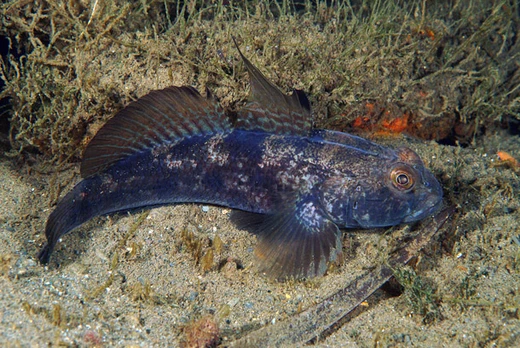
Largetooth goby
A solitary goby and the sole member of its genus.

The largetooth goby (Macrodontogobius wilburi), also called Wilbur's goby, is a ray-finned fish belonging to the Gobiidae family. It is the sole species in its genus. This fish lives in sheltered marine waters, typically at depths between 0 and 20 meters (0 to 66 feet), and prefers sandy seafloor areas. It reaches a maximum length of 6.5 centimeters (2.6 inches) SL. The species is not obviously sexually dimorphic. Its body is pale brown to greenish-brown with a pale underside, marked by brown and white spots. Pairs of larger brown spots form a row along the middle of each side, and there is a dark spot on the base of the tail fin. A brown blotch appears on the cheek, and a series of short brown bars runs along the back. The largetooth goby is solitary and inhabits coastal bays, lagoons, and estuaries over fine sand near reef edges or silt beds, often in sheltered, turbid waters near reefs. It is most often collected from shallow waters up to 7 meters (23 feet) deep around coral reefs; off southern Japan, it lives on the bottom of sandy bays. Its native range spans the Indo-Pacific from the Seychelles to Micronesia, and its known range has been extended to the Red Sea after specimens were photographed at one site and collected at another off Egypt. The specific name honors Dr. Ray Lyman Wilbur (1875–1949), an American physician, president of Stanford University from 1916 to 1943, and U.S. Secretary of the Interior from 1929 to 1933. Wilbur helped the species' author, Herre, reach Palau, the location where the type specimen was collected.
Quick Facts
- Taxon
- Macrodontogobius wilburi
Facts from the source article.
Lore & Background
The largetooth goby has a background colour of pale brown to greenish-brown with a pale ventral side. Its body is marked with brown and white spots, and pairs of larger brown spots create a mid-lateral row along its flanks. A dark spot is present on the caudal fin peduncle, a brown blotch on the cheek, and a series of short brown bars along its back. This species is not obviously sexually dimorphic. It is a solitary fish found in coastal bays, lagoons, and estuaries over fine sandy substrates close to the margins of reefs or silt beds in sheltered and often turbid coastal waters. It is most frequently collected from shallow waters to 7 metres (23 ft) around coral reefs, though off southern Japan it occurs at the bottom of sandy bays. The specific name honours the American physician Ray Lyman Wilbur, who was president of Stanford University and United States Secretary of the Interior; he helped the author, Herre, get to Palau, the type locality of this species.
Reader's Guide
The largetooth goby is significant as the only known member of its genus, Macrodontogobius, making it a distinct lineage within the Gobiidae. Its known range originally spanned the Indo-Pacific from the Seychelles to Micronesia, but has been extended to the Red Sea based on specimens photographed at one site and collected at another off Egypt. This species inhabits sheltered marine waters at depths from 0 to 20 metres, preferring sandy substrates in coastal bays, lagoons, and estuaries. It grows to a length of 6.5 centimetres SL. The species is not obviously sexually dimorphic, and its coloration includes pale brown to greenish-brown background with brown and white spots, a mid-lateral row of larger brown spots, a dark spot on the caudal fin peduncle, a brown cheek blotch, and short brown bars along the back. It is solitary and most frequently collected from shallow waters to 7 metres around coral reefs, though off southern Japan it occurs at the bottom of sandy bays. The specific name honors Ray Lyman Wilbur, who assisted the author Herre in reaching Palau, the type locality.
Did You Know?
- The largetooth goby is the only known member of its genus, Macrodontogobius.
- This species grows to a maximum length of 6.5 centimetres SL.
Frequently Asked Questions
What is the Largetooth goby?
The Largetooth goby, also known as Wilbur's goby, is a small ray-finned fish in the Gobiidae family with the scientific name Macrodontogobius wilburi. It is notable for being the only species in its genus.
Where does the Largetooth goby live in the wild?
This goby occupies sheltered marine waters across the Indo-Pacific, spanning from the Seychelles to Micronesia and extending into the Red Sea. It favors sandy seafloor habitats at depths from the surface down to roughly 20 metres (66 feet).
How big does a Largetooth goby get?
An adult reaches a maximum standard length of about 6.5 centimetres (2.6 inches), making it a notably small member of the goby family.
What does a Largetooth goby look like?
Its body is pale brown to greenish-brown on the upper surface with a lighter belly, scattered with brown and white spots. A distinctive row of paired, larger brown spots runs along the mid-flank of each side. Males and females do not appear to differ noticeably in coloration or markings.
Is the Largetooth goby related to other species in its genus?
No — Macrodontogobius wilburi is a solitary genus member with no close relatives sharing the same genus name. Its broader taxonomic ties are limited to the wider Gobiidae family.
More in Gobies 1-16
Spotted an error? Know more?
Reader corrections go straight into our review queue. Suggest an edit · How this site is sourced