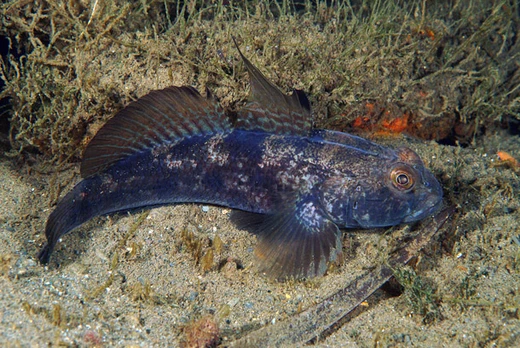
Evermannichthys bicolor
A sponge-dwelling goby from the Caribbean Sea.

Evermannichthys bicolor, called the bicolored sponge goby, is a perciform fish belonging to the goby family. It is known for living inside sponges and is found in the Caribbean Sea. Because its population size is unknown, it is unclear whether the species requires conservation.
The bicolored sponge goby has a long, slender body. Its scales and the number of pores on its head are reduced, and its body measures about 2 mm from top to bottom. The upper third of its body is dark, while the lower two-thirds are pale, and its fins are mostly clear. The frenum connecting the upper lip to the snout is small, but the lip and snout remain separate. Its tongue has a notched edge.
This species lives on the seafloor at depths of 27 to 30 meters in tropical waters. It occurs in the western Atlantic Ocean, particularly near Navassa Island, Jamaica, and Curaçao. Very little is known about its population numbers or conservation status, and the IUCN lists it as data deficient.
As its name suggests, the bicolored sponge goby dwells inside sponges, specifically near the openings of the in-current canals. Sponges offer the fish both protection and food, which enters through these canals. It is believed the goby spends its entire life inside sponges, and its eggs either drift into a sponge from open water or are laid directly inside one.
The bicolored sponge goby is considered data deficient by the IUCN, meaning its total population and population trends are unknown. Humans do not use this species in any way, and no threats to it have been identified. Although no specific conservation actions have been taken, many areas within its range, including its type locality, are protected.
Quick Facts
- Genus
- Evermannichthys
- Species
- bicolor
Facts from the source article.
Lore & Background
The bicolored sponge goby has an elongate, thin body with reduced scale-covering and head pores. Its color is dark across the dorsal-most third, with the lower two-thirds pale and fins generally clear. The frenum connecting the upper lip to the snout is reduced, and the tongue has a notched edge. This species is demersal, living between 27 and 30 m below the surface in tropical oceans of the western Atlantic, especially near Navassa, Jamaica, and Curaçao. As its name implies, it lives deep within sponges, near the openings of the in-current canals, which provide protection and food. It is thought that the bicolored sponge goby spends its entire life in sponges, and that its eggs either drift into a sponge from open water or are laid directly within a sponge.
Reader's Guide
The bicolored sponge goby is considered data deficient by the IUCN, meaning that estimations of the total number of individuals and the population trend through time are unknown. The species is not used by humans in any way, and no threats to it have been identified. While no specific conservation actions have been taken, many portions of its native range, including its type locality, are protected areas. Very little is known about its population numbers and conservation, underscoring the need for further research to determine whether this species is in need of conservation.
Did You Know?
- Its body measures about 2 mm dorso-ventrally.
- It is found in the western Atlantic Ocean near Navassa, Jamaica, and Curaçao.
Taxonomic Identity and Genus Placement
Evermannichthys bicolor is a species of goby that belongs to the genus Evermannichthys, a compact group of five recognized species within the broader goby family. The species was formally described by the taxonomist Thacker in the year 2001, making it the most recently named member of its genus. Its binomial name places it alongside four other congeners: E. convictor, commonly known as the tenant goby; E. metzelaari, the sponge goby; E. silus, the pugnose goby; and E. spongicola, which lacks a widely used common name in the available records. As a goby, E. bicolor shares the general body plan and ecological niche associated with that family, though its specific traits are defined by its position within this particular Atlantic genus. The genus itself is restricted to the Western Atlantic, meaning that E. bicolor, like all its close relatives, is a native inhabitant of the coastal waters along the Americas rather than a species found in the Pacific or Indian Oceans. Its placement in this genus reflects shared evolutionary ancestry with the other four species, all of which were identified and named by different taxonomists across more than eight decades of ichthyological research.
Geographic Range and Biogeographic Setting
The genus Evermannichthys, which includes E. bicolor, is native to the Atlantic coast of the Americas. The available taxonomic records specify that this range includes the Caribbean Sea and the Gulf of Mexico, indicating that the five recognized species of the genus collectively inhabit these interconnected Western Atlantic waters. As a member of this genus, E. bicolor is a native species of this Atlantic coastal realm rather than a Pacific or Indian Ocean goby. The geographic scope described for the genus spans the coastal waters along the Americas, with the Caribbean and the Gulf of Mexico explicitly named as part of that distribution. This places E. bicolor in a biogeographic context shared with its four congeners, all of which are likewise restricted to the same Atlantic coastal zone. The fact that the genus is described as native to this region means that the species did not arrive through human-mediated introduction but evolved and persisted in these waters as part of the indigenous goby fauna. E. bicolor, named by Thacker in 2001, represents the most recent taxonomic recognition of a goby within this Atlantic coastal group, adding to a roster of species documented in the Caribbean and Gulf of Mexico since the earliest descriptions in the early twentieth century.
Taxonomic Timeline and the History of Species Recognition
The five species that make up the genus Evermannichthys were not all described at once; rather, they were identified and named by different taxonomists over a span of more than eight decades. The earliest of the five, E. spongicola, was described by Radcliffe in 1917. Six years later, in 1923, C. L. Hubbs described E. metzelaari, which carries the common name sponge goby. A further forty-six years passed before J. E. Böhlke and C. R. Robins jointly described two additional species in 1969: E. convictor, known as the tenant goby, and E. silus, known as the pugnose goby. The most recent addition to the genus is E. bicolor, described by Thacker in 2001. This timeline reveals a pattern of incremental taxonomic discovery, with each new species expanding the known diversity of this small Atlantic goby group. The spread of descriptions across 1917, 1923, 1969, and 2001 suggests that the genus was not fully resolved in a single comprehensive study but was built up over time as researchers encountered and recognized additional distinct species within the same Atlantic coastal range. E. bicolor's 2001 description marks the latest chapter in this ongoing process of taxonomic clarification.
Sister Species and the Composition of the Genus
Within the genus Evermannichthys, E. bicolor shares its taxonomic group with four other recognized species, each bearing a distinct binomial name and, in three cases, a common name. The tenant goby (E. convictor) and the pugnose goby (E. silus) were both described by Böhlke and Robins in 1969, while the sponge goby (E. metzelaari) was named by Hubbs in 1923. The fifth member, E. spongicola, was described by Radcliffe in 1917 and does not carry a common name in the available records. Together, these five species constitute the full recognized membership of the genus, a small and geographically restricted group of gobies. E. bicolor, described by Thacker in 2001, is the youngest of the five in terms of taxonomic recognition. The genus as a whole is native to the Atlantic coast of the Americas, including the Caribbean and the Gulf of Mexico, meaning that all five species co-occur within the same broad biogeographic region. The relatively small number of species in the genus, combined with the staggered timing of their descriptions, paints a picture of a compact group of closely related Atlantic gobies whose full diversity was only gradually appreciated by the ichthyological community over the course of the twentieth and early twenty-first centuries.
Frequently Asked Questions
What is Evermannichthys bicolor?
It is a tiny sponge-dwelling goby native to the Caribbean Sea, classified in the family Gobiidae under the order Perciformes. Enthusiasts and marine biologists most often call it the bicolored sponge goby.
Where does Evermannichthys bicolor live in the wild?
This species occupies the Caribbean Sea at depths of roughly 27 to 30 meters, where it takes up residence inside sponges. That sponge-dwelling habit is its defining ecological niche and what gives the fish its common name.
What does Evermannichthys bicolor look like?
The fish has a long, slender body split into a dark upper third and a pale lower two-thirds, with fins that are mostly transparent. It also shows a reduced scale count and fewer head pores than many typical gobies.
How large does Evermannichthys bicolor grow?
Measured dorso-ventrally, the body is only about 2 millimeters tall, making it an extraordinarily small perciform. Its minuscule size fits neatly with its lifestyle tucked inside Caribbean sponges.
What is the conservation status of Evermannichthys bicolor?
The IUCN currently lists the species as Data Deficient because its population size has never been reliably estimated. Until more data is gathered, it remains unclear whether the bicolored sponge goby needs any formal conservation measures.
More in Gobies 1-16
Spotted an error? Know more?
Reader corrections go straight into our review queue. Suggest an edit · How this site is sourced