Discordipinna griessingeri
A small, reclusive goby with a distinctive elongated dorsal fin.

The spikefin goby, also known as the flaming prawn goby, is a small, vividly colored marine fish belonging to the Gobiidae family. It is sometimes mistakenly sold under the name "Stonogobiops griessingeri," which is not a valid scientific name. This species has a broad range across coral reefs in the western tropical Pacific, including islands like Hawai'i and Polynesia, as well as the Indian Ocean and the Red Sea. It is also occasionally captured and sold as an exotic aquarium fish in several nations.
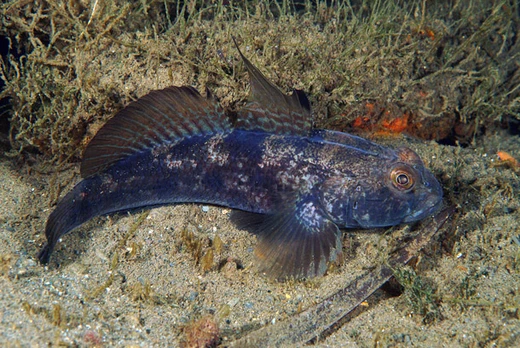
The body of *Discordipinna griessingeri* is mostly white, marked with orange stripes along the sides and the length of the dorsal fin, and dark spots on the head. A distinctive feature is the large, protruding dorsal fin located just behind the head. The rays of the pectoral fins are also elongated. The entire body is covered in scales, with ctenoid scales on the rear and cycloid scales toward the front. Adults measure between 10 and 22 mm (0.5–0.75 in) in standard length. Whether any sexual dimorphism exists in this species is not yet known.
This goby is a benthic fish, living in crevices and pockets within coral reefs at depths of 2 to 50 meters, on reef rock, rubble, and sand. It is reclusive and does not inhabit burrows or associate with prawns.
The genus name *Discordipinna* comes from Latin: *discors* meaning "different" and *pinna* meaning "fin," referring to the unusual placement of the elongated dorsal fin and the long rays of the dorsal and pectoral fins. The species name *griessingeri* honors Mr. S. Griessinger, who collected one of the paratype specimens.
- Common names
- spikefin goby, flaming prawn goby
- Adult size sl
- 10 to 22 mm (0.5-0.75 in)
- Depth range
- 2 to 50 meters
- Distribution
- western tropical Pacific, Pacific Islands (Hawai'i, Polynesia), Indian Ocean, Red Sea
- Habitat
- benthic, crevices and pockets in coral reefs along reef rock, rubble, and sand
- Scale types
- ctenoid on posterior, cycloid on anterior
Lore & Background
The spikefin goby is mostly white in the body, with orange stripes down the body and length of the dorsal fin, and dark spots on the face. It has a large protruding dorsal fin just behind the head that characterizes the species, and the pectoral fin rays are also elongated. The body is completely scaled, with ctenoid scales on the posterior and cycloid scales on the anterior. Sexual dimorphism, if any, is currently unknown.
Its genus name comes from Latin, where discors translates to 'different' and pinna translates to 'fin', referring to the peculiar location of the highly elongated dorsal fin and the long rays of the dorsal and pectoral fins. The species name honors Mr. S. Griessinger, the collector of one of the paratype specimens. Occasionally it is mislabeled as 'Stonogobiops griessingeri', a binomial species name that does not formally exist.
The spikefin goby is a reclusive benthic fish that inhabits crevices and pockets in coral reefs between 2 and 50 meters in depth along the reef rock, rubble, and sand. It is not associated with burrows or prawns.
Reader's Guide
Discordipinna griessingeri holds significance as a distinctive member of the Gobiidae family, noted for its unusual dorsal fin placement and elongated fin rays, which are reflected in its genus name meaning 'different fin'. Its wide distribution across the western tropical Pacific, Pacific Islands, Indian Ocean, and Red Sea indicates a broad ecological range within coral reef habitats. The species is also notable in the aquarium trade, being occasionally collected and traded as an exotic aquarium fish in multiple countries, though it remains reclusive in the wild, inhabiting crevices and pockets rather than burrows. The mislabeling as 'Stonogobiops griessingeri' highlights occasional taxonomic confusion in the trade. The species name honors paratype collector Mr. S. Griessinger, and the lack of known sexual dimorphism leaves aspects of its biology open for future study.
Did You Know?
- The spikefin goby is also called the flaming prawn goby.
- It is occasionally mislabeled as 'Stonogobiops griessingeri', a name that does not formally exist.
- The species name honors Mr. S. Griessinger, collector of a paratype specimen.
- Sexual dimorphism in this species is currently unknown.
Taxonomic Placement and Genus Composition
Discordipinna griessingeri is a species of goby assigned to the genus Discordipinna, a taxonomic group whose recognized membership is limited to exactly two species. This makes the genus a notably compact unit within the broader goby radiation. The two species that constitute Discordipinna are D. griessingeri and Discordipinna filamentosa. The genus is native to the Indian Ocean and the western Pacific Ocean, establishing a shared biogeographic boundary for both members. The designation as a goby places D. griessingeri within a well-known group of marine fishes, while the genus-level name Discordipinna sets it apart from numerous other goby genera distributed across the region. With only two described species, the genus represents a relatively narrow branch in goby phylogeny, and each member carries particular significance for understanding the diversity and evolutionary relationships of gobies in the Indian Ocean and western Pacific. The compact size of this genus also means that future taxonomic work could substantially reshape how we understand the group's boundaries and internal relationships.
Scientific Description and Common Name
The species Discordipinna griessingeri was formally described in 1978 by the researchers Hoese and Fourmanoir, establishing its place in the scientific literature at that time. Alongside its binomial name, the fish carries the common name Spikefin goby, a vernacular designation that points to a characteristic feature of its fin structure. The 1978 description predates the formal recognition of its genus-mate, Discordipinna filamentosa, which was not described until 2012 by I. S. Chen, T. Suzuki, and K. T. Shao. This means that for over three decades, D. griessingeri stood as the sole representative of the genus Discordipinna in the scientific record. The naming follows standard ichthyological conventions, with the species epithet griessingeri serving as the specific identifier within the genus. The common name Spikefin goby provides an accessible label for those who encounter the fish in its native waters spanning the Indian Ocean and western Pacific, bridging the gap between formal taxonomy and everyday natural history communication.
Biogeographic Range and Oceanic Context
The genus Discordipinna, of which D. griessingeri is a member, is native to the Indian Ocean and the western Pacific Ocean. This biogeographic range encompasses a vast stretch of marine waters stretching from the western Indian Ocean through the archipelagos of Southeast Asia and into the broader Pacific basin. Both recognized species of the genus—D. griessingeri and D. filamentosa—share this distribution, suggesting that the genus as a whole is adapted to conditions found across this Indo-Western Pacific region. The Indian Ocean and western Pacific represent a vast and interconnected marine region, and the presence of Discordipinna within this range places the genus among the many goby lineages distributed across these waters. The shared range of both species indicates that the genus has not been split into geographically isolated lineages, at least based on current taxonomic understanding.
The Genus in Context: Two Species, One Range
Discordipinna is a genus of gobies that currently contains two recognized species, making it a small but distinct taxonomic unit. The first species to be described was D. griessingeri, named by Hoese and Fourmanoir in 1978, while the second, D. filamentosa, was added to the genus by Chen, Suzuki, and Shao in 2012. This chronological gap of more than three decades between the two descriptions highlights how goby taxonomy in the Indian Ocean and western Pacific continues to evolve as researchers refine their understanding of species boundaries. Both species share the same broad geographic range, native to the Indian Ocean and western Pacific, which suggests they occupy overlapping or adjacent portions of this vast marine region. The genus name Discordipinna itself implies a morphological distinction—possibly related to fin structure—that unites these two gobies and separates them from other goby genera. As a two-species genus, Discordipinna represents a focused area of study for ichthyologists working to clarify the relationships among the many goby lineages found across the Indo-Western Pacific.
Frequently Asked Questions
What is Discordipinna griessingeri?
It is a tiny, vividly colored reef goby in the family Gobiidae, best known by the common names spikefin goby and flaming prawn goby. Its most eye-catching trait is a distinctly elongated dorsal fin that sets it apart from other small reef fish.
How big does Discordipinna griessingeri get as an adult?
Adults top out at roughly 10 to 22 millimeters (about 0.5–0.75 inches) in standard length, making it one of the smallest gobies you will find on a coral reef.
Where can I find Discordipinna griessingeri in the wild?
This benthic species hides in crevices, pockets, and rubble among reef rock and sand at depths of 2 to 50 meters. Its range spans the western tropical Pacific—including Hawai'i and Polynesia—as well as the Indian Ocean and the Red Sea.
Why do some aquarium shops list Discordipinna griessingeri under a different scientific name?
The fish is occasionally mislabeled as "Stonogobiops griessingeri," a combination that is not a valid scientific name. Shoppers should check for the correct binomial to avoid buying the wrong species or getting confused by the similar-sounding genus.
What physical traits make Discordipinna griessingeri easy to recognize?
Its body is mostly white with bold orange stripes, and the elongated dorsal fin gives it a spiky silhouette. The scales also shift type along the body—cycloid toward the head and ctenoid toward the tail—adding a subtle textural contrast.
More in Gobies 1-16
Spotted an error? Know more?
Reader corrections go straight into our review queue. Suggest an edit · How this site is sourced