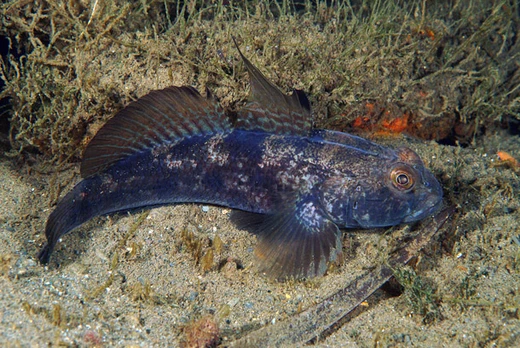
Amblyeleotris periophthalma
A small goby living symbiotically with alpheid shrimps in burrows.

Amblyeleotris periophthalma, also called the broad-banded shrimp goby or periophthalma shrimp goby, is a marine fish that lives on the bottom in reef areas of the Indo-West Pacific, including the Red Sea. This goby is small, reaching up to 8 cm in length, with a long, cylindrical body. Its whitish body is marked by broad brown stripes that vary in intensity between individuals, and many small brown dots are scattered mainly on the upper half. It has round, prominent eyes and a large, upside-down-U-shaped mouth.
The species inhabits sandy areas in lagoons or on outer reef slopes, at depths between 3 and 35 meters, though most are found from 10 to 20 meters. It forms a symbiotic partnership with alpheid shrimps inside burrows. The shrimp digs and maintains the burrow, which both animals use as a den. The goby acts as a lookout, warning the shrimp—which has poor eyesight—of potential danger. Its diet is carnivorous, typically consisting of small crustaceans or small fish that swim near the burrow.
Quick Facts
- Taxon
- Amblyeleotris periophthalma
Facts from the source article.
Lore & Background
Amblyeleotris periophthalma is a small fish reaching up to 8 centimeters in length, with a lengthened and cylindrical body. Its background coloration is whitish, banded with large brown stripes that vary in color intensity among individuals. A multitude of small brownish dots are distributed mainly on the superior part of the body. The eyes are round and prominent, and the mouth is big and shaped like an inverted 'U'.
Reader's Guide
The species is found on sandy substrates in lagoons or on external reef slopes at depths from 3 to 35 meters, though mostly between 10 and 20 meters. It lives in symbiosis with alpheid shrimps in burrows: the shrimps dig and maintain the burrows, which serve as dens for both animals. The goby acts as a watchman, warning of potential danger, which benefits the shrimp due to its poor vision. The goby has a carnivorous diet, typically eating small crustaceans or small fishes that pass close to its burrow. This mutualistic relationship is a key aspect of its ecological role, highlighting the interdependence between the two species in reef environments.
Did You Know?
- The body of A. periophthalma is banded with large brown stripes whose color intensity varies from one individual to another.
- It lives in symbiosis with alpheid shrimps, which dig and maintain the burrows shared by both animals.
- The goby acts as a watchman, warning the shrimp of potential danger because the shrimp has poor vision.
- Its mouth is big and in the shape of an inverted 'U'.
Physical Appearance and Morphology
The broad-banded shrimp goby is a compact marine fish whose maximum length reaches just eight centimetres, giving it a modest presence among reef dwellers. Its body plan is distinctly elongated and cylindrical, a shape that likely aids in navigating the tight tunnels it shares with its shrimp partners. The base coloration across the body is a pale, whitish tone, over which bold brown bands are laid. One of the most striking features of this species is the individual variation in stripe intensity—no two specimens display identical contrast, making visual identification in the field a matter of careful observation. Scattered across the upper portion of the body, numerous tiny brownish speckles add further textural complexity to the pattern. The head presents two large, round, and prominently positioned eyes, while the mouth is notably wide and curves in an inverted U configuration, suggesting a design well suited for rapid strikes at passing prey.
Habitat and Geographic Range
As a benthic marine species, the periophthalma shrimp goby is restricted to reef-associated environments spanning the broad Indo-West Pacific region, with its range extending as far as the Red Sea. Within this vast distribution, the fish shows a clear preference for sandy bottom substrates, whether in the calmer waters of lagoons or along the steeper external reef slopes. Its depth tolerance is remarkably wide, with records from as shallow as three metres to as deep as thirty-five metres below the surface. However, the bulk of observations cluster in a narrower band between ten and twenty metres, suggesting this is the depth window where conditions—light, current, and prey availability—align most favourably for its lifestyle. The species' benthic orientation means it remains anchored to the seafloor throughout its life, relying on the sandy terrain not merely as a resting surface but as the foundation for the burrow system that structures its entire existence.
Symbiotic Partnership with Alpheid Shrimps
Perhaps the most remarkable aspect of this goby's biology is its obligate partnership with alpheid shrimps, a relationship built around a shared underground dwelling. The shrimp takes on the labour-intensive role of excavating and continuously maintaining the burrow, keeping the tunnel network functional and free of debris. In return, the goby assumes the role of sentinel, perching at the burrow entrance with its large, prominent eyes scanning the surrounding water for any sign of approaching threat. This division of labour is not merely convenient but essential: the shrimp, despite its industrious digging, possesses notably poor vision and would be vulnerable to predators without a vigilant partner stationed at the opening. The goby's warning signals alert the shrimp to retreat deeper into the tunnel, while the shrimp's constant maintenance ensures the goby retains a secure refuge. Together, the two species create a self-sustaining micro-ecosystem within the sand, each filling a critical niche the other cannot fulfil alone.
Feeding Ecology and Predatory Strategy
The broad-banded shrimp goby is a carnivore whose hunting strategy is intimately tied to its sedentary, burrow-based lifestyle. Rather than pursuing prey across open water, it relies on an ambush approach, positioning itself at or near the burrow entrance where the wide, inverted-U mouth is ideally shaped to snap up small organisms as they drift or swim past. Its primary targets include tiny crustaceans and juvenile fish that happen to pass within striking distance of the tunnel opening. This sit-and-wait tactic is energetically efficient, allowing the goby to conserve the energy it would otherwise spend in active foraging. The proximity to the burrow also means the goby can quickly retreat into the safety of the tunnel if a larger predator approaches, making the feeding strategy both opportunistic and low-risk. The partnership with the shrimp further enhances this model: while the shrimp is occupied with burrow maintenance, the goby can focus its attention on detecting and capturing the small prey items that the sandy lagoon and reef slope environments naturally produce.
Frequently Asked Questions
What is Amblyeleotris periophthalma?
It is a small marine goby commonly called the broad-banded shrimp goby, found in sandy reef habitats across the Indo-West Pacific and the Red Sea. Adults grow to a maximum of about 8 cm (3 inches) in length.
What does Amblyeleotris periophthalma look like?
The body is long and cylindrical, mostly whitish and crossed by broad brown bands whose intensity differs from one individual to the next. Tiny brown spots dot the upper half of the body, and the face is dominated by large, round eyes sitting above a wide, inverted-U-shaped mouth.
Where does Amblyeleotris periophthalma live?
It occupies sandy substrates in sheltered lagoons or along outer reef slopes, most often between 10 and 20 meters deep, though it can be found anywhere from roughly 3 to 35 meters. Its range spans the Indo-West Pacific region, including the Red Sea.
What does Amblyeleotris periophthalma eat?
It is a small carnivore that picks out tiny crustaceans and small fish from the sand. Its feeding style suits its role as a benthic, ambush-style predator in its reef environment.
How does Amblyeleotris periophthalma interact with shrimp?
This goby forms a well-known symbiotic partnership with alpheid (cleaner) shrimps, sharing a burrow in the sand. The shrimp typically digs and maintains the tunnel while the goby watches the entrance, and both species gain protection from the shared shelter.
More in Gobies 1-16
Spotted an error? Know more?
Reader corrections go straight into our review queue. Suggest an edit · How this site is sourced