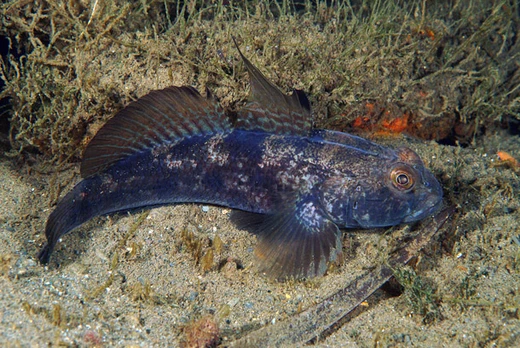
Callogobius
A genus of small gobies with head papillae ridges.

Callogobius is a genus of small gobies that live in brackish and marine environments across the Indian and Pacific Oceans. They belong to the family Gobiidae and are easily recognized by the ridges of papillae on their heads. The exact boundaries of the genus are not fully settled, but as currently understood, it contains 41 species.
Quick Facts
- Taxon
- Callogobius
- Type Species
- Eleotris hasseltii
- Type Species Authority
- Bleeker, 1851
Facts from the source article.
Lore & Background
The circumscription of the genus Callogobius is unclear, but as currently known it contains 41 species. These small gobies are distinguished by ridges of papillae on their heads. They are found in brackish and marine waters of the Indian and Pacific Ocean. The species list includes many with common names such as the Andaman flap-headed goby, Bauchot's flap-headed goby, Double-bar flap-headed goby, Centre-scale flap-headed goby, Saddled flap-headed goby, Stout flap-headed goby, Flap-headed goby, Slimy flap-headed goby, Hasselt's flap-headed goby, Spear-fin flap-headed goby, Ostrich flap-headed goby, Sculptured flap-headed goby, Okinawa flap-headed goby, Hairy-chinned flap-headed goby, Feather flap-headed goby, Elongate flap-headed goby, Pacific flap-headed goby, Stellar flap-headed goby, and Winterbottom's flap-headed goby.
Reader's Guide
The genus Callogobius is notable for its distinctive head papillae ridges, a key characteristic that helps distinguish these small gobies from other genera. The genus is found in brackish and marine waters across the Indian and Pacific Ocean, indicating a broad geographic range. The circumscription of the genus remains unclear, reflecting ongoing taxonomic uncertainty despite the recognition of 41 species. The species list includes many named after researchers and locations, such as Callogobius amikami, Callogobius bauchotae, Callogobius clarki, Callogobius dori, Callogobius sheni, Callogobius williamsi, and Callogobius winterbottomi, as well as species named for their morphology like Callogobius crassus (Stout flap-headed goby) and Callogobius hastatus (Spear-fin flap-headed goby). The genus includes species described as recently as 2024, indicating ongoing discovery and research. The common names often reference the flap-headed appearance, a trait shared across many species in the genus.
Did You Know?
- Callogobius is a genus of fish in the family Gobiidae.
- The genus contains 41 species as currently known.
Taxonomic Identity & Distinguishing Features
Callogobius is a genus classified within the family Gobiidae, one of the most species-rich families of fish. Members of this genus are small in size, consistent with the general body plan shared across the goby family. What truly sets Callogobius apart from its many goby relatives is a distinctive morphological feature: ridges of papillae on the head. These small, raised structures create a textured surface on the cranial region that serves as the primary diagnostic trait separating this genus from look-alike groups within Gobiidae. For ichthyologists examining specimens in the field or in a laboratory, identifying these papillae ridges is often the quickest and most reliable way to confirm that a small goby belongs to Callogobius rather than a closely related genus. The combination of the small goby body form, the family-level characteristics of Gobiidae, and those characteristic head papillae together define the core identity of this genus. No other feature is cited as a distinguishing mark, making the papillae ridges the single most important morphological clue for recognition.
Geographic Range & Habitat
Callogobius inhabits both brackish and marine waters, giving the genus a notable ecological breadth across different salinity regimes. Its range spans the Indian Ocean and the Pacific Ocean, two of the world's largest and most biodiverse water bodies. This dual-ocean distribution indicates that the genus has successfully colonized a wide arc of environments stretching across the Indo-Pacific region. The fact that both brackish and fully marine habitats are included in the genus's range suggests that at least some species tolerate or prefer the mixed-salinity conditions found in transitional waters, while others thrive in open marine settings. Several species names hint at specific localities within this vast range, such as the Andaman flap-headed goby and the Okinawa flap-headed goby, anchoring individual species to particular island groups or coastal regions. The broad geographic footprint of Callogobius, combined with its presence in multiple salinity zones across two major ocean basins, makes it a genus of considerable biogeographic interest for marine biologists studying Indo-Pacific fish diversity.
Species Diversity & Taxonomic History
As of current knowledge, Callogobius encompasses 41 recognized species, making it a moderately diverse genus within the Gobiidae. However, the circumscription of the genus remains unclear, meaning that taxonomists have not reached full consensus on exactly which species belong within its boundaries. This taxonomic uncertainty is not unusual for small, morphologically similar fish groups, where subtle differences can be difficult to resolve. The species have been described over a remarkably long span of time, with the earliest named species dating to 1851 (Callogobius hasseltii, described by Bleeker) and the most recent to 2024 (Callogobius aquilus, described by Li and Chen). This nearly 170-year timeline of species descriptions reflects both the ongoing discovery of new forms and the gradual refinement of the genus's boundaries. Multiple taxonomic teams have contributed to the genus over the decades, including researchers from Japan, the United States, India, and China, underscoring the international collaborative effort behind its taxonomy.
Nomenclature & Common Naming
The common names assigned to Callogobius species reveal a consistent and evocative naming tradition. The overwhelming majority of species carry the phrase "flap-headed goby" as their English common name, a direct reference to the distinctive papillae ridges on the head that give the fish a flapped or textured cranial appearance. Beyond this shared base, individual species are distinguished by descriptive epithets that highlight particular visual traits: the Double-bar flap-headed goby, the Saddled flap-headed goby, the Stellar flap-headed goby, the Feather flap-headed goby, and the Ostrich flap-headed goby all use pattern or shape references. Other species are named after the people who described them, such as Bauchot's flap-headed goby, Hasselt's flap-headed goby, and Winterbottom's flap-headed goby. A smaller set references geographic origins, like the Andaman, Okinawa, and Pacific flap-headed gobies. This layered naming system—combining a shared morphological descriptor with a unique qualifier—makes the genus relatively easy to navigate in field guides and research literature despite its 41-species roster.
Frequently Asked Questions
What is Callogobius?
Callogobius is a genus of small goby fish belonging to the family Gobiidae. They are found in both brackish and fully marine habitats stretching across the Indian and Pacific Oceans.
How do you tell a Callogobius apart from other gobies?
The key field mark is a set of distinct ridges formed by papillae on the head. That papillae-ridge pattern is the feature most goby keepers and field observers rely on for a quick ID.
Where do Callogobius species live?
These small gobies occupy both brackish estuarine waters and open marine environments. Their combined range covers the Indian Ocean basin and the Pacific Ocean basin.
How many species are in the genus Callogobius?
Under the current taxonomic arrangement, 41 species are assigned to Callogobius. That count can shift, though, because the genus boundaries are still being worked out by ichthyologists.
Why is Callogobius's taxonomy still unsettled?
The exact circumscription of the genus has not been fully resolved, so some species placements remain open to revision. This makes Callogobius one of the less stable goby genera to pin down with certainty.
More in Gobies 1-16
Spotted an error? Know more?
Reader corrections go straight into our review queue. Suggest an edit · How this site is sourced