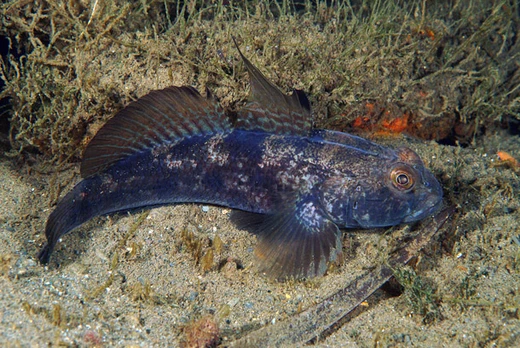
Crystal goby
A small, transparent goby found in European Atlantic and Mediterranean waters.

Crystallogobius linearis, commonly known as the crystal goby, is a species of goby native to the Atlantic coasts of Europe and the Mediterranean Sea. It is the only known member of its genus, and its name derives from Latin words meaning 'crystal' and 'gudgeon,' referring to its glassy, see-through appearance.
Quick Facts
- Taxon
- Crystallogobius linearis
Facts from the source article.
Lore & Background
The crystal goby was first described by Düben and Koren in 1846. It gets its common name from its glassy, see-through body. Males have reduced first dorsal fins and large caniform teeth, while females lack dorsal fins entirely. Neither males nor females have scales. Both have swimbladders and short, straight alimentary canals. Sexual dimorphism is present: males grow up to 4.7 cm and females up to 3.9 cm. The species lives only about one year, dying after breeding.
Reader's Guide
The crystal goby is notable as the sole member of its genus, Crystallogobius. Its transparent body and lack of scales are distinctive among gobies. The species exhibits unusual reproductive traits: females can become sexually mature at only four months, and they retain some larval anatomical features into adulthood. Spawning is thought to occur between May and September, with Northeastern Atlantic populations spawning before Mediterranean ones. Eggs are demersal and deposited in the tubes of polychaetes and serpulids. Although small, the crystal goby has been caught as by-catch by artisanal fishers using beach-seines in the Ligurian Sea (Italy) and has been sold in Barcelona, Spain. Its small size likely limits targeted fishing. The species' rapid maturation and annual life cycle help explain its anatomy and life history.
Did You Know?
- Females can be sexually mature at only 4 months old.
- The species dies after breeding, living about one year.
Taxonomic Identity and Naming
The crystal goby, classified under the binomial Crystallogobius linearis, occupies a singular position in the tree of life as the sole recognized species within its genus. This monotypic status means that no other goby shares the same genus-level classification, making it a taxonomic one-of-a-kind. The species received its formal scientific description in 1846, when the naturalists Düben and Koren documented and named it for the scientific record. The genus name itself is a compound drawn from Latin roots: "cristallum," which translates to crystal, paired with "gobius," meaning gudgeon. Together, these elements evoke the fish's most striking visual characteristic — its remarkably translucent, glass-like body — while anchoring it within the broader goby family. As a member of the goby order, it shares certain foundational biological traits with its relatives, yet its combination of physical peculiarities, limited geographic range, and short lifespan set it apart as a distinctive and somewhat enigmatic inhabitant of European coastal waters.
Body Structure and Sexual Dimorphism
The crystal goby's most immediately noticeable trait is its strikingly transparent, glassy body, which gives the species its common name. Both sexes lack scales entirely, a feature that contributes to this see-through appearance. The fish possess swimbladders and have alimentary canals that are notably short and straight in structure. In terms of fin anatomy, males display two to three dorsal spines alongside eighteen to twenty soft dorsal rays, while females entirely lack dorsal fins — a clear morphological distinction between the sexes. Males also bear large caniform teeth and have a reduced first dorsal fin. Size differences further reinforce the sexual dimorphism: males grow to a maximum of 4.7 centimetres in standard length, whereas females top out at 3.9 centimetres. The anal fin region shows one spine and twenty to twenty-one soft rays. These structural differences, combined with the species' lack of scales and its translucency, make the crystal goby a visually and anatomically unusual member of the goby family.
Geographic Range and Habitat
The crystal goby inhabits a broad but specific stretch of European waters. In the Northeastern Atlantic, its range extends from the cold coastal waters off Norway southward along the European shoreline all the way to Spain, and it is also recorded off the mainland coast of Madeira in Portugal. Within the Mediterranean basin, the species is distributed along the European coastline from Spain eastward to Turkey. In all of these locations, the fish occupies coastal and nearshore environments, living in waters that range from just one metre deep to a maximum of 400 metres. This depth span places the crystal goby in both shallow littoral zones and considerably deeper offshore waters. The species is native to these Atlantic and Mediterranean regions, and its distribution appears to be confined to European waters, with no records suggesting a presence in other ocean basins. The combination of its restricted geographic range and its preference for coastal to moderately deep habitats makes the crystal goby a regionally significant component of European marine biodiversity.
Annual Life Cycle and Reproductive Strategy
One of the most remarkable aspects of the crystal goby's biology is its annual life cycle: individuals live for approximately one year and die immediately after reproducing. Spawning is believed to occur between May and September, with populations in the Northeastern Atlantic reaching reproductive activity before their Mediterranean counterparts. The eggs are demersal, meaning they rest near the seafloor, and have been found nestled within the tubes of polychaete worms and serpulid tube worms. Perhaps most extraordinary is the speed at which females reach sexual maturity — as few as four months of age, which is exceptionally rapid among goby species. They are capable of reproducing while still relatively small in body size, and some larval anatomical features persist even at the time of breeding. Researchers have suggested that this combination of early maturation and retention of juvenile traits may help explain certain aspects of the species' overall anatomy. The entire lifecycle, from hatching to death, is compressed into roughly a single year, making the crystal goby a true "live and die in a season" organism.
Frequently Asked Questions
What is the Crystal goby?
The Crystal goby (Crystallogobius linearis) is a tiny, see-through goby species that inhabits the Atlantic coasts of Europe and the Mediterranean Sea. It stands out for its glassy, translucent body, which is where its common name comes from.
Where does the name 'Crystal goby' come from?
The name is built from two Latin roots: 'crystal' and 'gudgeon' (a small fish). Together they describe the species' strikingly transparent, glass-like appearance.
How big does a Crystal goby grow?
Males can reach up to about 4.7 cm in standard length, while females top out around 3.9 cm. Even at full size, this goby is barely two inches long.
Where can you find Crystal gobies in the wild?
They range across European Atlantic waters and the Mediterranean, and they've been recorded from shallow areas down to roughly 400 metres deep. That gives them an unusually wide depth span for such a small fish.
What makes the Crystal goby unique among gobies?
It is the sole recognized species in its genus, Crystallogobius, meaning no close relatives have been identified. Combined with its remarkable transparency, this makes it a one-of-a-kind little fish in the goby family.
More in Gobies 1-16
Spotted an error? Know more?
Reader corrections go straight into our review queue. Suggest an edit · How this site is sourced