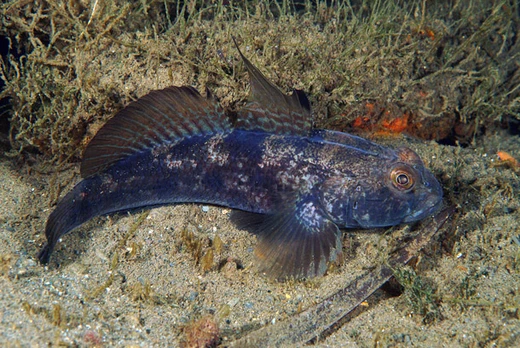
Gobiinae
A diverse subfamily of mostly small, benthic gobies.

The Gobiinae, commonly called true gobies, were once classified as a subfamily within the goby family Gobiidae, though the most recent edition of *Fishes of the World* no longer recognizes subfamilies within that group. These fish inhabit every ocean, as well as a handful of rivers and lakes, but they are most abundant in warm waters. In total, the group includes roughly 1,149 described species spread across 160 genera, and new species continue to be discovered regularly.
True gobies are ray-finned fish that range from medium to small in size. Some are vividly colored, while others are camouflaged. Most measure less than 10 cm (3.9 in) as adults. The largest species, *Glossogobius giuris*, can reach 50 cm (20 in), while the smallest known as of 2010, *Trimmatom nanus*, matures at just 1 cm (0.39 in)—making it one of the tiniest vertebrates. In many true gobies, the pelvic fins are fused into a suction cup, which they use to cling to surfaces. Most have two dorsal fins: the first consists of spiny rays, and the second has a few spines at the front followed by many soft rays.
These fish are most common in tropical and subtropical zones, but as a group they are nearly cosmopolitan in marine environments. A few species tolerate brackish water, and some—such as those in the genera *Padogobius* and *Pomatoschistus*—live in freshwater. Adults are generally bottom-dwelling (their eggs can disperse widely via ocean currents), though *Sufflogobius bibarbatus* is notably pelagic throughout its life. Most true gobies inhabit burrows or crevices and are somewhat territorial. Some form symbiotic relationships with unrelated animals, such as crustaceans.
Larger species are fished for food, sometimes commercially. Many Gobiinae are popular in aquariums, especially the colorful ones, which are regularly traded. Their interesting behavior and bold nature make them appealing pets, but their territoriality and the fact that even the smallest species are carnivorous and require live food make them difficult to keep—especially compared to the related family Eleotridae. Like many oceanic fish, most true gobies are nearly impossible to breed in captivity, and some species have become rare due to habitat destruction and overfishing.
The subfamily contains 152 genera and 1,332 species. Known fossil genera include †*Hesperichthys* and †*Proneogobius*.
Quick Facts
- Taxon
- Gobiinae
Facts from the source article.
Lore & Background
True gobies are usually mid-sized to small ray-finned fishes; some are very colorful, while others are cryptic. Most true gobies are less than 10 cm (3.9 in) long when fully grown. The largest species Glossogobius giuris can reach up to 50 cm (20 in); the smallest known species as of 2010, Trimmatom nanus, is just about 1 cm (0.39 in) in length when fully grown, making it one of the smallest vertebrates. In many true gobies, the pelvic fins have grown together into a suction cup they can use to hold on to substrate. Most have two dorsal fins, the first made up from spiny fin rays, while the other has some spines in the front followed by numerous soft rays. They are most plentiful in the tropical and subtropical regions, but as a group are almost cosmopolitan in marine ecosystems. A few species tolerate brackish water, and some – Padogobius and Pomatoschistus species – even inhabit fresh water. They are generally benthic as adults (the spawn can distribute widely by ocean currents), only Sufflogobius bibarbatus is noted to be quite pelagic throughout its life. Most inhabit some sort of burrow or crevice and are somewhat territorial. In some cases, they live in symbioses with unrelated animals, such as crustaceans.
Reader's Guide
The larger species are fished for food, in some cases on a commercial scale. Many Gobiinae species are popular aquarium fish. Especially popular are the colorful species, some of which are regularly traded. In general, the interesting behavior and bold habits make most true gobies seem attractive pets. However, their territoriality and because even the smallest species are fundamentally carnivorous and need living food to thrive make them not easy to keep (particularly compared to the related family Eleotridae). As typical for oceanic fishes, many Gobiinae tend to be almost impossible to breed in captivity, and some species have become rare from habitat destruction and overfishing. The subfamily contains 152 genera and 1332 species, including fossil genera such as †Hesperichthys and †Proneogobius.
Did You Know?
- The largest true goby, Glossogobius giuris, can reach up to 50 cm (20 in) in length.
- The smallest known true goby as of 2010, Trimmatom nanus, is about 1 cm (0.39 in) long, making it one of the smallest vertebrates.
Taxonomy and Global Reach
The true gobies, classified under the subfamily Gobiinae, represent one of the most species-rich lineages within the goby family Gobiidae. While the fifth edition of the Fishes of the World chooses not to formally subdivide Gobiidae into subfamilies, the Gobiinae nonetheless unite roughly 1,149 described species spread across 160 genera, with taxonomists still uncovering new members at a steady pace. Their geographic footprint is remarkable: true gobies occupy every ocean on Earth and extend into a handful of rivers and lakes, though the overwhelming majority favor warm waters. They are most densely represented in tropical and subtropical zones, yet as a collective group they are nearly cosmopolitan across marine habitats. A few lineages, including Padogobius and Pomatoschistus, have crossed into fully freshwater environments, while others tolerate the intermediate salinities of brackish estuaries. The fossil record adds a deep-time dimension, with two extinct genera—Hesperichthys and Proneogobius—described in 2016, confirming that gobies have been diversifying in aquatic environments for a very long geological span.
Body Architecture and the Extremes of Size
True gobies are predominantly small, mid-sized ray-finned fishes, and the vast majority measure under 10 centimeters at full adult length. Yet the subfamily spans an extraordinary size spectrum: the largest member, Glossogobius giuris, can grow to roughly 50 centimeters, while the tiniest known species, Trimmatom nanus, reaches only about 1 centimeter when fully mature, placing it among the smallest vertebrates on the planet. Visually, the group is equally diverse—some species blaze with vivid coloration, while others rely on cryptic, muted tones to blend into their surroundings. Structurally, a defining feature is the fusion of the pelvic fins into a single disc-like suction cup that allows the fish to anchor itself firmly to rocks, coral, or sandy substrate. Most species also carry two separate dorsal fins: the anterior one built from stiff spiny rays, and the posterior one transitioning from a few leading spines into a long field of soft rays. This combination of a gripping underside and a flexible upper profile suits a life spent clinging to and patrolling the seafloor.
Benthic Life and Social Ecology
As adults, true gobies are overwhelmingly benthic, spending their lives close to the seafloor in burrows, crevices, and other sheltered microhabitats. Their eggs, however, are a different story: spawn can be carried far and wide by ocean currents, giving the next generation a broad dispersal advantage even though the parents remain tied to a small patch of territory. Most species are somewhat territorial, defending their chosen burrow or rock face from rivals. A notable exception to the benthic norm is Sufflogobius bibarbatus, which remains pelagic—living in the open water column—throughout its entire life. Socially, some gobies form symbiotic partnerships with unrelated crustaceans, sharing shelter or benefiting from the activities of their partners. Their distribution peaks in tropical and subtropical waters, but the group as a whole is nearly cosmopolitan in marine settings. A handful of species push into brackish environments, and genera such as Padogobius and Pomatoschistus have fully adapted to freshwater rivers and lakes, demonstrating the subfamily's remarkable ecological flexibility across salinity gradients.
From Plate to Aquarium: Human Interactions and Conservation
Larger true gobies are harvested as food in several regions, and in some cases this fishing reaches a commercial scale. Beyond the kitchen, Gobiinae have become a major presence in the ornamental aquarium trade. Their bold, often colorful appearances and engaging behavioral displays make them highly desirable pets, and many species are regularly moved through the global fish trade. However, keeping them is far from straightforward. Even the smallest gobies are fundamentally carnivorous and require living prey to stay healthy, and their territorial nature means they can be aggressive tankmates. Compared with the related family Eleotridae, true gobies are notably more difficult to maintain. Breeding them in captivity is, for most species, nearly impossible, a challenge typical of many marine fishes. Compounding these husbandry difficulties, some Gobiinae species have declined to rarity due to habitat destruction and overfishing in the wild, raising conservation concerns for a group that, despite its enormous diversity, remains vulnerable to human pressure.
Frequently Asked Questions
Who is Gobiinae?
Gobiinae, often called the "true gobies," is a large assemblage of small, bottom-dwelling ray-finned fish that once held subfamily rank within the goby family Gobiidae. They are found in every ocean on Earth, plus a handful of rivers and lakes, with warm-water regions hosting the densest populations.
What is Gobiinae's role in the ecosystem?
True gobies are primarily benthic, spending most of their lives on the seafloor where they serve as a critical food source for larger predators. Their compact bodies let them exploit micro-niches from tiny crevices to open sandy bottoms, filling a trophic gap few other groups occupy as thoroughly.
Why is Gobiinae important to ichthyology?
With roughly 1,149 described species spread across 160 genera, this group represents one of the most species-rich assemblages in all of marine fish biology. New species continue to be described regularly, meaning the roster is still expanding.
What is the size range within Gobiinae?
The smallest member, Trimmatom nanus, measures only about 1 cm, while the largest, Glossogobius giuris, can reach roughly 50 cm. Most species fall in the medium-to-small category, and their coloration spans the full spectrum from vivid hues to near-perfect camouflage.
More in Gobies 1-16
Spotted an error? Know more?
Reader corrections go straight into our review queue. Suggest an edit · How this site is sourced